
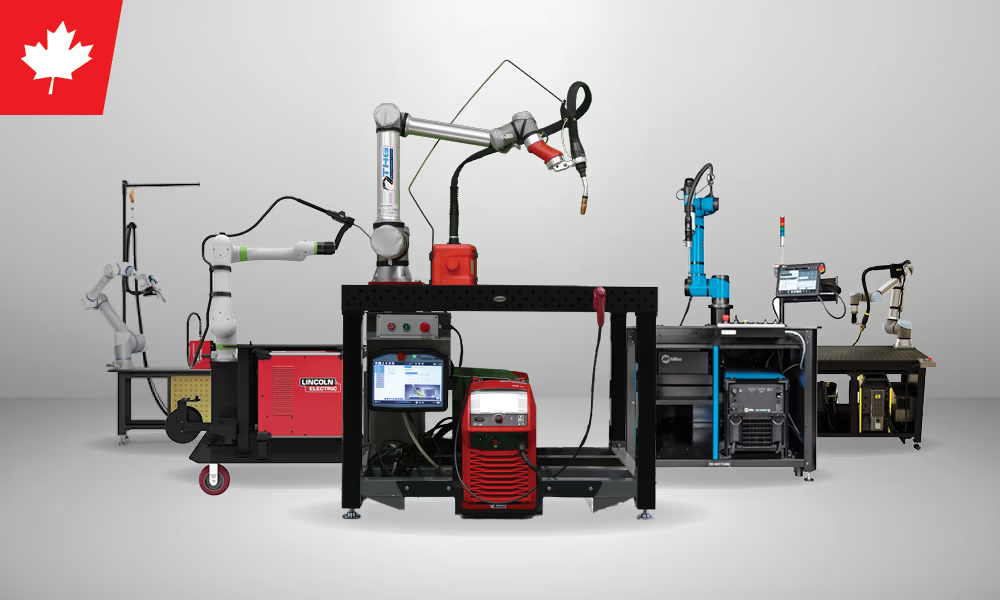
Cobot welding systems can look similar in a demo, but they may follow very different automation approaches. Programming, welding capability, sensing, expansion options, and support all affect how well a system will fit your production.
The best choice should match the parts you weld today and leave the door open for the applications you may automate next.
Quick Comparison of Cobot Welders Available in Canada
The main systems available to Canadian shops follow different automation approaches. Some focus on fast deployment for MIG welding. Others provide a broader platform that can support new processes, external motion, and more complex applications.
Click to enlarge

Click here to see the full comparison in a PDF format
System | Robot Brand and Model | Best Fit | Welding and Cutting Processes | Supported Power Sources | Programming Approach | Expansion Options | Canadian Support | Base price |
THG Automation | Universal Robots (UR8L, UR20) |
|
| Fronius:
IPG Lightweld®:
Hypertherm:
IHT Automation:
|
|
|
| 125K- 180K$ CAD |
ESAB Welding Cobot | Universal Robots (UR10e or UR20) |
| MIG | MIG welding:
|
| Extended table areas |
| 132K$ CAD |
Lincoln Electric Cooper | FANUC CRX or ABB GoFa™ |
| MIG | MIG Welding:
|
|
|
| 162K-204K$ CAD |
Weldmatic Automation |
|
|
| MIG welding:
Laser Welding:
| Teach pendant | 1 to 6-axis positioners | Direct support from Weldmatic Automation | Verify with the vendor |
Linde ProStar™ Lancer™ | Universal Robots (UR10e) |
|
| Miller:
Hypertherm:
| UR teach pendant | Configuration-specific |
| Verify with the vendor |
Miller Copilot™ and Miller Copilot™ Builder™ | FANUC CRX or another cobot option, depending on package |
| MIG | MIG welding:
|
|
|
| Verify with the vendor |
Base price alone does not show the full production value. Power source, software, sensing, tables, installation, training, and support can all change the final system cost.
What to Compare Before Requesting Cobot Welding Quotes
Start with the parts you weld today, then consider the applications you may automate next. Material, thickness, joint type, part size, production mix, fit-up, and joint access all shape the right system architecture.
Process requirements also matter. A shop may need standard MIG welding or pulsed MIG, PMC, LSC, or CMT. Other applications may call for TIG, plasma welding, laser welding, plasma cutting, or oxy-fuel cutting. Advanced processes require the correct power source, torch equipment, and software package.
Compare the complete system in each quote, including:
- Robot reach
- Welding power source and process packages
- Table, fixtures, and safety systems
- Arc monitoring, touch sensing, seam tracking, or path correction
- Installation, commissioning, and training
- Future requirements for added processes, part sensing, external axis, or a larger work area
Programming affects how easily your team can create and adjust jobs. Compare app-based tools, graphical interfaces, hands-on teaching, and support for advanced paths or coordinated motion.
Ask whether the original system can accept positioners, tracks, coordinated motion, added sensing, or another process. Confirm whether these additions connect to the existing controls or require a major rebuild.
Compare the full installed cost rather than the advertised base package. Ask each vendor to evaluate representative parts and explain what the proposed architecture can support now and later.
Best Cobot Welders in Canada: Brand-by-Brand Shortlist
Each system offers a credible path into cobot welding. The better fit depends on how your shop produces parts and how you expect the automation to grow.
THG Automation
THG Automation builds modular welding and cutting systems that can add processes, sensing, and external motion as production needs change. Its Canadian operation in Burlington, Ontario, provides system integration and local support.
THG can automate the fabrication of a wide range of parts because it supports multiple welding processes, including CMT, TIG, and laser welding. And you can rotate your parts using positioners if needed. THG can also accommodate large parts using tracks to move the robot and expand its reach. Across its product range, THG offers:
- Fronius-based MIG, TIG, and plasma welding
- IPG laser welding
- Hypertherm plasma cutting
- Oxy-fuel cutting

THG also offers multi-process support within a single cobot system in MultiMode, including non-arc welding processes. For example, MIG + Laser.
THG’s expansion options include:
- SideCar: Lets operators switch a compatible welding power source between manual and robotic welding.
- MultiMode: Combines THG-supported welding and cutting processes within one cobot cell, with manual or automatic tool changing depending on the configuration.
- Tracks and positioners: Extend the cobot’s work envelope for longer or larger parts and rotate or reposition parts to improve weld access.
- Coordinated motion: Moves the robot and positioner together during the weld.
- Mobile platform: Lets shops move the system between work areas or stations.
- Automatic tool changing: Allows applicable systems to park one torch and pick up another through the robot program.
These capabilities are available through separate or specially configured systems. Every system is pre-integrated with the entire THG architecture. This means native, simple expansion as needed.
These options may suit shops with large parts, multi-axis work, or plans to add another process later.
ESAB Welding Cobot
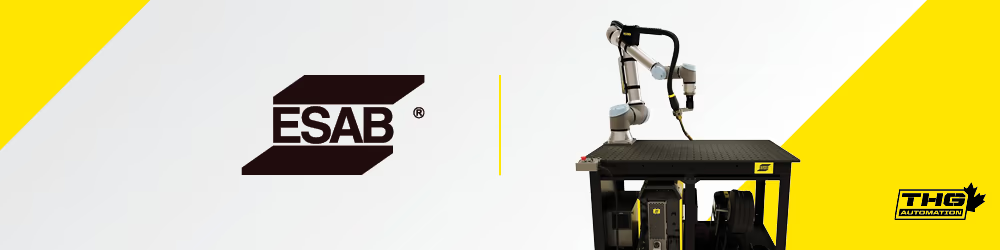
ESAB provides ready-to-weld MIG automation with cloud-based programming. The cloud-based app lets welders teach and program jobs through a phone or tablet.
Available configurations include:
- A UR10e system with a 32-by-48-inch table
- A UR20 extended-reach system with a 5-by-10-foot table
- MIG and pulsed MIG welding packages for steel, stainless steel, and aluminum
The UR20 provides 1,750 mm of reach, compared with 1,300 mm for the UR10e. This gives the cobot more room to reach larger parts or cover more of the worktable from one mounting point.
The table-based architecture may suit high-mix, low-volume MIG work where parts can be fixtured within a defined work area. The cloud connectivity may also appeal to shops that prefer app-based programming over a conventional robot interface. However, shops should also consider internet connectivity requirements and any internal policy issues with cloud and app use.
Lincoln Electric Cooper
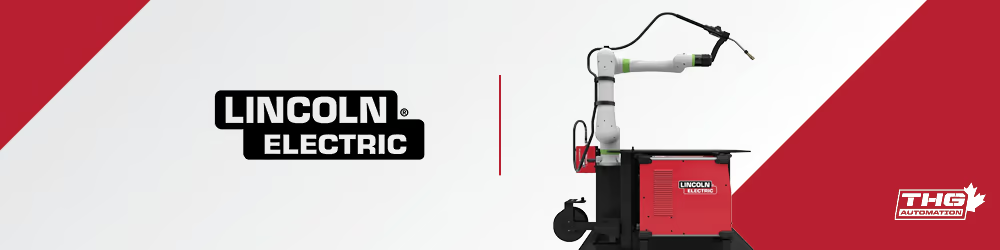
Lincoln Electric Cooper systems combine Lincoln welding equipment and software with either FANUC CRX or ABB GoFa™ cobot arms. The Cooper App supports guided weld programming on both robot platforms.
Available configurations include:
- FANUC CRX and ABB GoFa™ cobot arms
- Compact cart systems and non-cart packages
- Air-cooled and water-cooled versions
- Aluminum welding configurations
- Power Wave® R450 robotic welding power source
- Touch sensing and Thru-Arc Tracking on applicable packages
- Cooper Cobot Adapt allows manufacturers to add a track or headstock positioner with coordinated motion support.
The cart systems provide a mobile, self-contained setup. Non-cart packages give shops more freedom to mount the cobot around an existing table or custom work area. Water-cooled models are designed for heavier-duty applications and larger wire sizes.
The Cooper App connects the welding setup and robot programming through one interface. Lincoln also offers preset weld settings through its Weld By Numbers feature. Depending on the package, you can add tools such as touch sensing, multipass programming, seam tracking, and real-time weld adjustments.
Cooper may suit shops that already use Lincoln welding equipment. The choice between FANUC CRX and ABB GoFa™ also gives you two established cobot platforms within the same Lincoln system family.
Weldmatic Automation
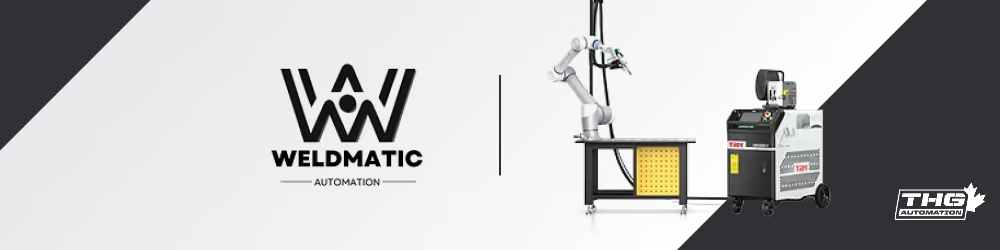
Weldmatic Automation is a Canadian supplier offering cobot welding systems built around DOBOT CRA and RobotMeta cobot platforms. Its cobot lineup includes DOBOT CRA configurations such as the CR10A and CR5A (with magnet platform support), along with RobotMeta RM 1100/4 C and RM 1470/8 C (higher reach) options.
The DOBOT CRA package is for shops that need simple cobot operation with more configurable welding features. Weldmatic lists support for multi-pass welding, seam tracking, and mobile magnetic base cobot. The DOBOT has compatibility with multiple welding machine brands and communication methods, which may appeal to shops that want to choose or retain a preferred welding power source.
Available capabilities include:
- MIG welding with a user-selected power source
- Laser welding with TRM laser welding systems
- DOBOT CRA or RobotMeta cobot platforms
- Teach pendant programming
- Drag-and-place programming on RobotMeta systems
- Multi-pass welding
- Laser seam tracking or positioning features
- 1- to 6-axis positioners
- Custom integration support from Weldmatic Automation
Weldmatic may suit Canadian fabricators looking for a locally supported cobot welding supplier with flexible robot and power-source options.
Since the final configuration depends heavily on the selected cobot, power source, laser package, positioner, and sensing requirements, buyers should verify the exact supported processes, integration scope, and service responsibilities directly with Weldmatic before comparing it against more standardized systems.
Linde ProStar™ Lancer™
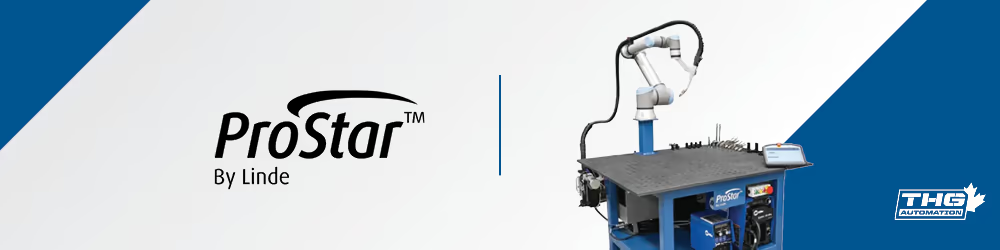
The ProStar™ Lancer™ is a compact collaborative welding system listed directly by Linde Canada. The current 350 A (500 A optional) air-cooled package uses a Universal Robots UR10e cobot with pendant or hand-guided programming. It also provides a 60-by-48-inch work area.
Its main capabilities include:
- MIG welding
- Optional Hypertherm Powermax® plasma cutting
- Linear, circular, and weave weld motions
- Pendant or hand-guided path teaching
- Compact table-based fixturing
Linde positions the system for high-mix, low-volume fabrication. The table-based layout may suit shops that need a defined work area for smaller or repeatable parts.
The ProStar™ Lancer™ also offers a familiar supply route for shops that already purchase welding equipment, gases, or consumables through Linde Canada. Available power sources, training, service, and add-ons may vary by region or configuration.
Miller Copilot™

Miller® offers two main collaborative welding platforms: the table-based Copilot™ and the reconfigurable Copilot™ Builder™. Both use Miller-developed software and guided programming tools designed around welding tasks.
The standard Copilot™ includes:
- A 48-by-48-inch weld table
- Auto Deltaweld™ or Auto-Continuum™ power-source options
- AccuGuide™ precision joystick for torch positioning
- IntelliSet™ weld-setting support
- Caster wheels and fork pockets for relocation
Copilot™ Builder™ uses a pallet-based layout instead of a fixed table. Components can be detached and rearranged around a user-supplied work area. Builder™ systems use Auto Deltaweld™ 350 or 500 power sources, depending on the package.
Available welding features vary by configuration and may include:
- MIG and pulsed MIG
- RMD® short-circuit welding
- High-deposition MIG
- Flux-cored and metal-cored welding
- Touch sensing
- Through-arc seam tracking
- Multipass programming
- Air-cooled or water-cooled torch packages
- Aluminum welding with an available push-pull torch
Miller® also offers a Copilot™ Builder™ configuration with a FANUC long-arm cobot. That version provides 1,778 mm of reach and includes touch sensing and through-arc seam tracking. It is available with the Auto Deltaweld™ 500 power source.
The standard Copilot™ may suit shops that want a complete table-based cell. Copilot™ Builder™ may fit applications that need a different mounting position, a user-supplied table, or a layout that can change as the work changes. Canadian buyers can source both platforms through Air Liquide Canada.
Why Local Canadian Support Matters After Installation
A robotic welding system often needs support after it enters production. New parts, fixture changes, calibration issues, and process adjustments can all affect output and uptime.
Robot support covers motion, controls, communication, and tool-centre-point calibration. Welding support deals with arc behaviour, consumables, joint design, distortion, and process limits. Shops may need both types of expertise when a program runs correctly but the weld still does not meet requirements.
THG provides direct support through its Burlington, Ontario, operation. Customers can work with one team for both welding process questions and automation support.
Before placing an order, confirm:
- Who will install and commission the system?
- Who will train operators and programmers?
- Who will help develop or adjust weld parameters?
- Who will troubleshoot fixtures and new-part programs?
- Who will provide on-site repairs?
- Where are critical replacement parts stocked?
Clear support responsibilities can reduce delays when production problems arise.
How to Choose the Right Cobot Welder for Your Shop
The right system should handle your current parts, fit your team’s skill level, and leave a practical path to future applications.
Review the vendor’s weld trial results, including weld quality, cycle time, fixture needs, sensing requirements, and known process limits. Compare the final installed proposals and let the employees who will use the system test the programming workflow.
Confirm the training, warranty, service responsibility, software costs, and expansion terms before signing.
Choose a system that fits current production without creating an expensive limit later.
THG Automation designs welding and cutting systems around each shop’s parts, processes, and production goals. Talk to our fabrication experts about an automation platform that can support the work you have now and the applications you may add next.
All trademarks, registered trademarks, product names, and company names are the property of their respective owners. Use of these names is for identification and comparison purposes only and does not imply endorsement, sponsorship, or affiliation unless expressly stated.