

Canadian aerospace suppliers are under pressure to increase welding capacity. At the same time, they cannot compromise on the quality required for certified work.
Many shops need better repeatability, stronger documentation, and more stable output. They also have to manage lower-volume parts, complex assemblies, and skilled labour limits.
Robotic welding can help, but only when the system fits aerospace welding production. For Canadian aerospace shops, the goal is to protect qualified procedures and improve throughput without using rigid mass-production robotics.
Canadian Aerospace Suppliers Face Capacity Pressure
Market demand is pushing for more from Canadian aerospace suppliers, while skilled welding capacity remains hard to replace. Recent Canadian aerospace data shows why this pressure matters:
- Canada’s aerospace industry contributed $34.2 billion to GDP and supported 225,000 jobs in 2024, according to the ISED/AIAC State of Canada’s Aerospace Industry report.
- Canadian aerospace revenue reached $45.2 billion in 2024, up 17% from 2023 and 22% from 2019.
- Aerospace manufacturing revenue grew 18% from 2023 to 2024, while aerospace MRO revenue grew 10%.
- Export Development Canada reported that Canada exported nearly $27 billion in aerospace goods to 166 countries in 2024. More than 70% of industry revenue was tied to international markets, and the United States accounted for 63% of Canadian aerospace exports.
For suppliers, those numbers are not abstract. Rising aerospace revenue, export demand, and MRO activity put more pressure on shops to deliver quality parts on time. Since many Canadian aerospace suppliers compete in global markets, they may also face different cost pressures, customer expectations, delivery timelines, and regulatory requirements. Delays, rework, and inconsistent welds can affect programs beyond one shop floor.
At the same time, welding labour is not easy to scale. The Canadian Occupational Projection System projects 25,600 job openings for welders and related machine operators from 2024 to 2033. Replacement demand accounts for much of that need, and most replacement demand is linked to retirement.
Automation does not solve the labour shortage on its own. However, it can help Canadian aerospace shops make better use of skilled welders by moving repeatable welds into a controlled system. When the process is a good fit, automation can support capacity, consistency, and throughput without weakening quality control.
Certified Aerospace Welding First Requires Process Control
Aerospace shops should automate the process only after they can control it. In aerospace welding, the automation system must protect the procedure, program, and inspection requirements that the shop is already responsible for meeting.
Depending on the aircraft component, contract, and customer, welds may need to follow approved WPS/PQR documentation or internal quality procedures. CWB, AWS, or customer-specific requirements may also apply when the work calls for them. For example, AWS D17.1 applies to fusion welding for aerospace applications when it is specified. In Canada, CWB requirements may also apply when the project, customer, or governing standard calls for them.
That matters because automation can only repeat the process it is given. The system must be able to reliably and repetitively weld parts after part presentation.
A proper automation system can improve consistency because it repeats approved welding parameters and torch movement more closely than manual welding can over long runs. Poor setup creates the opposite problem. If the part presentation, fit-up, or program is wrong, the robot will repeat the same defect more consistently.
This is why Canadian suppliers should look for more than robot hardware. They need welding process support, application validation, and clear program control before production starts. A Canadian vendor with CWB-aware welding expertise can help connect the automation system to the procedures, inspection expectations, and customer requirements the shop already has to meet.
Flexible Modular Systems Fit High-Mix, Lower-Volume Work
High-mix aerospace work needs automated robotic solutions that can adapt and scale. A basic robotic welding system may not be enough. Many suppliers work with lower-volume parts that change by contract, program, or customer.
Since Canada’s aerospace sector is tied to export-driven supply chains, suppliers may need to meet requirements from customers in different markets. A fixed robotic cell can feel too rigid for that mix, while a simple cobot package can also be too limited if it only supports basic part setups.
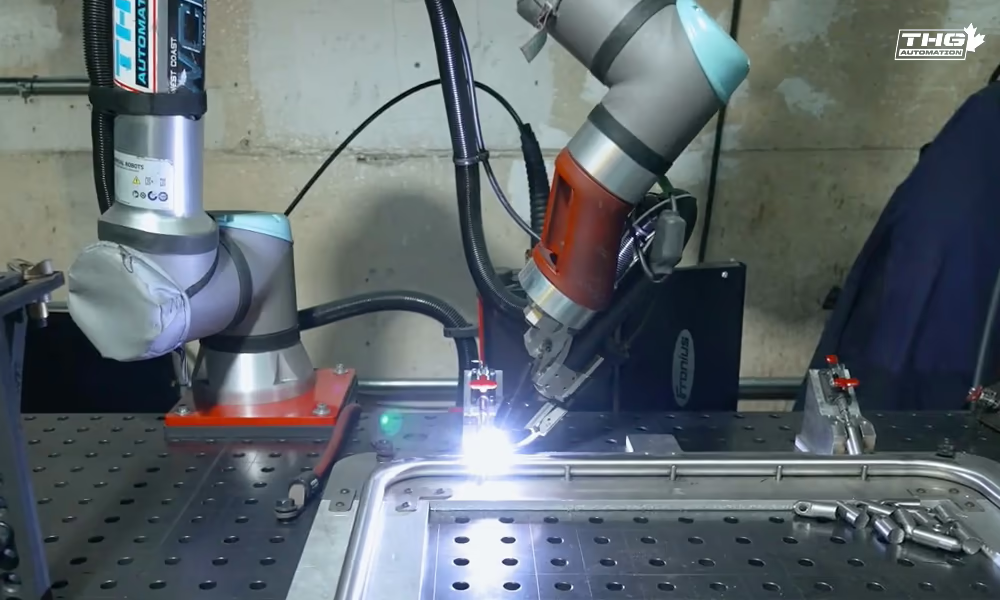
For aerospace work, the system should support the welding process the part already requires. It should control key welding variables, not only robot movement. That can include advanced TIG support, stable arc control, repeatable parameters, and the ability to add motion when part access becomes more complex.
This is where modular architecture matters. A shop may start with one qualified application, then add capability as the work changes. That could include external axes, positioners, tracks, rotary tables, or coordinated motion. These options help the system handle more complex assemblies without forcing the shop to start over with a new cell.
For Canadian suppliers, this is the type of system architecture to look for. THG Automation builds around modular, pre-integrated capabilities that can be matched to the application, including:
- Tracks, positioners, rotary tables and coordinated motion
- MIG and TIG robotic welding systems
- Laser welding where appropriate
- SideCar for manual-to-automated welding flexibility
- Multi-process capability on a single robot, including automated process switching
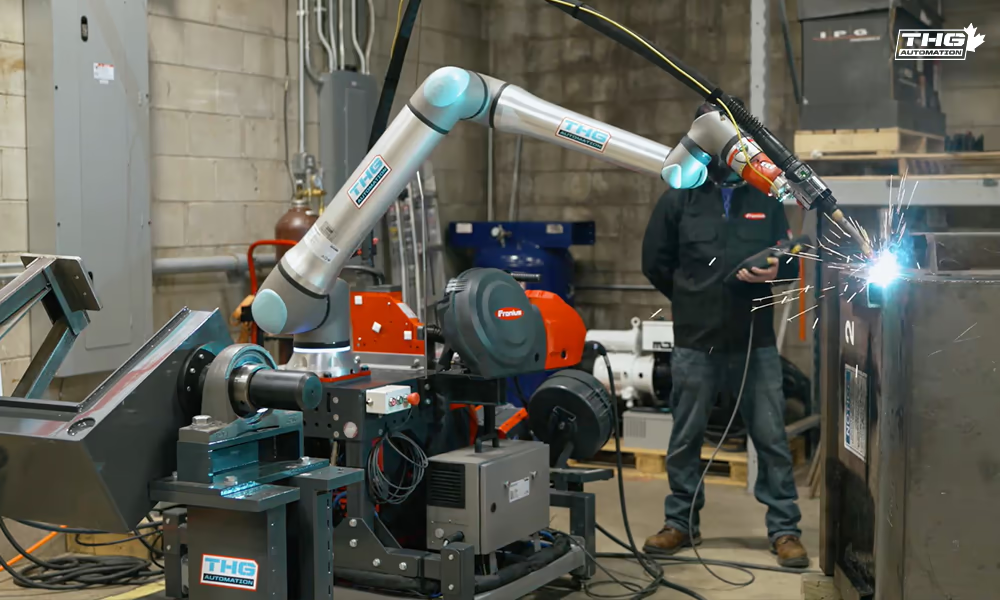
This gives shops a way to build around current production needs while leaving the door open for future parts and process changes.
What Aerospace Welding Jobs Are a Good Fit for Automation
The best welds to automate are repeatable and worth the setup time. For aerospace shops, volume is not the only question. A low-volume part may still be a good fit if automation can improve consistency, access, documentation, or throughput.
A good starting point is a weld that can pass a basic fit check:
- Can the part be fixtured repeatably?
- Can the robot access the joint?
- Is the weld path consistent enough to program, test, and approve?
- Can upstream fit-up support automation?
If the answer is no, automation may still be possible. The weld may need better fixturing, sensing, added motion, or a better starting application.
Material behaviour also matters. Aluminum can be sensitive to heat input, cleanliness, oxide control, and distortion. Stainless can require careful heat control and shielding. Thin or high-value aerospace assemblies may need tighter process control because scrap, rework, and inspection failures can be costly.
Added motion can make more parts realistic candidates. Positioners can improve joint access. Tracks can extend reach. Coordinated motion can help maintain torch angle on more complex geometry.
Repeatable welds are often the best place to start. But automation is not limited to repetitive production. A one-off or very low-volume job may still make sense if it improves precision, consistency, documentation, safety, or access. Start with welds where the shop can control fit-up, access, and quality.
How to Select Automation for Canadian Aerospace Welding
The right automation system should fit the parts you weld today and the work you may need to automate next. It should also include Canadian support and meet the welding requirements for your shop. A system may look capable during a demo, but the real test comes after installation, when the shop needs training, troubleshooting, application changes, and future upgrades.
Ask your robotic system supplier:
- Can you support future system expansion, including additional processes, robots, axes, and software?
- Can you support the system in Canada after installation?
- What are your installation, training, and troubleshooting processes?
- Do you understand the export-driven aerospace market in Canada and common customer requirements?
The next step is process fit. The system should support the welding process already used or qualified whenever possible. If the part requires TIG, MIG, or laser welding, choose a system that supports that process. For aerospace, that’s mostly going to be TIG. Before production, confirm whether automation will require procedure updates, requalification, or customer approval. Process requalification can be more trouble than it’s worth.
Quality and documentation should be reviewed early. The shop may need weld data capture, controlled program revisions, inspection support, or traceability. Those needs depend on the part, customer, and contract, but they should not be treated as afterthoughts. Use automated systems with documentation processes built in. For example, THG systems can include Fronius’ Weld Cube for systematic weld data documentation at the component and seam level.
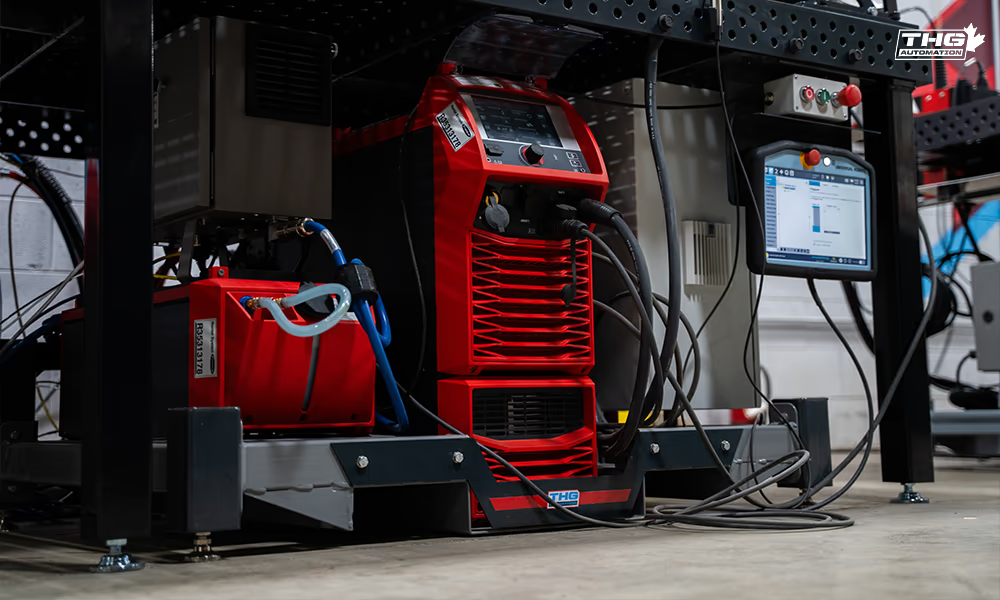
System architecture also matters. Some jobs may need a table, fixture, rotary positioner, track, or coordinated motion. The system should fit the first application while leaving room to expand. Otherwise, the shop may outgrow the setup as soon as the next program changes.
For Canadian suppliers, the best vendor fit is usually the one that can support the full application, not only the robot. THG’s modular approach, welding knowledge, and Canadian support can help shops start with one application, validate it, and expand the system as future work changes.
Flexible Automation Starts With the Right System
Automation can help Canadian aerospace suppliers improve consistency and throughput, but the system has to fit certified, high-mix, lower-volume work. That starts with process control. The weld, program, parameters, and inspection needs should be understood before automation is added.
From there, shops can choose repeatable applications where fit-up, access, and quality outcomes can be controlled. Modular architecture gives the system room to grow as parts, programs, and customer requirements change.
If your Canadian aerospace shop is considering welding automation, talk to THG’s welding automation team. We can help review your application and build a system around your real process, not a one-size-fits-all package.