
If you are comparing cobot welding quotes in Canada by headline price alone, you are probably comparing the wrong thing.
Two cobot welding systems can look similar on paper and still lead to very different results once they hit production. One becomes a dependable capacity tool that improves throughput, weld quality, and flexibility. The other turns into a slower, more expensive lesson in what the quote did not include.
That gap exists everywhere, but in Canada, it can get even wider. Cross-border sourcing can introduce tariffs, brokerage fees, exchange-rate volatility, and slower support response times. Even when the upfront price looks competitive, the total cost can shift quickly once service, downtime, and implementation realities enter the picture.
Understanding what drives these differences makes it much easier to compare quotes properly and choose a system that delivers value in a real manufacturing environment.
Cobot Welding Costs in Canada
Most cobot welding systems in Canada fall between $135,000 and $185,000+ CAD, depending on the process and system capability.
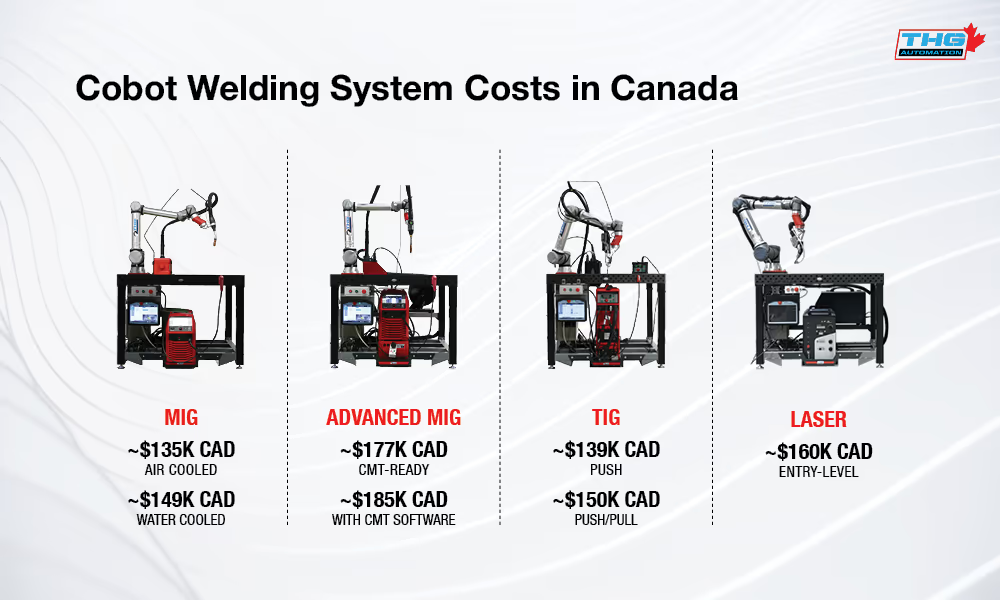
Typical system ranges include:
- Air cooled: ~$135K CAD
- Water cooled: ~$149K CAD
Advanced MIG (Push-Pull / CMT Systems)
- CMT-ready: ~$177K CAD
- With CMT software: ~$185K CAD
- Push: ~$139K CAD
- Push/pull: ~$150K CAD
- Entry-level: ~$160K CAD
These numbers reflect typical system pricing, but they do not include the full cost of getting a system running in production. Installation, downtime during deployment, operator training, and fixturing can all add to the total investment.
These ranges reflect different levels of system capability. Entry-level setups are typically suited for simple parts and flat table welding. Higher-tier systems are built for more complex parts, better weld control, and greater flexibility.
That is why price ranges alone do not tell you much. To understand real cost, you have to look at how the system is built, how it performs in production, and what limitations are already built into it.
What’s Included in a Production-Ready Cobot Welding System
A production-ready cobot welding system includes several integrated components, and overall performance depends on how well those components work together.
Core system components typically include:
- Collaborative robot arm
- Welding power source (MIG, TIG, or laser)
- Wire feeder, torch, and consumables
- Welding table
- Teach pendant and control software
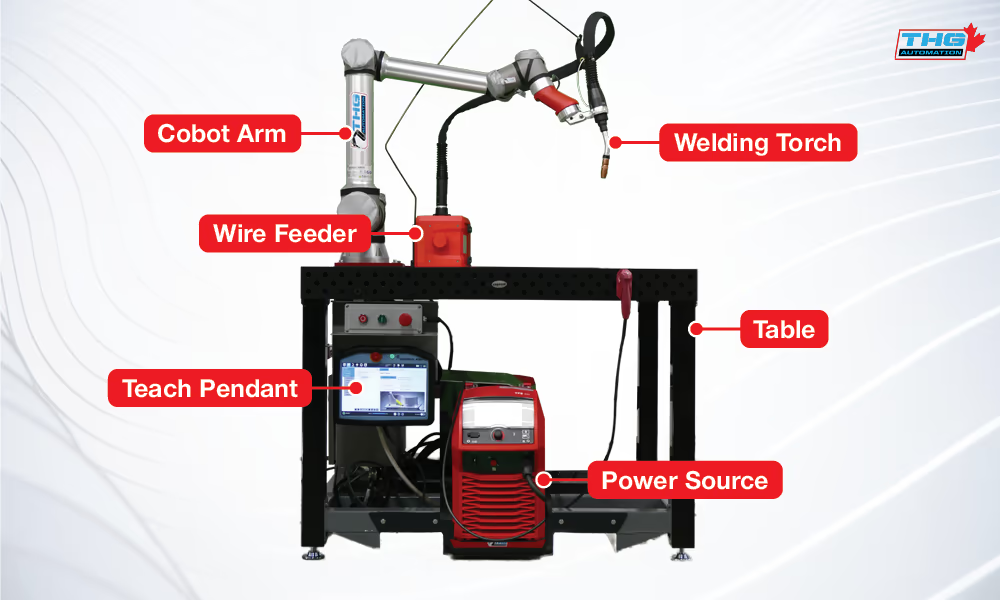
That is the baseline. But in real production, the base package is rarely the full story.
Many applications also require:
- Fixturing designed for repeatable part positioning, often customized and not fully included upfront
- Additional axis if required: table or floor mounted positioners and tracks
- Safety systems to meet operational requirements, unless the entirety of the safety assembly is provided by the vendor. Usually, cobot welding systems are designed not to require dedicated fencing. But the welding process and operating realities may require additional safety measures (e.g., robotic laser welding must be under a specialized safety enclosure). You may also need other safety equipment. For example, fume extraction.
Higher-end systems also include adaptive features that help manage real-world variability. Technologies like seam tracking can adjust the weld path during operation. This helps account for part variation, fixture tolerances, and heat distortion.
For example, THG systems can include advanced Fronius robotic welding features, such as seam tracking and wire sensing. These functions help locate parts, adjust the weld path in real time, and maintain consistent weld quality despite variation in fit-up or heat distortion.
That is what separates a basic cobot welding package from a system that is genuinely ready for production. Reliable output across shifts depends on stable communication between components, well-integrated controls, and features that help the system respond to variation instead of collapsing under it.
When key elements are missing or poorly integrated, performance drops and additional costs often follow.
Why Cobot Welding Quotes Vary So Much
Cobot welding quotes can vary widely because they reflect different levels of capability, system design, and long-term flexibility.
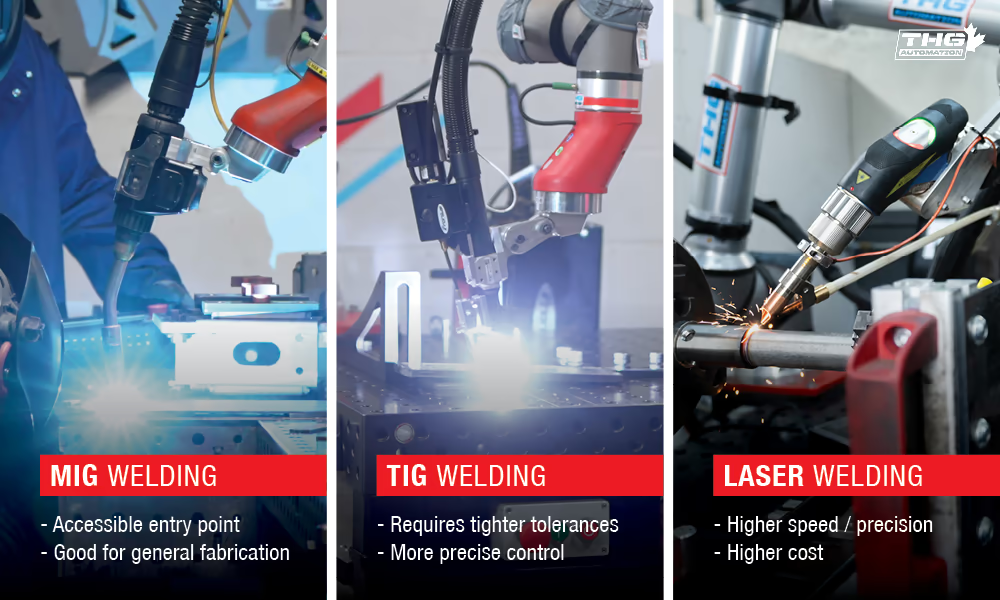
One of the biggest factors is the welding process:
- MIG is the most accessible entry point and works well for general fabrication
- TIG requires tighter tolerances and more precise control
- Laser offers higher speed and precision, but at a higher cost
System capability also plays a major role. A basic setup may include a flat welding table, while more advanced systems add:
- Positioners or external axes to improve part access
- Seam tracking or sensing technologies to handle variation
- Multi-process capabilities with automatic robot-based process switching
- Ability to quickly switch between manual and robotic
The underlying system architecture is another key difference:
- Fixed systems are built for narrowly defined applications such as simple part welding on a welding table
- Modular systems are designed to expand as production needs grow and handle everything from simple to highly complex parts.
Vendor approach is another major reason quotes differ. Some vendors provide systems with pre-integrated capability and clear architectural planning. Others sell a system that works for the immediate application, but requires expensive customization later to do anything more.
This is why similar quotes are not directly comparable. Two systems at the same price can deliver very different production and ROI results. Limitations often become clear only after implementation and with some real-world cobot welding experience
The Hidden Costs That Impact Your Total Investment
A significant portion of cobot welding cost comes from implementation and operational factors that are not included in the initial system quote.
These costs often begin with integration and commissioning:
- System setup, validation, and testing
- More effort required for complex or multi-process systems which weren’t designed for it. For example, asking the vendor to introduce system components from another brand they don’t usually integrate.
There is also production downtime during deployment:
- Lost output while the system is installed and brought online
- Impact varies based on workload and scheduling
Training and ramp-up add another layer:
- Operators need time to learn programming and workflow
- Early production runs are typically slower and less efficient
Fixturing and process refinement are often underestimated:
- Custom tooling is needed for consistent part positioning
- Iteration is required to stabilize weld quality
Ongoing costs include:
- Maintenance and consumables
- System updates, depending on the vendor
This is also where integration quality starts paying for itself. Properly integrated systems tend to reduce troubleshooting, shorten ramp-up, and make future changes less painful. Poorly integrated systems do the opposite.
At THG, we build expansion options like coordinated motion, positioners, tracks, and multi-process welding into the system architecture from the start. This significantly reduces future customization, retraining, and downtime as production needs change.
Unique Canadian Factors Affecting Cobot Welding Costs
In Canada, local sourcing, support, and funding programs can influence both upfront cost and long-term ROI.
Local system sourcing helps avoid added costs from cross-border purchases, including import tariffs, brokerage fees, and delays. It also leads to more predictable timelines. At THG, we build, source, and support systems in Canada. This improves access to local service and helps keep production moving.
Currency exposure is another factor. Systems sourced internationally are often tied to USD exchange rates, while Canadian-built systems reduce that variability.
Local support and service access also impact cost. Faster response times help reduce downtime and keep production moving. Delays in service can lead to extended stoppages and lost output, making local support a key factor in maintaining production.
Working with CWB-certified experts also helps manufacturers establish process confidence earlier. Proper setup, validation, and weld quality planning at the beginning can prevent expensive rework and avoidable mistakes later.
Canadian manufacturers may also be able to reduce upfront costs through federal and provincial programs.
Together, these factors show that total cost depends on more than the system itself, and local advantages can add up over time.
Why System Design Matters More Than the Initial Price
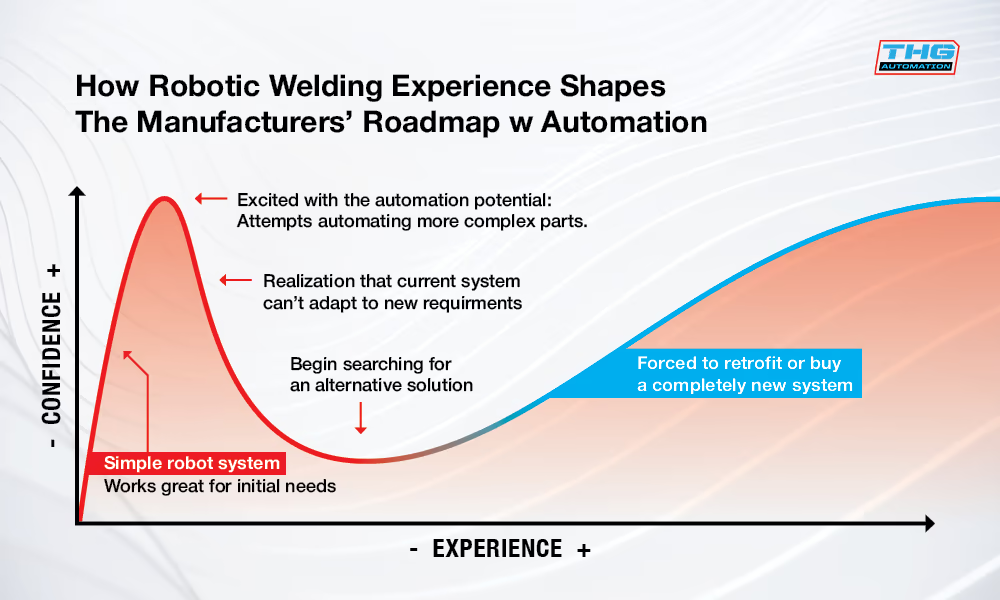
The long-term cost of a cobot welding system depends on whether it can adapt to future production needs.
Fixed systems are built for specific parts or workflows. They can work well at the start, but expanding them later is often difficult or costly.
Outgrowing a system can force you into:
- Retrofitting with new components
- Additional downtime for integration
- Retraining operators
- In some cases, purchasing a second system
Modular systems are designed to grow with production. At THG, we build high-quality systems with pre-integrated options that allow manufacturers to:
- Add positioners, rails, and external axes
- Expand into MIG, TIG, or laser welding within the same platform
- Maintain a single system architecture as needs evolve
For example, see the video below where THG CEO Matt Hendey walks you through system modularity and how adding a positioner to an existing system looks like:
This approach reduces the need for re-integration and helps keep production moving.
A lower upfront cost may seem attractive, but systems that cannot scale often lead to higher lifetime costs. Systems designed to evolve help protect the initial investment.
Build a System That Delivers Value From Day One
Choosing a cobot welding system comes down to how well it fits your production today and how easily it can adapt as your needs change. The way the system is designed, integrated, and supported will shape how quickly it delivers results.
If you are evaluating options, the next step is to look at your parts, workflow, and growth plans as a whole. That is how you identify the system that fits today and avoids added cost later.
Talk to our fabrication experts to review your application, explore available funding options, and understand what a THG system would look like in your shop.