
Canadian manufacturers need reliable welding capacity, but adding that capacity is becoming more difficult every year. Skilled welders can be challenging to recruit when demand rises. Smaller shops may also struggle to carry extra labour during slower periods.
Automation can help close the gap, but it also brings real investment risks. The system must fit the work, the team must know how to use it, and the investment must make sense over time. This is one of the core issues for the future of welding in Canada, and it’s up to all market participants to solve it.
Maintaining welding capacity will require skilled people and modern training. It will also require practical automation and dependable local support.
Labour Shortages Are Making Welding Capacity Harder to Maintain
Canada’s welding industry may appear balanced at first, but many manufacturers struggle to locally find qualified workers when they need them. This is especially true in remote areas where the labor pools are going dry.
The CWB Group’s 2024 employment survey found that 47% of respondents viewed qualified-worker shortages as the welding industry’s leading challenge. Another 41% identified the aging workforce as a major concern. These findings show two needs: filling jobs now and replacing experience as welders retire.
The Government of Canada projects 25,600 job openings for welders and related machine operators from 2024 to 2033. It also expects about 25,000 job seekers. Nearly 78% of the openings will come from replacement needs rather than job growth, with 26% of welders being over the age of 50 in 2023
Those national figures do not reflect every local market. Labour conditions vary across Canada. Some regions may face much greater difficulty finding experienced workers than the national outlook suggests. Welding demand varies across fabrication and machinery work. It also changes across industries such as construction, automotive, aerospace, shipbuilding, energy, and repair. As a result, individual shops may face serious hiring pressure even when the national totals appear closely matched.
In the future, the aging and retiring workforce may account for an even higher percentage of active welders. This is a reasonable assumption to make, considering the last decade and present trends.
Skilled Welders Will Remain Essential to Automated Production
Automation works best on welds that follow a repeatable path and use stable process settings. A robotic system can complete this work consistently when the parts, fixtures, and program are under control.
However, automation does not correct a weak process. Poor fit-up, unstable fixtures, unsuitable parameters, or inconsistent parts can still lead to poor results. Skilled welders will remain essential because they understand how these factors affect weld quality.
In future, Canadian welders’ responsibilities will include:
- Evaluating which applications are suitable for automation
- Developing and refining welding parameters
- Preparing fixtures and setting up jobs
- Inspecting welds and troubleshooting variation
As more shops adopt automation, some welding roles will combine hands-on skills with robotic setup, monitoring, inspection, and process improvement.
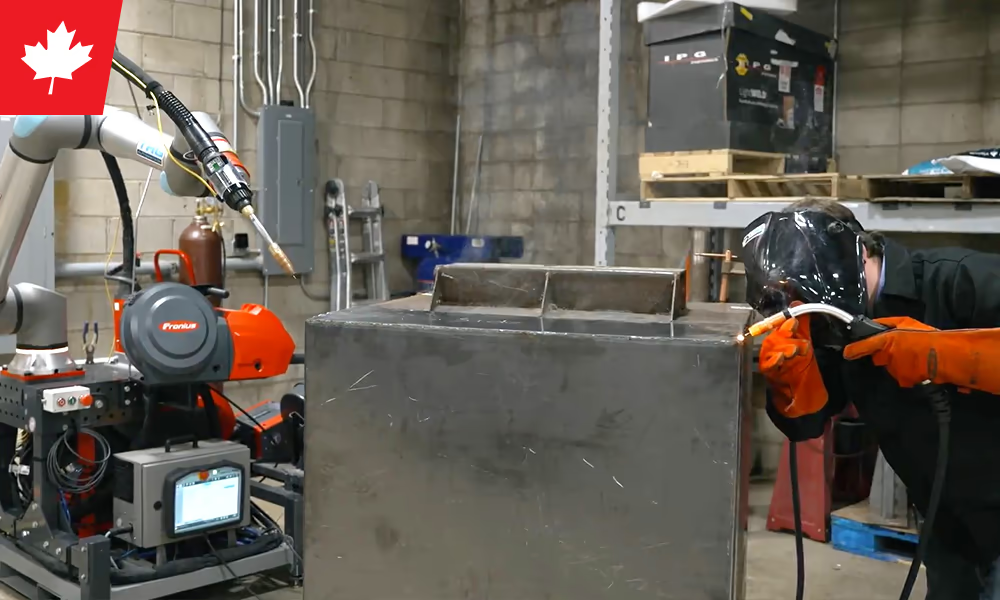
We already see this shift in the field. Customers have asked for ways to move between manual and robotic welding without making the process harder for operators. That demand helped shape our SideCar system. It allows the operator to switch between robotic and manual welding at the flip of a switch. This type of manual-robot flexibility will become more important in the coming years. It lets shops automate repeatable welding while keeping manual control available for tacking, prep work, small jobs, and irregular parts.

Manual welding will still remain important for complex assemblies, repairs, prototypes, variable parts, and lower-volume work. These jobs often need an experienced welder’s judgment and flexibility. Skilled welders will continue to work alongside automation, rather than be replaced by it.
Welding Training Must Keep Pace With Technology
Canada needs strong training pathways for new and current welders. These pathways must keep pace with changing production methods.
Apprenticeships are likely to remain a key pathway into the skilled trades. They combine workplace experience with technical instruction. Red Seal training and certification also support national standards and labour mobility across Canada.
Canadian welding trends also demonstrate an increasing access to the trade. Pre-apprenticeships can introduce basic welding skills, safety, and career expectations. The CWB Welding Foundation’s Women of Steel program helps women explore welding through hands-on learning and career guidance. Newcomer bridging programs can connect previous experience with Canadian qualifications and workplace requirements. Youth outreach can introduce welding before students choose a career path.
Employers play a direct role by hiring apprentices, providing supervised experience, and supporting mentorship. They must also train current employees as technology changes.
Modern welding training should include:
- Robotic setup
- Process monitoring
- Troubleshooting
- Inspection
- Safe equipment operation
Flexible Automation Is the Future for Shops
Automation can help smaller shops add capacity, but only when the application makes sense. A system still requires capital, training, process development, and reliable fixturing. Parts with high variation or very limited repeat work may not produce a strong return.
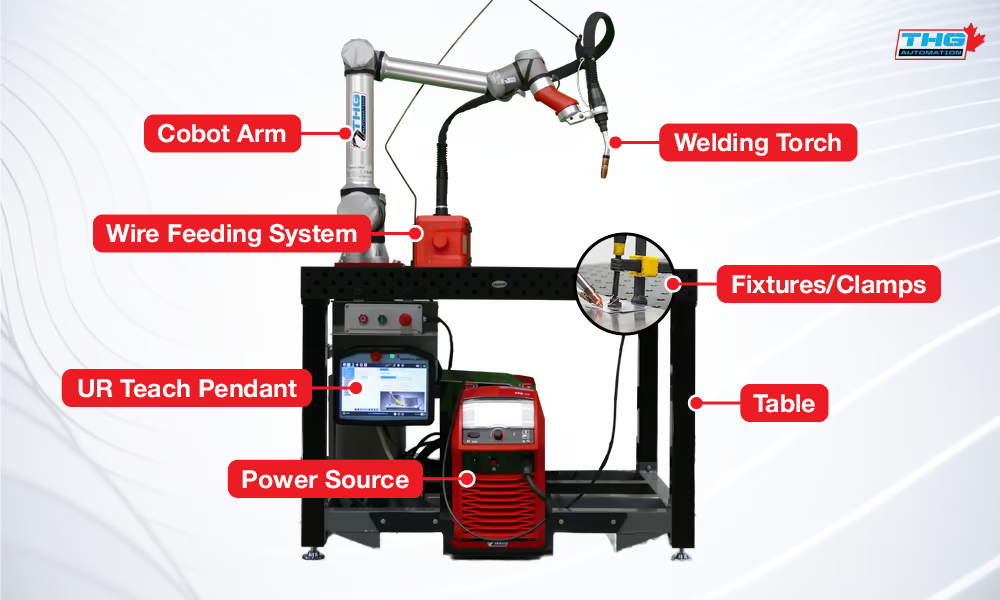
Given the rising need for automation, future shops are more likely to benefit if their automation is as flexible as a human. Shops won’t be introducing automation solely for the sake of automation. It’ll be because they need to tackle the labor challenges. So, their system selection will be heavily influenced by its practicality. You wouldn’t hire a welder who can only do one thing. The same approach is likely to shape the future of automated welding in Canada.
Practical automation should be easy for the team to use. Important capabilities include:
- Hand-guided teaching and welder-focused controls
- Reusable programs for recurring parts
- Manageable changeovers between jobs
- A setup that fits the shop’s parts, processes, space, and workforce
The system should also be able to grow. Positioners, tracks, external axes, coordinated motion, and added processes can expand what it can handle over time.
Here at THG Automation, we are tackling these issues today. And, Pik Rite offers a useful example. The Pennsylvania manufacturer added a THG cobot welding system to support large agricultural and industrial assemblies. The company later added a linear rail to extend the robot’s reach as production needs changed. In a THG case study, Pik Rite reports completing some parts in half the manual welding time.
Local Support Will Be Critical for Automated Welding
Considering the upcoming increase of reliance on automated welding, shops will need reliable Canadian support. Shops using systems from non-local brands might risk more downtime and less reliable job completion. The more fluid and reliable your welding is in the coming years, the better you are to handle the turbulent transition to the manual-automated job shop model.
A welding system needs more than a successful installation. Shops also need:
- Application testing
- Process validation
- Commissioning
- Operator training
- Guidance on fixtures and programs
Support remains important after production begins. New parts may require program changes. Employees may need refresher training. Adding a positioner, track, or other capability may also require further integration and validation.
THG Automation can help you plan a system around your welding needs and electrical requirements. Systems are assembled locally and supported from within Canada. Customers may also avoid cross-border import tariffs on the complete system.
Building a Stronger Future for Canadian Welding
Canada’s welding capacity will depend on how well manufacturers combine people, training, technology, and support. Skilled welders provide the process knowledge. Strong training pathways prepare the next workforce. Flexible automation extends productive capacity, while local support helps shops maintain and expand their systems over time.
To explore where automation could fit in your operation, talk to our fabrication experts about your parts, production goals, and current welding challenges.