
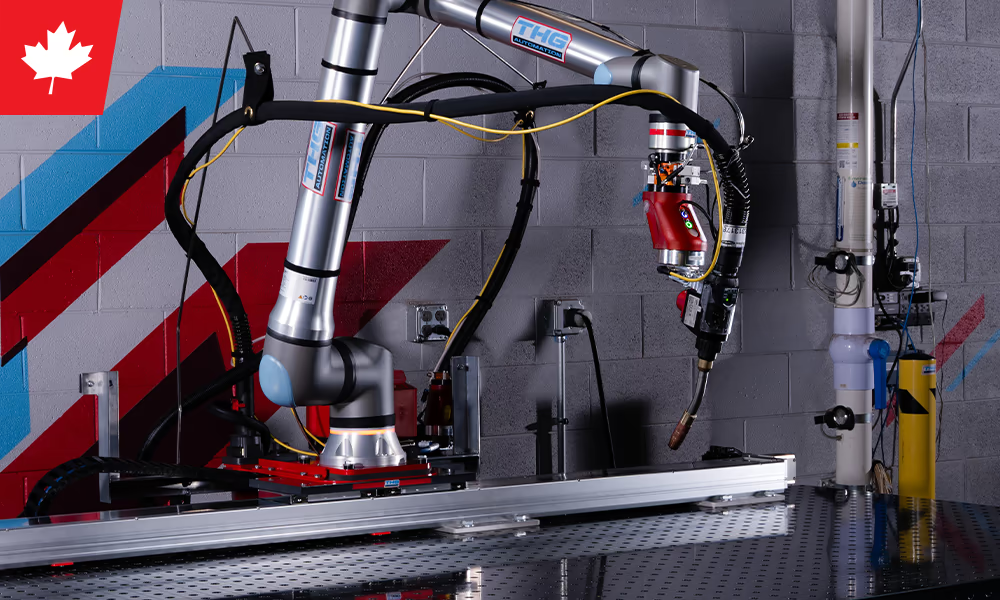
Canadian fabricators are facing pressure from every direction. Skilled welder shortages make hiring difficult. Rising overtime and labour costs also make it harder to protect margins. At the same time, customers still expect faster turnaround times, consistent quality, and reliable delivery. Add in the cross-border tariffs, and it becomes increasingly more difficult to tick all the boxes.
For many shops, the focus is on increasing throughput without adding more people or putting more strain on the team. Robotic welding is becoming a practical way to expand capacity, improve consistency, and help Canadian manufacturers stay competitive in a demanding market.
However, there are plenty of failed robotic welding projects in the market. Local support from a Canadian vendor that’s actually there for your team is critical for long-term success.
Why Canadian Fabricators Are Investing In Robotic Welding
For many fabricators, robotic welding has become a more reliable way to increase output without increasing labour pressure. When parts are presented consistently, robotic systems improve repeatability from the first part to the last. This helps reduce variation across shifts and lowers the risk of scrap, rework, and missed deadlines.
The biggest operational gains often come from:
- Higher arc-on time: More of the shift is spent welding instead of repositioning, adjusting, or waiting around between parts
- Reduced scrap and rework: Consistent weld paths and parameters lower defect rates
- Improved delivery consistency: More predictable cycle times help protect deadlines and customer confidence
- Stronger margin control: Less waste and less overtime help protect profitability
For most Canadian shops, this is best viewed as capacity expansion, not labour replacement. Skilled welders still lead fit-up, quality checks, fixture setup, and more complex welds. The robot handles repetitive production welds so your team can stay focused on higher-value work.
A robot is an extremely powerful tool in your welders’ hands. It scales the application of their skills and can make a dramatic jump in the shop’s productivity.
Cobot vs Traditional Robotic Welding Systems
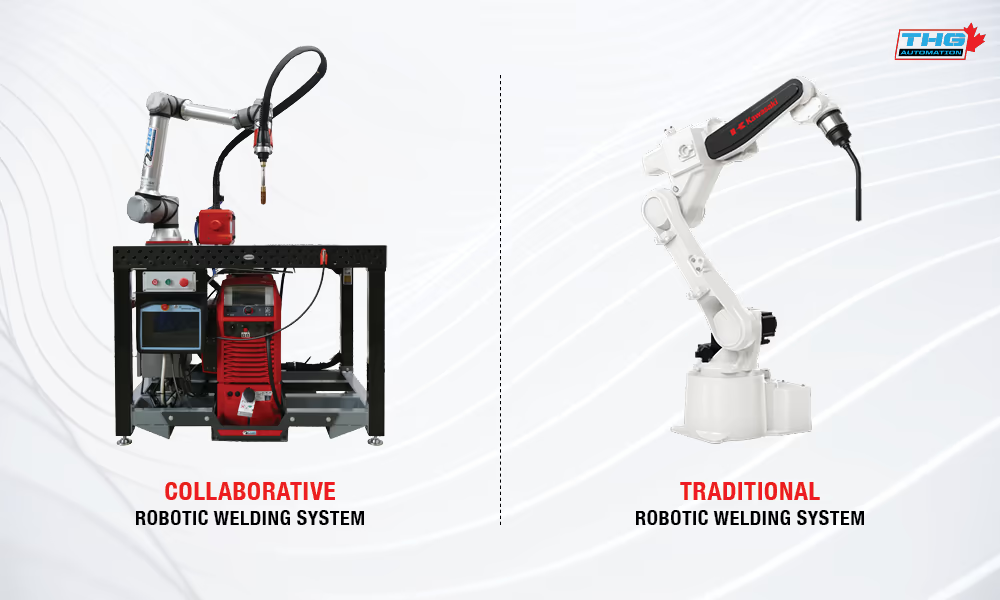
The right robotic welding system depends on your production mix, batch size, and how often your team needs to switch between parts. For many Canadian manufacturers, this decision comes down to flexibility versus maximum throughput.
Collaborative Robot Application (Cobot)
A collaborative robot application is often the better fit for high-mix, lower-volume work. (Note: While many manufacturers still use the popular term “cobot,” current ISO language focuses on the collaborative application itself rather than the robot alone.)
This approach takes up less floor space, simplifies programming, and supports faster changeovers between jobs. That makes it a strong starting point for small-to-medium manufacturers and job shops running varied part batches.
Traditional Robotic Welding Cell
A traditional robotic welding cell is usually the better choice for higher-volume, serial production. These systems may deliver faster cycle times, but they require more guarding, more floor space, and more involved programming. They make the most sense when the same parts run at high volumes with fewer changeovers.
When Comparing Both Options, Focus On:
- Floor space: Collaborative applications fit more easily into smaller fabrication shops
- Programming complexity: Collaborative applications simplify teaching and changeovers. With a good system, you can program parts in minutes, not hours or days.
- Safety design: Traditional cells require advanced guarding
- Changeover frequency: Collaborative applications perform far better when part variety is high
- Batch size: Larger dedicated runs often justify traditional cells
For many Canadian SMMs, starting with a modular MIG-first collaborative robot application makes the most sense. THG’s platform supports future expansion with tracks, positioners, and multi-process capability as workflows become more advanced.
What Your Shop Needs For Automation
Robotic welding works best when the welding process is already stable before the robot is introduced. A robot repeats the same motion every cycle. That means it will repeat poor fit-up, weak fixturing, or inconsistent weld settings just as accurately as a strong process.
As one of THG Automation’s customers put it: “Robots are cool because they do exactly as you tell them to,” after they accidentally had the robot weld with the wrong settings. After correcting it, the robot also did as told and made flawless welds. Read how they achieved a 700% welding boost in our case study; it’s a very inspiring story.
See their experience and 4 critical lessons to be aware of when introducing a robotic welder to a shop:

Production Readiness Comes First
Before automation, your shop should have:
- Repeatable fit-up: Joint gaps and part dimensions need to stay consistent
- Consistent fixturing: Parts must locate the same way every cycle
- Documented weld parameters: Voltage, wire speed, travel speed, and torch angles should already be proven
- Repeatable part presentation: The robot needs the part to appear in the same position every time
The Right Hardware Expands What The Robot Can Weld
The hardware around the robot matters just as much as the arm itself. A stable welding table is often enough for simpler parts, but more complex weldments may need:
- Positioners: Keep the weld in the best working angle
- Tracks: Extend reach for larger assemblies and longer weld paths
- Advanced software: Seam tracking and auto-weld path correcting help address part inconsistencies.
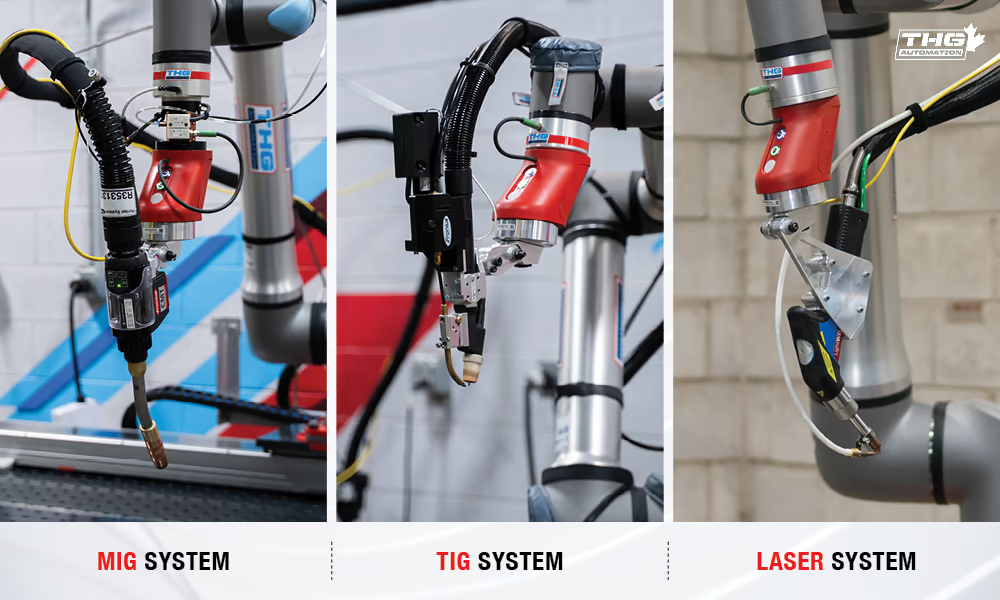
Process choice also affects how smoothly the deployment goes:
- MIG: The most common deployment. It provides extreme productivity with the right power source and it’s much more forgiving than TIG
- TIG: Better for cosmetic welds, tighter tolerances, and precision work if robotic MIG isn’t an option
- Laser: Best for thin materials, high travel speeds, and low distortion
For manufacturers, local commissioning, code-ready weld validation, and procedure qualification support also matter. The best results come from a process-first approach because robots repeat strong and weak processes equally.
Robotic Welding Costs And ROI In Canada
Robotic welding ROI is shaped by total production impact, not just the cobot purchase price. A MIG cobot system is usually the most accessible entry point. Standard GMAW systems commonly start in the CA$135,000 to CA$150,000 range. Systems built around advanced MIG, TIG, laser, coordinated motion, tracks, or multi-axis setups require a higher initial investment.
The quoted system price is only part of the investment. The full ROI picture should also include:
- Training: Time for operators and maintenance staff to learn the system
- Downtime: Reduced production during installation and ramp-up
- Custom fixturing: Fixtures often need to be upgraded for repeatability
- Maintenance: Annual service and consumable replacement
- Future retrofits: Added cost if the original system cannot scale
The strongest ROI drivers usually come from:
- Higher throughput
- Reduced scrap and rework
- Lower wire and gas waste
- Less overtime
- Stronger delivery confidence for customer deadlines
Modular architecture provides the best long-term cost advantage. A system that can expand into tracks, positioners, or multi-process welding later helps avoid buying a second system when your production needs evolve.
See below how THG systems’ modularity works and why this is huge for ROI and robotic welding costs.
For Canadian manufacturers, grants and tax credits can help reduce upfront costs. Many federal and regional programs support automation investments. Reviewing available Canadian business grants for manufacturers can help you identify programs that improve project payback and lower the initial capital burden.
Choosing A Canadian Robotic Welding Partner That Scales With You
A Canadian-built robotic welding system can reduce tariff exposure, shorten service timelines, and make future upgrades easier. For growing fabrication shops, local support makes expansion far less disruptive.
THG’s systems are built in Canada, helping reduce cross-border delays and keep support close to your operation. For small and mid-sized manufacturers planning future automation growth, that local, modular approach helps protect long-term ROI.
More often than not, vendor’s presence and partnership are what make or break welding automation. Having local support can be critical in actually profiting from the welding robot, not just having it collect dust in the corner.
Build a robotic welding system that grows with your shop. Talk to our team about a Canadian-built platform designed for long-term expansion.
FAQ
How long does it take to deploy a robotic welding system in Canada?
Deployment depends on system complexity, fixturing, and commissioning. A standard MIG cobot setup can be installed quickly, while larger multi-process cells take longer.
Are there Canadian grants or tax credits for robotic welding automation?
Yes. Many Canadian manufacturers can access grants, tax credits, or regional funding programs. These can help offset automation costs. Review available Canadian business grants here.
What batch sizes make robotic welding worth it for Canadian shops?
Robotic welding often makes the most sense for repetitive runs and moderate batch sizes. It is also a strong fit for high-mix work, where changeovers still need to remain efficient when using a collaborative robotic application.
Can a modular robotic welding system help avoid future retrofit costs?
Yes. A modular platform can expand into tracks, positioners, or multi-process welding later. This helps reduce the need for second-system purchases. This is a THG proven concept that takes an entirely different approach than what most welding automation providers do.