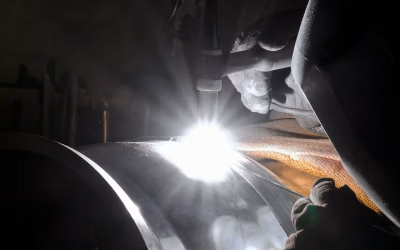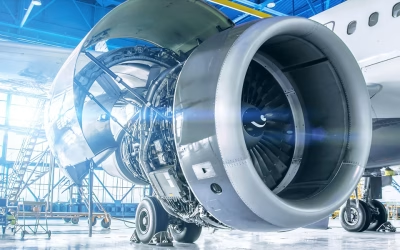



TIG welding high-performance aerospace alloys requires exceptional skill and precise process control. It can meet demanding procedure and quality requirements, but manual TIG is difficult to scale as production demand rises and qualified welders become harder to replace.
So how can manufacturers increase output without compromising qualified procedures?
Modern power sources, mechanized and orbital systems, and robotic cells all offer potential solutions.
The challenge is matching the solution to the work. Traditional automation can excel on stable, repetitive applications, while high-mix, low-volume production may require systems that are easier for welders to program, reconfigure, and expand.
This article will show you today’s aerospace TIG welding challenges and the technologies manufacturers can use to address them.
Why TIG Welding in Aerospace?
Gas tungsten arc welding (GTAW), more commonly called TIG (tungsten inert gas) welding, uses a nonconsumable tungsten electrode to create the arc. Filler metal can be added separately when the joint requires it. This separation gives the welder or welding system precise control over both fusion and filler addition.
The aerospace industry uses TIG welding for:
- Thin sheet
- Tubing and ducts
- Fuel and exhaust assemblies
- Tanks
- Manifolds
- Hydraulic components
- Propulsion hardware
- Structural components
- And other critical parts.
Depending on the application, the TIG process may be performed manually. Or with mechanized torch travel, using orbital welding equipment, or with a robotic welding system.
TIG is the dominant arc welding process in aerospace because it provides several advantages for difficult materials and precision joints:
- Relatively precise heat-input control
- Independent control of the arc and filler metal
- Clear visibility of the weld pool
- Low-spatter, clean welding
- Strong suitability for thin sections and tight-tolerance joints
These characteristics help reduce the risk of porosity, lack of fusion, oxidation, cracking, and other weld discontinuities. This is especially important when joining aluminum, titanium, nickel alloys, stainless steels, and other high-performance, exotic materials.
Modern welding equipment has expanded TIG’s usable process window. There’s very little TIG welding can’t do today. Unless you are working with alloys not suitable for arc welding, TIG can produce astonishing weld quality. With advanced waveforms, pulsed current, and repeatable parameter control, manufacturers can tailor the arc exactly to the material, thickness, and joint.
However, technical capability is only part of the reason TIG remains so common.
Many aerospace parts are already tied to qualified TIG procedures, customer specifications, inspection requirements, and operator qualifications. Another process may offer faster travel or higher deposition rates, but changing processes can introduce requalification costs, customer approval requirements, and additional production risk.
That’s why the most practical approach is to amplify the TIG welding capacity and speed, not necessarily requalify the process.
Aerospace Materials And Qualified Procedures Define TIG Welding
Aerospace materials are selected for low weight, high strength, corrosion resistance, and performance at extreme temperatures. Unfortunately, such a mix of traits usually requires exotic alloys that are difficult to weld. Their welding behavior often narrows the process of choice to TIG.
Compare TIG Welding Challenges Across Aerospace Materials
Select a material to see its primary welding risks, why TIG is often chosen, and which process variables demand the most control.
Aluminum
Rapid heat conduction, low melting temperature, oxide removal, porosity, distortion, and burn-through.
AC TIG provides precise heat control while helping balance oxide cleaning and penetration.
Surface preparation, AC waveform, filler selection, shielding, and changes in joint mass.
Relative process-control priorities
Important: These indicators compare relative process-control priorities. They are not welding parameters or qualification limits. Actual requirements depend on the alloy, joint, qualified procedure, and applicable specification.
Magnesium, maraging steels, and other specialty aerospace alloys also introduce their own material-specific requirements. Across these groups, TIG is often preferred because welders can control the arc independently from the filler metal. So, welders can respond precisely to changes in joint mass, fit-up, and puddle behavior.
Component design makes the welding process selection even less forgiving. Restricted joints, thin sections, and complex assemblies can also benefit from TIG. The ability to introduce filler metal on command or weld autogenously (no wire) lets manufacturers expand the scope of design.
Aerospace Specifications And Material Requirements
Aerospace specifications address the welding risks associated with aluminum, titanium, stainless steel, nickel alloys, and other materials. And TIG is often specified because it can meet those requirements consistently.
AWS D17.1 is a primary fusion-welding specification for many aerospace applications. However, customer and program-specific requirements may add further controls.
Aerospace manufacturers need to maintain:
- Welding Procedure Specifications
- Procedure Qualification Records
- Welder and welding-operator qualifications
- Material and consumable traceability
- Production and inspection records
Weld acceptance may require visual and dimensional inspection. This involves penetrant testing, radiography, ultrasonic testing, or another specified method. Nadcap requirements and obligations tied to FAA, EASA, defense, or individual aerospace programs can also shape the process and documentation.
Aerospace TIG Welding Challenges
TIG welding can meet the specification requirements. But, there are many challenges welders must deal with on the fly. TIG welding is more demanding than other arc welding processes, especially when applied on aerospace materials.
Contamination And Shielding
Oil, moisture, oxides, hydrocarbons, and cross-contamination can cause arc instability and various weld discontinuities. Reactive materials often require backside purging, trailing shields, or enclosed shielding. Even small changes in gas purity, flow rate, torch angle, drafts, or post-flow time can reduce protection.
Heat Input And Distortion
Excessive heat can cause burn-through and distortion, or degrade material properties. Insufficient heat, can lead to incomplete fusion and poor penetration. Thin sections and changing joint mass make that balance especially difficult to maintain.
Discontinuities And Joint Variation
Aerospace welding specifications usually have very strict acceptance criteria for discontinuities. This is especially true for Class A welds. Porosity, cracking, undercut, lack of fusion, oxidation, and dimensional distortion can all lead to rejection. Small changes in fit-up, joint gap, edge preparation, or weld location may require the welder to adjust technique in real time.
Rework is not only a quality problem. It consumes qualified labor, delays downstream operations, and reduces effective throughput.
Skill And Repeatability
Manual TIG welding requires real-time control of arc, torch angle, speed, filler addition, and heat input. Difficult access and repetitive precision welding can also increase fatigue and operator variation. Aerospace parts can be highly complex, requiring exceptional welding skill to produce them uniformly.
While qualified aerospace welders have the skill, they are more scarce than ever. Across the U.S. welding workforce, more than 157,000 welders are approaching retirement and the projected number of welding job openings by 2029 is 320,500.
Speed And Production Capacity
TIG has relatively low travel and deposition rates. But the real bottleneck may extend beyond arc time. Cleaning, purging, fixturing, repositioning, inspection, and documentation all affect how many acceptable parts leave production.
Improving TIG Welding Quality And Consistency With Modern Welding Equipment
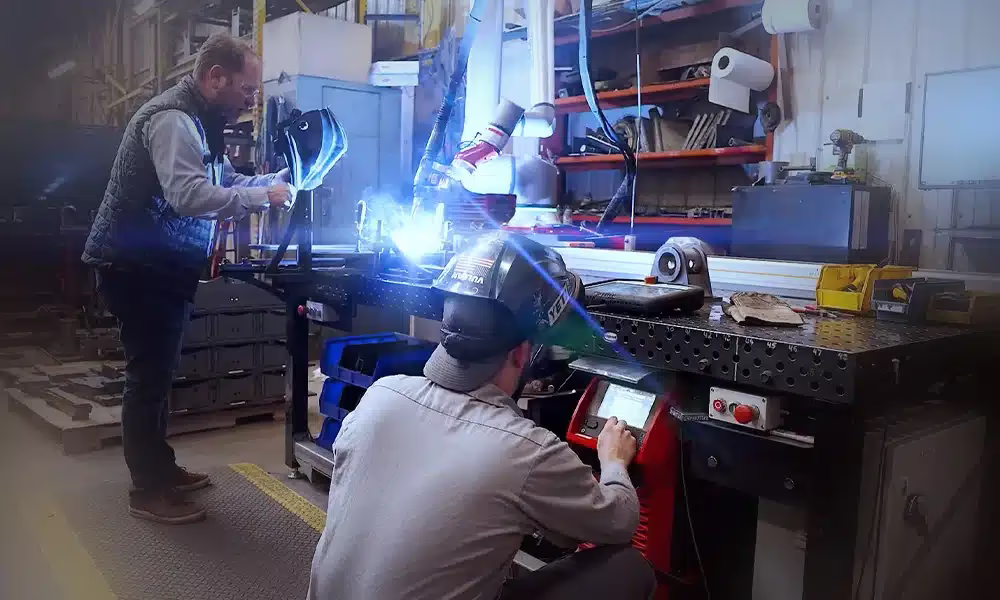
Modern TIG welding power sources can significantly improve weld quality and consistency, especially through automation. Fronius robotic welding power sources support that control through features such as:
- Pulsed TIG: Alternates between peak and background current to maintain fusion while reducing overall heat input. This is especially useful for thin sections and heat-sensitive alloys.
- Advanced AC control: Adjustable AC balance and frequency help manufacturers manage oxide cleaning, penetration, and arc focus when TIG welding aluminum.
- Independent EN and EP current control: Where available, separate control of the electrode-negative and electrode-positive portions of the AC waveform provides greater flexibility than conventional balance adjustment alone.
- Repeatable parameters: Validated settings can be saved for specific parts or procedures, reducing setup variation between production runs.
- Controlled arc heat input: Programmable arc starting, upslope, downslope, and crater filling improve consistency at the beginning and end of the weld, where discontinuities commonly develop.
- Weld-data monitoring: Fronius WeldCube can record welding parameters and store production data for process verification and traceability.
Modern equipment gives welders and automated systems more precise control over the process they are already responsible for maintaining.
Robotic TIG Welding Solves The Aerospace Capacity Challenge
Robotic TIG welding can solve an identified problem. Don’t introduce automation for the sake of automation. Look for specific issues to solve like slow travel speed, limited labor capacity, excessive rework, or insufficient welding precision. Once you know exactly what you are solving for, you can organize the robotic process around it.
This is especially important in high-mix aerospace automation. Shops usually don’t produce high volumes of single parts to justify conventional automation. Instead, they usually need to solve for capacity, speed, or weld quality in high-mix manufacturing. In that case, the system must easily provide the needed flexibility.
Today, many collaborative welding robots solutions exist precisely for this reason. However, not all cobot welding systems can meet the aerospace requirements.
Basic cobot packages often lack the welding controls, external motion, and application flexibility needed for this work. Fully custom cells can solve complex problems, but they also require more time, money, and integration than the application justifies.
A pre-designed but configurable system provides a middle path.
THG Automation Robotic TIG Welding Systems
THG Automation builds robotic TIG welding systems around industrial Fronius power sources and collaborative robots. THG robotic systems are simple to use for everyday welders. But, we don’t over-simplfy the robot’s capability.
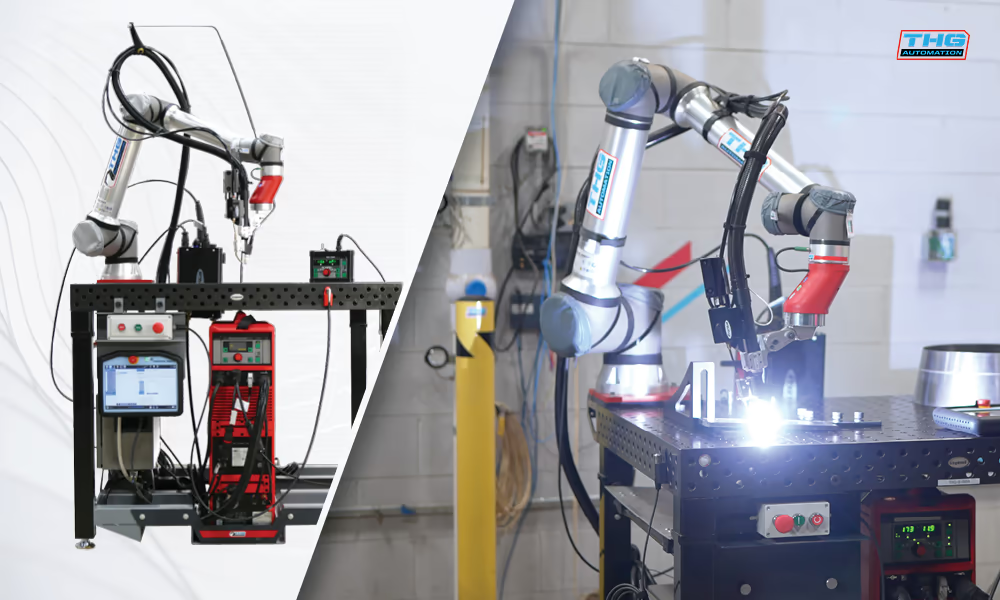
The platform can be configured with:
- AC/DC TIG welding
- Floor- or table-mounted positioners
- Linear tracks for larger work areas
- Coordinated motion between the robot and positioner
- Manual + robotic welding with SideCar
- MultiMode to combine TIG with MIG, laser, and plasma arc welding (PAW)
- Advanced arc adaptive features that adapt to part distortion and part variations in real time.
Coordinated motion is particularly valuable for aerospace components. Instead of forcing the robot to reach around a stationary part, the robot and positioner move together. This helps maintain torch angle, joint access, and a favorable welding orientation throughout complex weld paths.
However, motion alone is not enough.
Aerospace parts can vary because of fit-up, tolerance stack-up, or distortion during welding. Depending on the application, Fronius WireSense, TouchSense, and SeamTracking, and other adaptive functions can help the robot locate or follow the real joint instead of blindly repeating the original programmed path. These Fronius features can give the system the adaptability a skilled welder applies manually.
Fronius power sources also support repeatable parameter programs and weld-data collection. Tools such as WeldCube make it easier to document welding parameters and connect production records with individual parts or seams.
The goal is to give your team a tool that handles repeatable work while they control procedures, validate programs, and supervise production.
Scale your team’s skills with highly capable THG systems designed to handle aerospace applications. Talk to our experts to see if THG robotic TIG welding, or another process, is the right fit for your aerospace shop.