
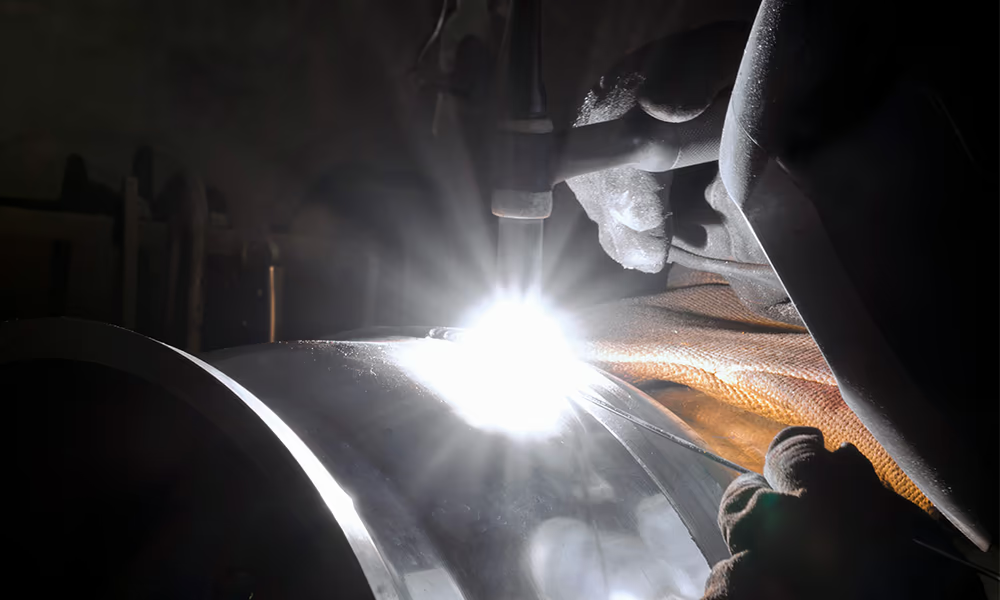

Welding aluminum is tricky. But welding aluminum for the aerospace industry usually brings a significant number of constraints. Aerospace manufacturers must meet industry specifications and customer requirements while working with aluminum alloys prone to weld discontinuities.
Today, manufacturers face an increasing demand while the pool of qualified welders is shrinking. This adds another layer of challenges to solve while winning jobs and staying ahead.
This article will show you how to select aerospace aluminum welding processes, manage common welding challenges, and use flexible automation to increase capacity.
Aluminum Welding Applications In Aerospace
Aircraft and spacecraft designers minimize weight because every unnecessary pound can reduce fuel efficiency. This allows for higher payload capacity, range, and overall performance. Materials like magnesium, titanium, beryllium, and aluminum are critical for these goals.
Aluminum combines low density with useful strength, corrosion resistance, and fabrication flexibility. However, its weldability varies considerably across alloy families, so material selection must account for both the component’s service requirements and the joining process.
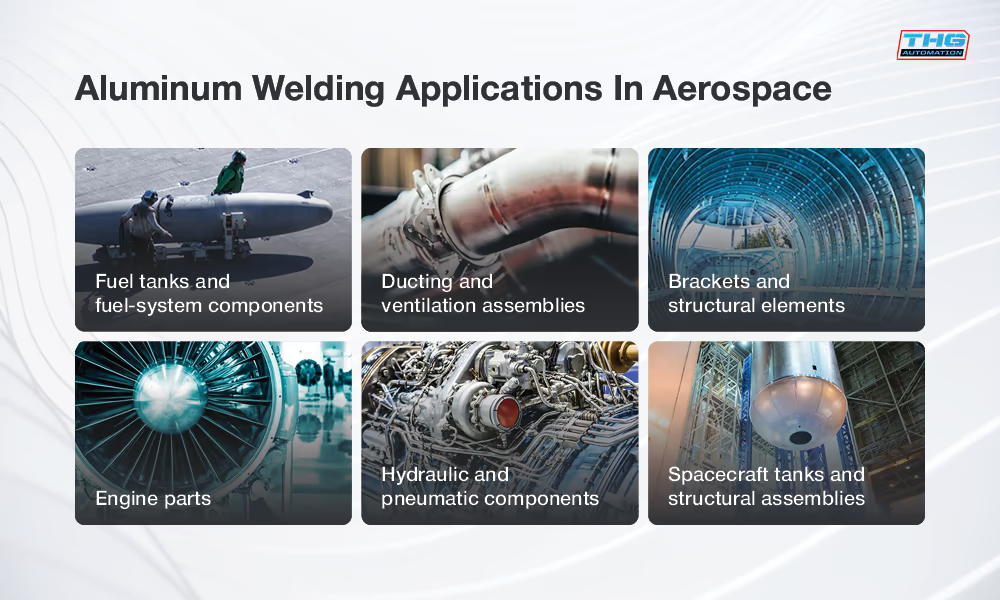
Welded aluminum is used for:
- Fuel tanks and fuel-system components
- Ducting and ventilation assemblies
- Brackets and structural elements
- Engine parts
- Fuselage and airframe subassemblies
- Heat exchangers
- Hydraulic and pneumatic components
- Ground-support equipment and aerospace tooling
- Spacecraft tanks and structural assemblies
Process Selection For Aerospace Aluminum Welding
Aerospace manufacturers primarily consider part requirements and qualifications when selecting the welding process. Welding speed and productivity are certainly desired. However, the process selection comes down to:
- Customer specifications
- Existing welding procedure specifications
- Procedure qualification records
- Acceptance criteria
- Alloy properties
- Joint configuration
The governing standard may further narrow the available process choices. The American Welding Society publishes separate aerospace specifications for:
- Fusion welding under AWS D17.1/D17.1M specification for fusion welding for aerospace applications
- Resistance welding under AWS D17.2/D17.2M
- Friction stir welding of aluminum alloys under AWS D17.3/D17.3M.
Manufacturers must therefore select and qualify the process within the requirements applicable to the part rather than simply choosing the method with the highest welding speed.
Process | Advantage |
GTAW/TIG | Autogenous welding, precise control, high arc visibility, clean welds. Applicable for most arc welded parts, including thin sheet. |
GMAW/MIG | Higher deposition rates for suitable joints and production volumes. |
Friction stir welding | Solid-state joining of some alloys that are difficult to fusion weld. |
Laser beam welding | Fast, concentrated welding with a narrow heat-affected zone. |
Electron beam welding | Deep, narrow welds for specialized applications. |
Resistance welding | Localized joining of overlapping sheet components. |
Friction stir welding is particularly valuable for suitable aerospace parts because it can join aluminum alloys traditionally considered difficult to fusion weld. However, aerospace applications use a broad range of welding processes. Friction stir and electron beam welding is generally selected only when the engineering requirements and production economics justify the specialized equipment and qualification work.
Arc welding remains the most practical choice for price, quality, and meeting the specifications for a wide range of parts. And TIG is the most common choice for precision aerospace aluminum work. It provides clear visibility of the joint and weld pool, precise heat control, independent filler-metal addition, autogenous welding capability, and strong control on thin sections. AC TIG also provides the cleaning action needed to disrupt the aluminum oxide layer.
Many aerospace parts are already qualified for TIG welding. Replacing it with a faster process may require procedure development, testing, customer approval, and requalification. In many cases, those costs outweigh the productivity gain. The more practical option is therefore to improve or automate the qualified TIG process rather than replace it.
Unique Aerospace Aluminum Welding Challenges and Best Practices
Aerospace requirements narrow an already small process window because the weld must satisfy the qualified procedure part-specific acceptance criteria. A change that improves productivity or appearance may still be unacceptable if it falls outside the approved procedure or requires requalification.
However, as challenging as aerospace welding is, there are plenty of ways to improve the success rate and productivity.
Challenge | Why it matters | Best practice |
Aluminum oxide | The oxide is solid at temperatures that melt the base metal, interfering with fusion. | Clean the joint immediately before welding and use the specified AC TIG balance to break away the oxide layer. |
Rapid heat dissipation and low base aluminum melting point | Aluminum has high thermal conductivity, yet its low melting temperature creates a sudden burn-through risk. | Control amperage, travel speed, arc length, fit-up, and weld sequence simultaneously. Use automated solutions. |
Hydrogen porosity | Moisture, hydrocarbons, dirty filler, poor shielding, and contaminated surfaces can introduce hydrogen. | Keep materials clean and dry, use dedicated aluminum tools, verify shielding-gas purity, and prevent condensation. |
Hot cracking | Sensitivity varies with alloy chemistry, filler selection, restraint, and solidification behavior. | Match the filler and procedure to the specific alloy and weld joint. |
Alloy and temper variation | Aerospace alloys’ response varies with fusion welding. They may lose strength in the heat-affected zone. | Confirm weldability, filler compatibility, heat-treatment requirements, and allowable property loss. |
Anodizing discoloration | Filler wire may respond differently from the base metal during anodizing. | Consider post-weld appearance when selecting the filler alloy. |
Specialty shielding gases | Argon-helium blends can increase heat input, but incorrect mixtures, flow, or contaminated equipment can cause instability and porosity. | Follow the WPS and verify gas purity, flow, and delivery equipment. Be extra careful of cylinders with poor upkeep. |
Process documentation and traceability | The need to record welding parameters, operator, and inspection results for each part or weld. | Use integrated weld-data software to maintain records down to the weld seam. |
Automation constraints | Aluminum soft wire, inconsistent fit-up, distortion, and difficult access can destabilize robotic welding. | Use high-quality wire feeding, repeatable fixturing, positioning, and adaptive functions where needed. |
All of the issues described above require simultaneous handling. None appear independently. For example, even a small change in fit-up, shielding, travel speed, or material condition can move the weld outside the acceptable process window.
However, following best practices and finding ways to automate welding where you haven’t already can improve welding quality and your capacity.
Increase Aerospace Welding Capacity With Modular Automation
Aerospace manufacturers are faced with rising market demand. More than 35,000 new aircraft are needed by 2032, and there’s a talent gap of about 2 million unfilled manufacturing jobs in the next decade, according to the Manufacturing Institute. The growing demand for satellites, rockets, and other spacecraft is also significant. But even if you focus on commercial aircraft, the industry currently has a backlog of 15,000 aircraft.
At the same time, manufacturers are dealing with unprecedented disruptors such as the need for green technologies and higher fuel efficiency, among others.
However, manufacturers cannot increase output by reducing weld quality, qualified procedures, or customer requirements. And, skilled aluminum TIG welders are difficult to recruit, train, qualify, and replace.
Manual TIG provides the precision many aerospace applications require, but it is slow and heavily dependent on operator skill. Manufacturers must therefore produce more acceptable welds without losing the required weld control.
So, what is the solution?
High-Mix Aerospace Welding Requires Flexible Automation
Aerospace automation can help existing welders produce more. But many conventional solutions are poorly suited to the high-mix, lower-volume work that remains manual.
Straightforward, repetitive parts are often already handled by traditional robotic systems. The greater opportunity lies in complex applications that require frequent changeovers and involvement from experienced welders.
Traditional robotic welding cells can provide the necessary process and motion capabilities. However, they may require costly custom integration, specialized programming, long deployment timelines, and personnel with extensive robotics experience. These systems can be difficult to justify when production volumes are moderate or the part mix changes frequently.
Basic cobot welding systems create the opposite problem. They may be easy to program and deploy, but many are designed primarily for simple MIG applications. They usually lack advanced TIG welding, adaptive arc features, weld-data documentation, or the ability to expand for more demanding parts.
Aerospace manufacturers need a middle path: collaborative robotic systems that welders can operate themselves without sacrificing industrial welding capabilities.
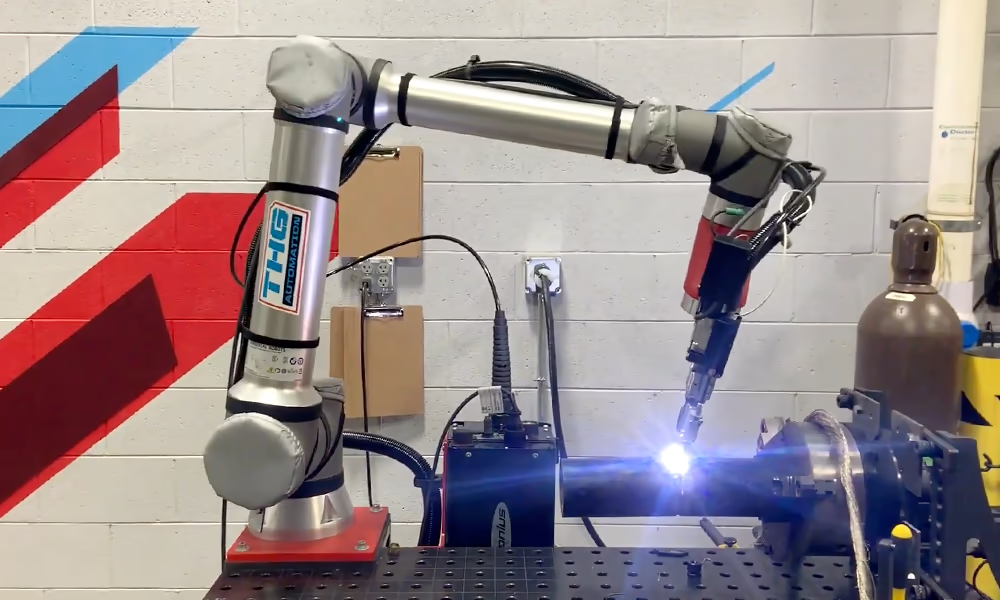
Pre-Designed, Modular Cobot Systems Combine Simplicity With Industrial Capability
THG Automation builds pre-designed, modular cobot welding systems around this principle. The THG systems use collaborative robots and intuitive programming while supporting:
- Advanced Fronius robotic welding equipment
- Positioners
- Linear tracks
- Coordinated motion
- Documentation
- Real-time adaptive arc features
- Using TIG and MIG or laser welding in a MultiMode setup
- and other capabilities selected around the application.
For aerospace aluminum TIG welding, the GTAW robotic welding system can require an advanced AC/DC power source. This is critical for controlling AC balance, frequency, pulsing, waveform behavior, and low-current arc stability. THG Automation integrates Fronius welding equipment to provide high-end process control needed for thin aluminum sections, oxide cleaning, penetration control, and repeatable heat input.
Documentation is usually equally important. Fronius WeldCube can capture and organize welding data at the component and seam level, helping manufacturers maintain process transparency and traceability. It does not replace the manufacturer’s quality system or establish compliance by itself, but it can reduce the manual effort needed to record and review production data.
Positioning and Adaptive Features Support Complex Aerospace Parts
A robot arm alone cannot always maintain the required torch angle or joint access on complex aerospace assemblies.
Floor- or table-mounted positioners can rotate or tilt the part, while coordinated motion allows the robot and positioner to move together during welding. Linear tracks can extend the robot’s reach for larger weldments and may be combined with positioners when the application requires additional axes.
Some parts may also benefit from adaptive arc functions such as Fronius TouchSense, WireSense, or SeamTracking. These technologies can help the system locate the weld joint or respond to seam and part variation. That capability can be especially valuable when aluminum distortion or upstream dimensional variation changes the joint position during production.
THG systems can also support manual-to-robotic welding flexibility when individual welds or parts are not suitable for full automation. Manufacturers can automate repeatable portions of the work while retaining manual control where welder judgment remains necessary.
Talk to our fabrication experts, and we’ll help you automate your aerospace aluminum welding with a flexible yet highly capable robotic welding system your welders can use themselves. No robotic experience required.