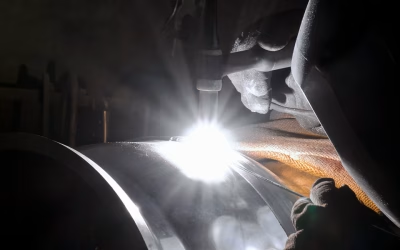

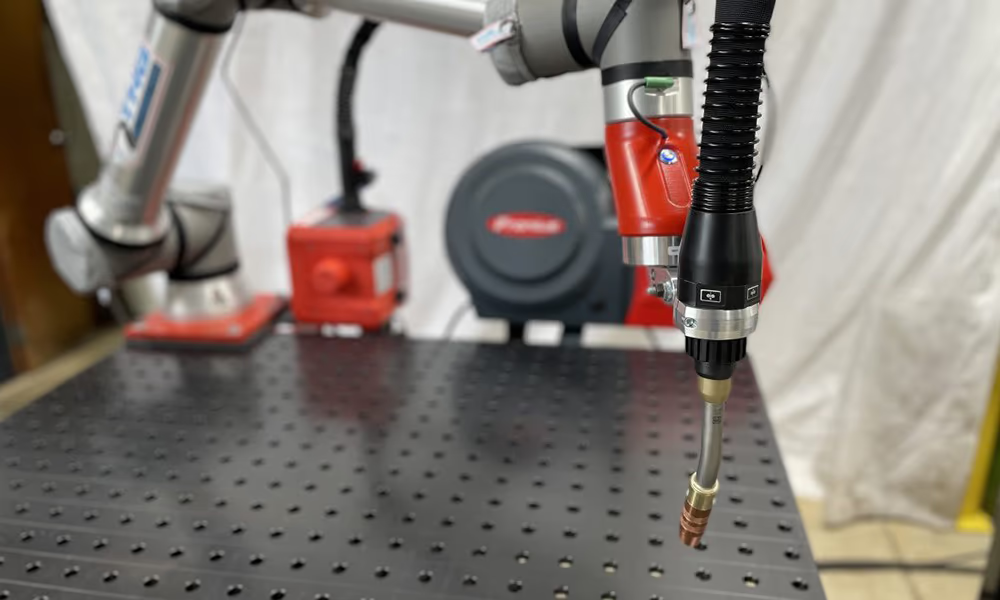

Cold Metal Transfer (CMT) is one of highly sophisticated welding processes that can significantly improve automated welding even more so than automation itself.
Maximizing the benefits of robotic welding requires choosing the most advanced welding process suitable for your application. Otherwise, you are automating a less efficient process to begin with. While you will benefit from most robotic arc welding, you don’t want to miss out on additional multiples on your productivity, throughput, part quality, and bottom line.
That’s why staying on top of advancements in the welding processes is critical, and Cold Metal Transfer (CMT) isn’t a technology to miss out on.
What Is Cold Metal Transfer (CMT) Welding?
Cold metal transfer welding is a modification of the GMAW (MIG) welding process invented by Fronius to dramatically reduce heat input and spatter.
In a nutshell, CMT works by retracting the welding wire at the very moment it short circuits with the welded workpiece (or its weld pool).
As a result, the welding arc burning phase is extremely brief, and so is the heat exposure time.
Then, wire again dips into the pool, short circuits, and retracts, repeating the process at 50-170 Hertz (times per second).
That’s the gist of it, and no other welding process offers the same combination of advantages, speed, and applications. CMT is a unique, proprietary Fronius technology that significantly improves manual and robotic welding for suitable applications (most are).
Advantages of CMT Welding
- 2X higher welding speed compared to dip transfer arc.
- 33% less heat input.
- Drastically reduced distortion on thin sheets.
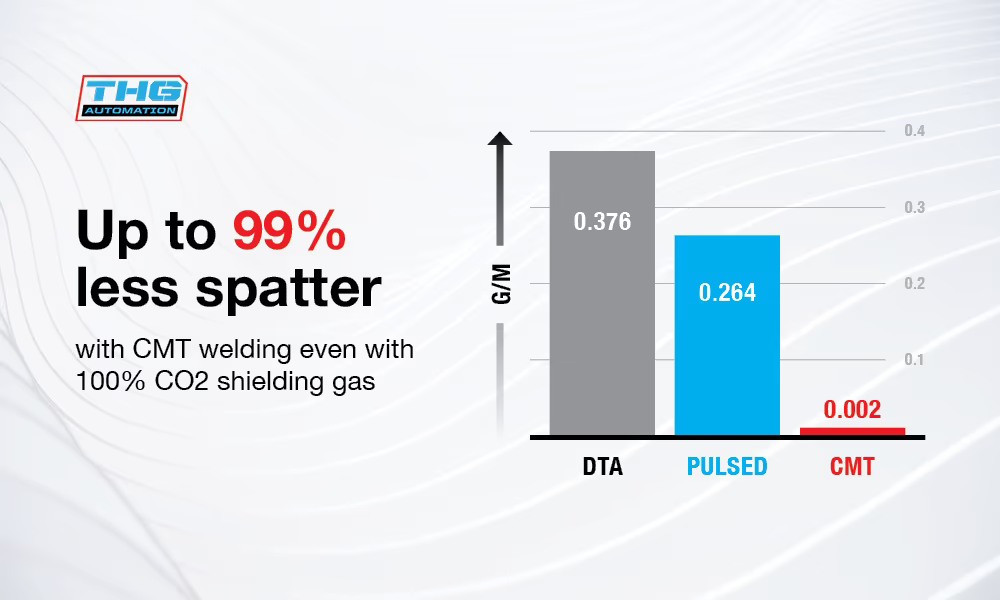
- Up to 99% less spatter.
- Ability to use 100% CO2 gas on steel, which is far less costly than Ar/CO2 mix.
- Exceptional weldability in ALL welding positions.
- Excellent weldability of exotic materials (think ≤ 1 mm aluminum with excellent welds).
- You don’t need weld pool support to keep the weld from dropping through.
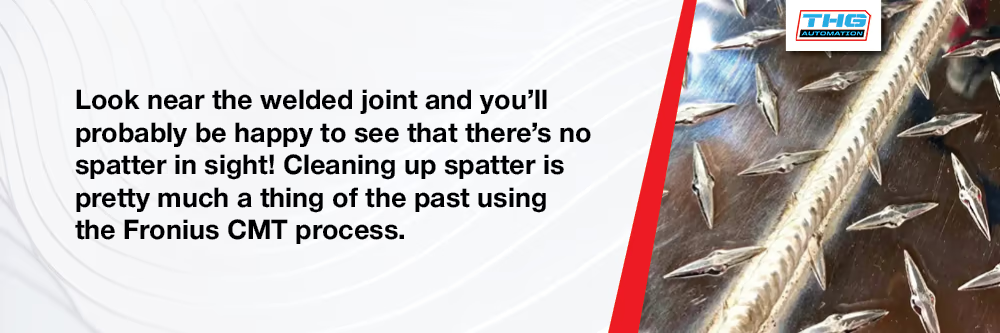
CMT is among top-tier welding technologies that can completely transform many manufacturing businesses today.
While Fronius is yet to blow up in the North American market, they are a highly dedicated brand pushing through the boundaries of what’s possible. And CMT is one of their most valuable technologies so far.
Applications for CMT Welding
From automotive to food and beverage and general manufacturing, CMT welding can be applied for parts and equipment. CMT is particularly applicable for:
- Root passes
- Thin and medium sheet metal range
- Carbon and stainless steels
- Aluminum and other exotic materials
- Parts requiring high visual appeal
- Rapid prototyping
- Surfacing, overlay welds

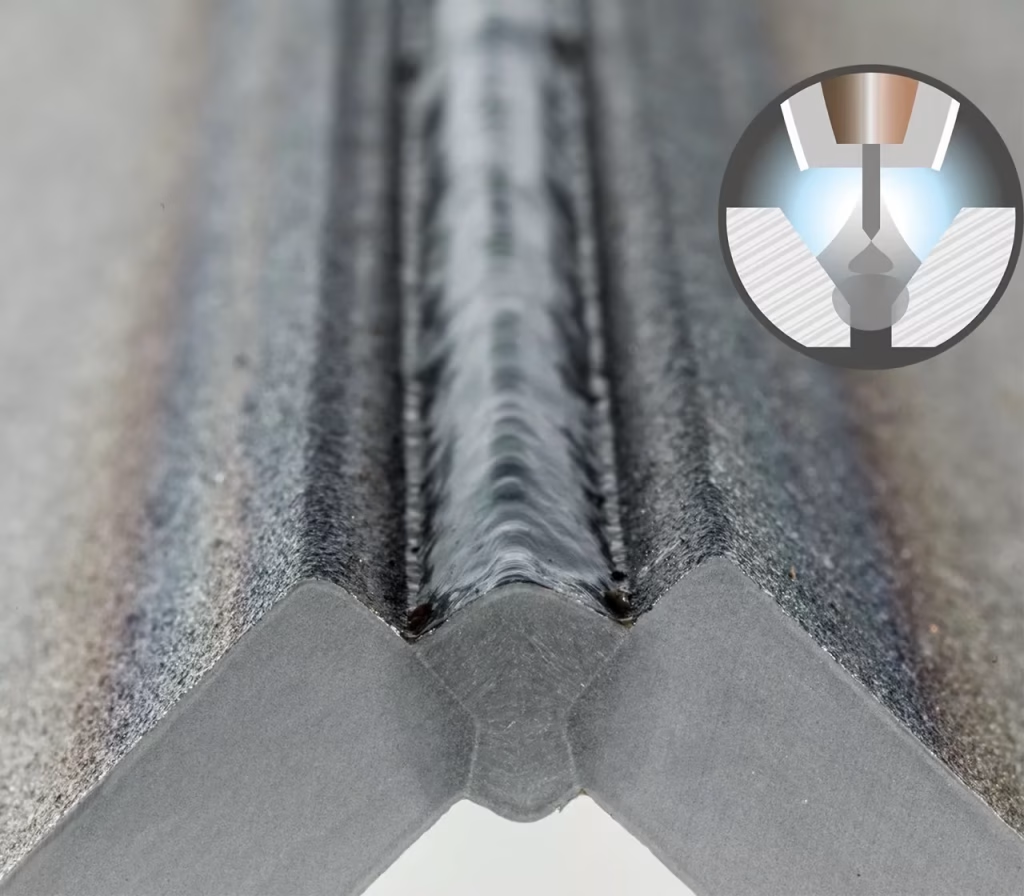
Take just the root welding as an example. Standard MIG is notorious for root cold laps and lack of fusion occurring due to random short-circuit explosions that splash the molten metal on the sidewalls. CMT provides a powerful, stable arc with excellent gap-bridging ability for root welding. Just see the image below. Substituting standard TIG or MMA for root with a reliable wire-fed CMT, which on its own is 2X faster than MIG, dramatically improves time-to-completion.
What Equipment You Need For CMT Welding
You need a Fronius power source with CMT support for CMT welding. If automated, you’ll also need a fully-integrated robotic system that can use CMT to full extent.
For example, the URW-2PA Robotic MIG Welding System is a CMT-ready push-pull system.
THG Automation is an official Fronius robotic welding partner. We specialize in highly integrated, robotic welding systems designed for real-world manufacturing.
THG Automation places particular emphasis on providing high-end technologies like CMT welding to small and medium sized welding shops, allowing our customers to dramatically boost their productivity and quality. See our robotic MIG welding systems and learn more about robotic welding in our dedicated guide. And see a real-world example of a clean weld on .030” stainless steel made by our CMT system. No spatter, warping, or excessive heat input:

CMT Welding vs. Standard MIG Welding Process
Traditional MIG welding creates constraints that CMT specifically addresses: excess heat input on thin materials, spatter cleanup, and fine weld control. CMT is a significant leap forward in GMAW evolution. It’s like comparing old school AC buzzbox MMA welding to standard GMAW. That’s the level of difference in quality, productivity, ease of use, and application range.
| Standard MIG | Cold Metal Transfer | |
| Travel Speed | Lower | 2X Higher |
| Spatter | High | 99% Less spatter |
| Arc Stability | Low | Excellent (even with 100% CO2 shielding gas) |
| Heat Input | Moderate | 33% Less heat |
| Application Range | Moderate | Very high |
| Robotic Welding Suitability | Moderate | High |
Travel speed, arc stability, and spatter differences speak for themselves. CMT will provide dramatic savings with these, no question about it. But just consider what less obvious differences bring to you.
For example, the ability to use 100% CO2 for steel. Straight carbon is far less expensive than 75/25 MIG gas. For shops doing lots of welding, this saving alone is enough to pay off the CMT system long-term, let alone everything else.
CMT Welding Offers a Range of Features
CMT isn’t just one fixed process. It has an extremely versatile range of functionalities. This allows you to tune CMT and apply the most appropriate settings for the job.
CMT Alternating Current (CMT AC)
You can’t use standard MIG in AC, but you can use CMT in AC. This dedicated function achieves an incredibly low heat input by combining the CMT’s wire back and forth motion and the reversal of the wire polarity without the loss of the deposition rate.
Furthermore, CMT AC lets you actually control the DCEP and DCEN parameters of the AC cycle (similar to advanced TIG AC power sources, only for GMAW CMT welding). AC cycle control allows an unprecedented level of control over the weld puddle and heat input.
CMT AC has excellent gap-bridging and additive welding abilities. It has high performance on ultra thin and thin metal, especially where visuals matter (e.g., automotive parts).
With corrective parameters for AC Power Balance (for aluminum) and DCEP and DCEN cycle (for steel/CrNi-steel), you can fine tune the energy input for almost all applications.
And one more benefit of CMT AC is a significant reduction in welding fumes.
CMT Cycle Step
CMT Cycle Step lets you set the number of individual droplets to deposit per welding spot and the time pause between each cycle. In practical terms, this means you get to control weld deposition in terms of droplets per spot, while using all the benefits of CMT.
It’s heat control and visual appearance fine-tuning on steroids. You are literally building up the weld as you see fit. Once you dial it in, run the program and enjoy the results.
See the video below just how effective CMT Cycle Step is with our robotic deployment:
CMT Cycle Step lets you weld thin metals with minimal to no warping while achieving aesthetics you decide, including highly pronounced TIG-like ripple if the job requires it.
Furthermore, CMT Cycle Step allows you to apply the tiniest possible fixation points (or as thick as you want). This is incredibly useful to avoid the use of spot welding, which is time-intensive in terms of part and spot welder handling and requires additional process involvement.
CMT MIX
CMT MIX combines the cold phase of the CMT and a hotter pulsed arc phase to give you the best of both worlds for specific applications that can benefit from it.
Typical applications of CMT MIX include:
- Welding aluminum and stainless steel
- Thicker wall sections
- Visible seams where perfect seam joining is desired
- Automotive parts
See an example of CMT MIX welding by the THG Automation system below:
Getting The Most From CMT With Robotic Welding
While you can apply Fronious’ CMT manually, robotic welding takes it to the next level. CMT is a sophisticated process that greatly benefits from robotic precision and far higher welding speeds than a human can control or maintain.
THG Automation is one of the largest Fronius OEMs for robotic welding systems, with the option for full-feature-range of CMT integration.
Pairing CMT with robotics can yield tremendous results. All Fronius welding technologies benefit from robotic integration and CMT is no exception. Take a look at how Funkhouser Race Cars boosted their welding output by 700% using a THG Automation system featuring Fronius technologies below:
THG systems are designed with modular architecture, allowing us to best meet your present and future needs. Our robotic systems can grow with you as your needs evolve. Need CMT today? No problem. Need to use CMT with a positioner and coordinated motion a few years later? We’ll just expand your system with our pre-integrated positioner hardware and software.
Manufacturers looking at advanced technologies often don’t consider the limits of the system until their confidence to automate more complex tasks grows. That’s why THG Automation pre-integrates advanced modular capabilities. We are ready to expand your system as soon as your needs and robotic confidence grow.
This is a major long-term ROI factor you should question the robotics vendor you choose to work with. You don’t want a system that works today but can’t expand with tracks, positioners, larger work areas, platforms, or additional software you might need later.
Ready to explore how robotic CMT welding can improve your production? Talk to our fabrication experts about your welding challenges.