

You’ve seen what cobots can do, and you want to know: “How much?” While the majority of cobot welding packages are between $95-180k, the numbers alone won’t reveal the full picture. You don’t want to shell out another $120k in less than a year, right? Nobody does, but many do. The details matter, and we are about to show you why.
Cobot welding price includes more than just the cobot arm or the welding power source. Beyond the integrator’s cost, you must account for your downtime, training, any custom tooling, and other not-so-obvious costs.
Most importantly, you must consider the future costs as well. You are paying for a tool and its ability to handle the welding jobs that come up. However, no “plug-and-play” collaborative robot can achieve that on its own, as we will discuss shortly. Therefore, future needs must be factored into your cost considerations and payback calculations.
What a complete, production-ready system actually costs
THG Automation systems prices built on UR8L cobots with a 4×8 Siegmund welding table:
- MIG (with CMT): $135K – $150K, depending on selected power source
- TIG (Push/Pull, AC/DC): $140K
- MIG & TIG combined: $180K
- Laser (IPG): $132K
These land inside the $95K–$180K range most shops see quoted. It’s that the price tag alone still doesn’t tell you what you’re getting, which is exactly what the rest of this article breaks down.
Cobot Welding Package And Installation Costs
Understanding what you’re actually paying for matters more than the quoted number. Different welding processes come with different price tags and capability trade-offs. The integration, downtime, and training often cost more than the robot itself.
Let’s break down what’s included in a complete system and where hidden costs lurk. We’ll also dive into the strategic way of thinking about cobot welding costs. You aren’t just buying a cobot welder, but a capability that shouldn’t be redundant for complex parts.
What a Complete Cobot Welding System Includes
A cobot welding package isn’t just a robot arm bolted to a cart. Understanding what components come standard versus what costs extra prevents budget surprises.
A baseline cobot welding package typically includes:
- Collaborative robot arm
- Welding power source
- Wire feeding system
- Torch and consumables
- Welding table
- Basic fixturing
- Teach pendant for programming
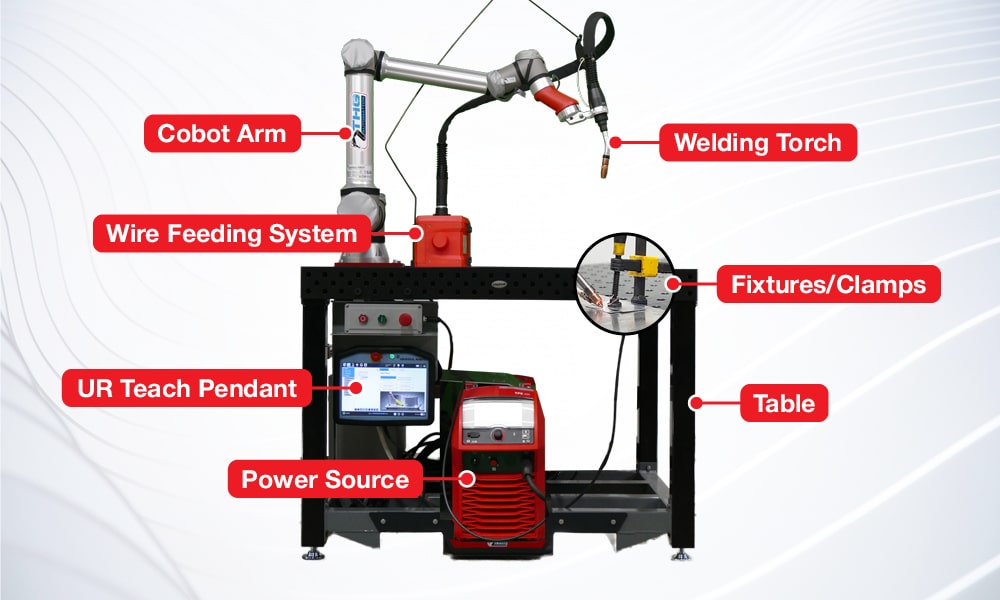
This basic configuration gets you a functional welding cell that can handle straightforward parts. Most manufacturers start here because it’s simple enough.
These “complete” cobot packages look good in marketing. It’s easy to get sold on a system that welds simple, small parts on a flat welding table. But that’s not where the cobot welding journey ends for most manufacturers.
As your team learns the system, they’ll want to do more with it. Usually, this opens the discussions on introducing positioners and coordinated motion. Likewise, welding exotic materials and reducing spatter are the next steps. That’s why it’s more cost-effective long term if your cobot system supports natively:
- Positioners and coordinated motion
- Tracks and extended welding surface area
- Sensing features for the cobot to adjust on the fly for part variability
- Additional welding processes (including advanced processes, like robotic MIG welding systems with CMT)
- And more.
Just imagine welding curved exhaust system components on a flat welding table with a basic cobot. Not going to happen. You’ll be seeking retrofitting or custom integrations.
Therefore, consider future needs when evaluating the cobot packages. That’s why THG Automation puts emphasis on pre-integration of various components you might need down the line.
Welding Processes Affect System Costs And Value
The welding process you choose determines both your upfront investment and your ability to take on different types of work. Every welding process has pros and cons in terms of costs. Usually, the more sophisticated the process, the more costly the equipment.
| Cobot Welding Process | Typical Price Range | Key Characteristics | Best For |
| GMAW Welding (MIG) | $95,000-$120,000 | Most affordable entry point, has some fit-up wiggle room, easier to integrate, most used in the industry. | General fabrication, structural welding, thin to medium thicknesses, steel and aluminum. |
| GTAW Welding (TIG) | $110,000-$145,000 | Requires precision motion control, tighter tolerances, premium power sources, more challenging to integrate in a cobot package. | Aerospace, precision manufacturing, medical devices, high-value work. |
| Laser Welding | $150,000+ | Premium weld quality, unmatched speed and precision on thin materials. | Sheet metal welding, all metals, medical, food and beverage, automotive, and general manufacturing. |
What matters more than individual process costs is whether your vendor can provide multiple processes under one system architecture. You maintain single vendor use and avoid additional integration, downtime, and training processes.
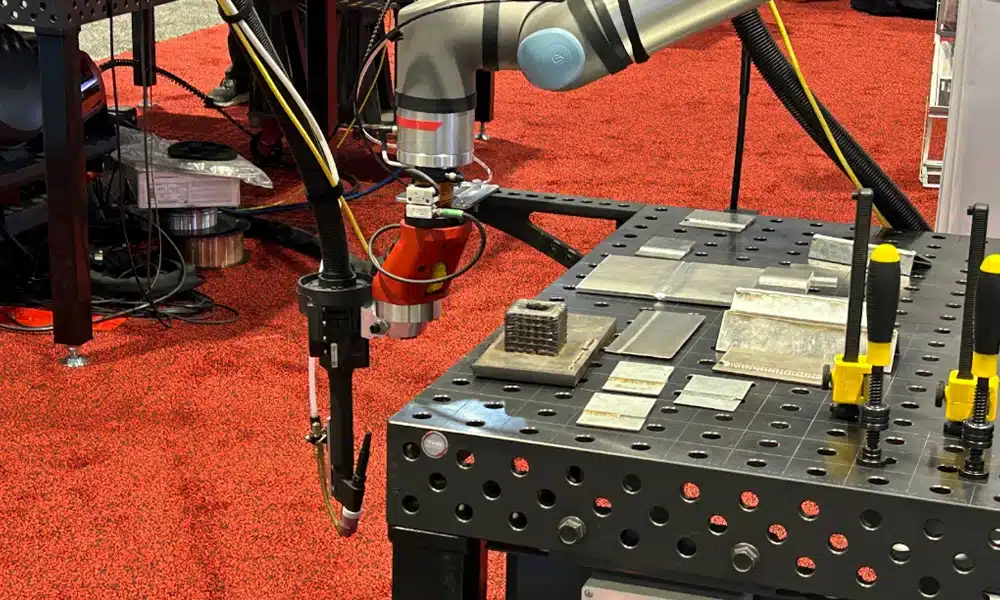
Likewise, you can also use MIG + TIG MultiMode to use one robot with two processes. Exploring different options can help you keep costs down while meeting all capability needs.
The Hidden Costs That Double Your Budget
The quoted system price represents roughly 50-60% of your total investment. The remaining 40-50% comes from hidden costs that are often overlooked.
The good news is that working with experienced vendors can reduce or eliminate some of these costs.
| Cost Category | Typical Range | Notes |
| Integration & Commissioning | $15,000-$40,000 | Higher for multi-process or custom integration requirements. |
| Installation Downtime | $25,000-$75,000 | Based on 2-4 weeks of lost production. |
| Operator Training | $8,000-$15,000 | This can be even higher if you account for the loss of the operator’s productive time. |
| Safety Evaluation | $3,000-$8,000 | May be included or charged extra. |
| Custom Fixturing | $5,000-$25,000 | Depends on part complexity. |
| Software Licensing (5-year) | $0-$10,000 | Check if your vendor has software charges and if updates are free. |
| Annual Maintenance | $3,000-$7,500/year | 3-5% of system cost. |
| Total Hidden Costs | $62,000-$186,500 | Can exceed base system price. |

You Can Start Simple Without Future System Limitations
While most manufacturers start cobot welding with simple systems, many want to do more after gaining experience with them. That’s why keeping your options open is critical to keep your costs down. Your system should be able to evolve from your starting point.
You might want to start with a MIG cobot welding system with a welding table and add a positioner or tracks later. However, not all vendors provide systems with pre-integrated components under one vendor’s software and system architecture.
Vendors offering systems that can’t expand in capability only meet your present needs. You don’t want to be limited when inevitably you try to push cobot welding to the next level.
This can result in:
- Hitting the ceiling on what your team can learn and only welding parts the system supports.
- Turning down profitable work because your cobot can’t weld it.
- Accepting work the cobot can’t handle and delegating it to manual welders.
- Buying a second system from another vendor.
- Doing custom integrations of tracks, positioners, sensors, software, or other components needed to retrofit the first cobot.
Ask your vendor: if we decide to add a positioner in 18 months, what does that cost? If we need extended reach with a track system next year, can our current setup accommodate it?
Keep in mind that each custom integration incurs:
- Downtime
- Additional training
- Coordination costs among multiple vendors.
Working with a vendor that pre-integrates advanced capabilities helps you future-proof at lower costs. When your team feels ready for more complex cobot welding, more capabilities are already engineered into the platform. No custom integration. No vendor coordination headaches. Minimal downtime. Your operators stay on the same system they’ve mastered.
THG Automation designs every system with this expansion architecture built in. Positioners, tracks, multi-process capability—they’re not afterthoughts requiring custom engineering. They’re pre-integrated options that your team can add as production demands evolve.
How to Calculate an Accurate Payback Period
Most payback calculations ignore half the equation. They focus on labor savings while overlooking the hidden costs that stretch payback timelines and the opportunity costs of choosing inflexible systems.
Cost Savings and Value Gain
Calculate payback based on more than just replaced labor hours. Include:
- Reduced scrap rates from consistent welds
- Reduced rework labor time
- Lower wire and gas waste
- Eliminated overtime and weekend premium rates
- Significant improvement in throughput of 2-10X
- Freed-up skilled welders
Don’t forget revenue enablement. A cobot that lets you take on contracts you couldn’t staff manually creates value beyond cost reduction.
This also includes more opportunities when expanding your cobot system. For example, if you add a positioner with coordinated motion later, your capabilities grow. You can handle more complex parts and obtain more value from the market. The system pays itself far faster when it does higher value jobs and can serve wide market needs.
Summing Up Total Costs
Your total cost includes the purchase price plus all hidden costs:
- Integration and commissioning
- Installation downtime
- Training (operator and maintenance)
- Custom fixturing
- Software licensing
- Ongoing maintenance
Calculating the Payback Period
Use the payback period formula below to estimate your cobot welding system’ payback period. For more realistic results, consider your value gain in two scenarios: having a system that can adapt for more complex parts vs. a simple system that can’t accommodate additional features.
Payback Period Formula

While starting with a simple cobot welding system works rather well, you’ll hit a wall when your team decides it’s time to upgrade. A simple system can also pay for itself, if table welding of simple parts is all you’ll do. However, it’s far more cost-effective to keep the door open for future upgrades.
Manufacturers frequently reach out to us asking to retrofit their “plug-and-play” systems because they need added reach, positioners, coordinated motion, CMT to reduce spatter, or other features not supported by their vendor. This is a critical cost factor to consider.
Your custom work or working with another vendor will add significant costs, and you’ll go through additional downtime and training. That’s why working with vendors like THG Automation reduces your future costs while maintaining the productivity boost you get from robotics.
Future-Proof Your Cobot Welding With THG Automation
Don’t just look at the price when evaluating your first welding cobot. Consider the jobs you don’t know you’ll do just yet. Then, compare across the cobot market and see which systems can adapt and justify the price you pay today.
Be strategic with your investments. Not all cobot welding systems are genuine capability tools with the ability to handle complex parts. Contact THG Automation today. Let’s discuss how modular, pre-integrated systems can help you grow today and in the future.