

Collaborative robots allow manufacturers to scale their productivity without necessarily hiring extra hands. The advantage of collaborative robots over traditional robotics is far easier programming and safer operation.
Don’t lose sight of the vendor’s role when investing in a cobot system. The robot itself isn’t capable of much without integrated supporting systems and software. It’s the vendor’s role to integrate it all into a highly functional system that delivers maximum value.
A robotic system is a capability tool giving “extra hands” to your employees. However, this tool can be basic or an expert helper that redefines what’s possible.
A good system will take your business to the next level by doing much more than automating what you already do manually.
What Are Collaborative Robots?
Collaborative robot applications use robotics, popularly known as “cobots” in a human-robot collaboration. Cobot systems are typically programmed with a user-friendly graphical interface and manual robot arm manipulation. You literally guide the cobot by hand and tap some touchscreen buttons.
Cobots are designed to be safe around humans when the robotic application meets the ISO 10218-2:2025 standard on safety requirements with a fully completed risk assessment. Most of them have force-limiting features, allowing safe human presence in the workplace.
This easy and safe workflow makes cobots incredibly attractive to manufacturers, especially SMMs. Cobots can dramatically raise the productivity of your team. For example, Funkhouser Racecars increased production by 700% using a THG Automation GMAW cobot welding system. However, such results aren’t possible just because of a cobot arm. Still, it’s cobot technology that plays a major role in successful robot applications.
Collaborative robots outperform traditional industrial robots for high-mix, low-volume manufacturing. On the other hand, traditional robots are perfect for serial, consistent production.
| Collaborative robot applications | Traditional robot applications | |
| Best for | High-mix, low-volume | Serial, high-volume |
| Programming | Generally, graphical, no-code interface with manual robot manipulations | Generally, using computer programming languages |
| Safety requirements | Lower | Higher |
| Workspace footprint | Smaller | Larger |
Best Collaborative Robot Applications in Manufacturing
Cobots succeed with consistent parts, moderate volumes, and applications where flexibility matters the most. Therefore, cobots are great for high-mix manufacturing applications where robotic precision and repetition are required.
Here are several examples from the real-world use:
- Welding: One of the most popular cobot applications for high-mix, low-volume shops. Cobots handle repetitive MIG, TIG, and laser welding with consistent quality. Best for batches of 50-500 parts with moderate complexity.
- Cutting: Precision cutting and beveling on thick and thin sheet metal and tubes with moderate volumes. Requires consistent material thickness and clean surfaces.
- Grinding, Sanding & Finishing: Handles repetitive finishing with consistent pressure. Effective for deburring and surface prep on similar parts. Basic cobots without force control struggle with variable geometries.
- Assembly & Screwdriving: Maintains consistent torque and placement for repetitive assembly tasks. Requires tight tolerances on hole alignment and consistent part geometry.
- Material Handling & Machine Tending: Loading/unloading CNCs, presses, stamping equipment, and 3D printers. Works well for parts under 10-30kg where flexibility matters more than speed. Struggles with heavy parts or ultra-high-speed operations. Ideal for shops running multiple products where frequent reprogramming is necessary.
- Palletizing & Packaging: End-of-line stacking for low-to-moderate speeds with boxes under payload limits. Not suitable for high-speed lines or very heavy products.

How To Program Collaborative Robots
Well-designed cobot systems eliminate the need for programming languages. This means using a graphical interface and manual manipulation of a robot arm to teach the movements.
While this is application-specific, see the example of THG Automation robotic weld programming below. Whether you are programming a palletizing or a grinding cobot, the steps will be similar conceptually.

The more capable the system, the more functions it supports, including variable hardware. That’s why we use a custom URCap developed in-house for Polyscope software from Universal Robots. This allows us to provide quick and easy-to-use software that lets you use a wide range of Fronius welding features and fine-tune robotic movements without coding.
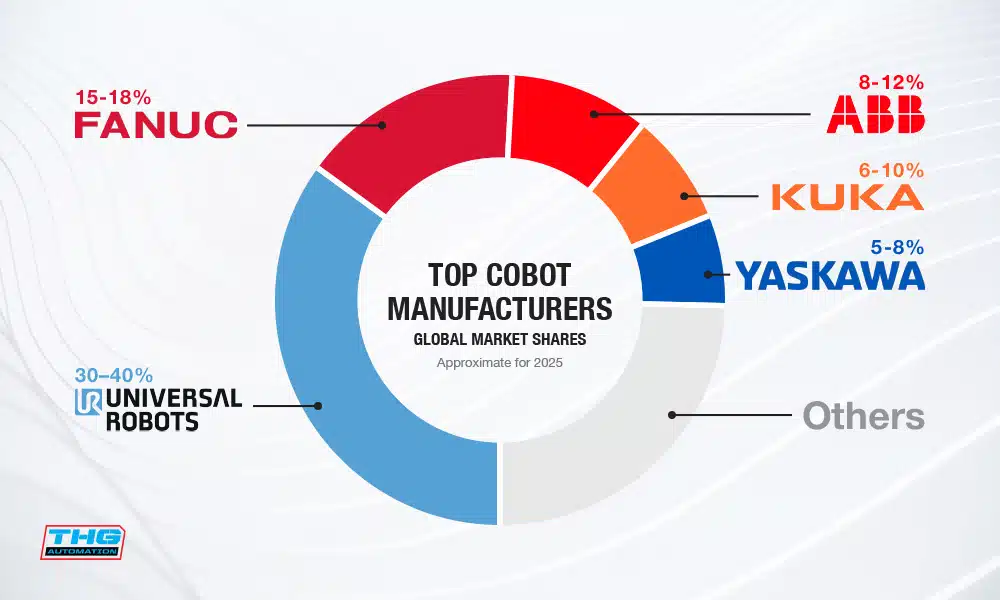
Cobot manufacturers like ABB, Fanuc, KUKA, Universal Robots, Yaskawa, and others have proprietary software interfaces. While similar in functions, you should carefully evaluate if your vendor provides simplified and fully integrated software with the robotic teach pendant software.
Think Application First, Cobot Second
Don’t just automate what you’re currently doing with human workers. Reimagine what’s possible with robotics.
Manual and robotic operations have fundamentally different constraints and capabilities. What’s impossible or impractical to do manually might be simple for a cobot, and vice versa. You can leave a lot on the table if you don’t re-evaluate your approach compared to what you do manually.
For example, a manual welder might default to TIG welding because it offers the precision for tricky joints. But with robotic automation, you can switch from TIG to MIG or laser welding with comparable or better results at far higher welding speeds.
For example, we helped West Coast Manufacturing achieve a 400% productivity boost by re-evaluating their processes, not just automating “what already works.” They automated their manual TIG with robotic laser welding and never looked back.
The same goes for sanding, grinding, screwdriving, palletizing, painting, or anything else.
Don’t Ignore Underlying System Technologies
What we noted above is only half the story. Yes, robotics itself is good enough to let you think bigger than what’s even possible with human hands. However, it’s the combination of robotics and technologies such as power sources, wire feeders, and auxiliary devices that helps push your processes to levels you never thought possible.
Here’s a very simple example from the real-world production environment:
TIG welding. You know it looks great, fuses well (where applicable), but sucks at speed.
While the robot can replace TIG with laser welding (as we noted above), in some applications, you can get an even more dramatic boost. Funkhouser Racecars, which we mentioned earlier, achieved a 700% productivity boost. But not just because they automated TIG with a robotic MIG, but because they used a Fronius robotic welder we provided.
First, watch this video if you are automating welding or trying to understand how to boost automation results in general:
Second, look at the comparison below:
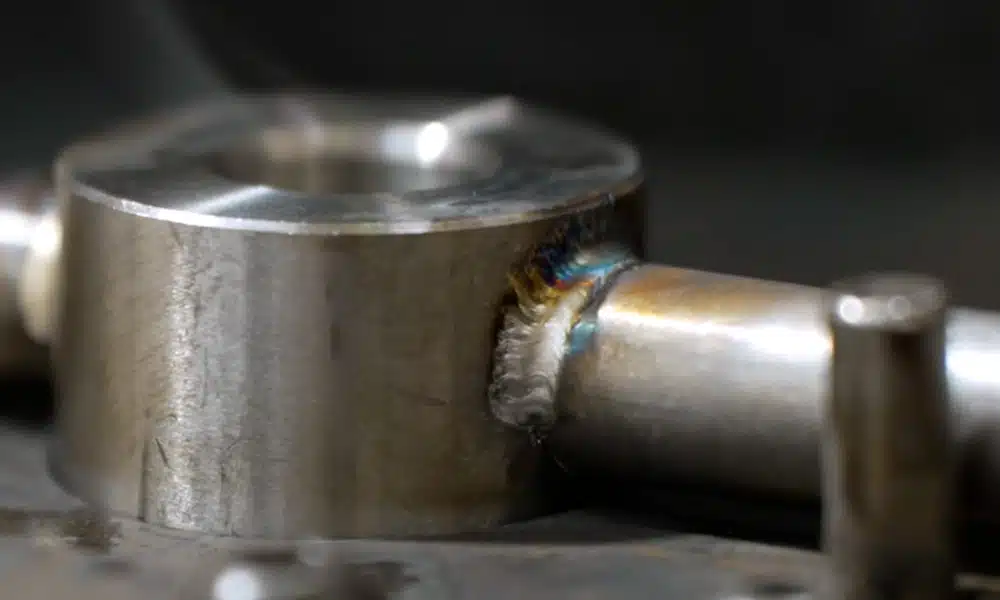
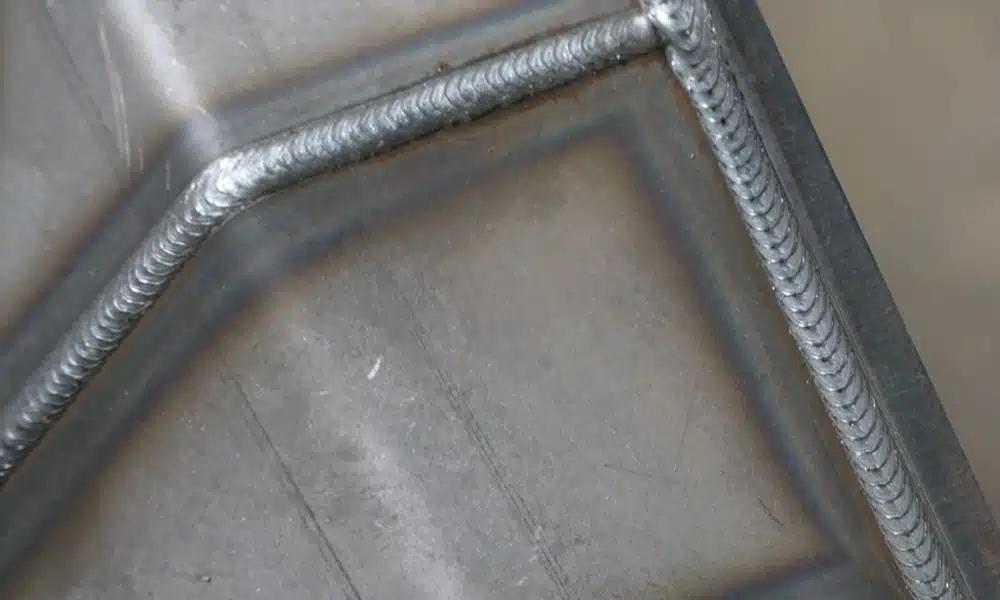
As you can see, our system provided results matching or beating the usual results you’d get with highly-skilled manual TIG execution. Had they just automated TIG, they would have never achieved a 700% boost. And it’s all thanks to the right technologies. Fronius Cold Metal Transfer (CMT), PMC, LSC, and others allow manufacturers to go far beyond what they envision automated welding can do.
You’ll leave nothing on the table if you pair:
- Advanced process technologies
- The right welding, or other manufacturing process, for your application
- Robotics for collaborative applications
- And optimized software for all of the above.
Observe Your Collaborative System As a Whole
A cobot is just a piece of the puzzle. It requires plenty of additional hardware and software to give you the results you want or better. While this is process-specific, let’s examine it from the welding POV, given it’s a dominant cobot application.
A baseline welding robot for collaborative applications includes:
- Teach pendant for programming
- Collaborative robot arm
- Welding power source
- Wire feeding system
- Torch and consumables
- Welding table
- Basic fixturing
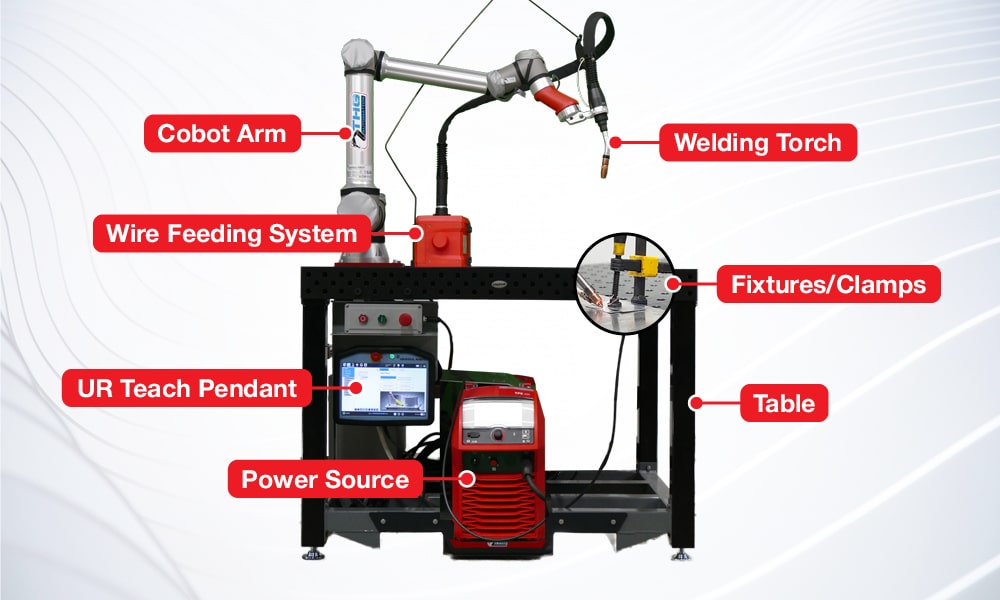
While you should consider the whole package, individual components can make or break automation efforts. You absolutely do not want to get a collaborative robot package that has even a single element not designed for real-world manufacturing. For example, a flimsy welding table, poor robot arm flanges, low-grade welding torch, poorly integrated 3PE, and worst of all, a power source with limited features.
Which brings us to…
Advanced Features Are a Dramatic Competitive Advantage
A system that can adapt grinding, screwdriving, sanding, painting, or welding processes to meet the highest requirements depends on the power source, software, and auxiliary systems.
From the welding perspective, this mostly comes down to the power source and software.
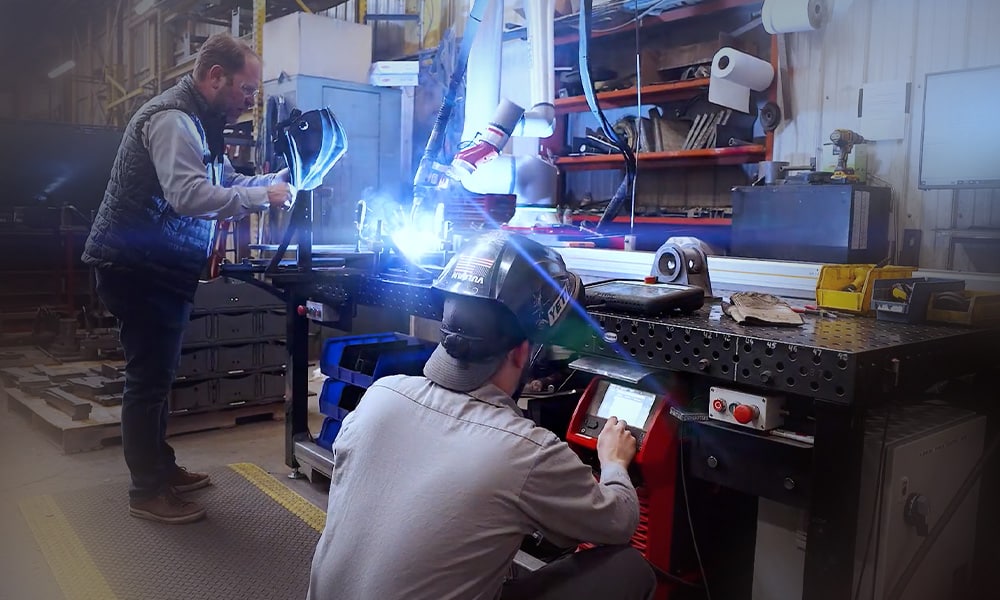
We mentioned Fronius welding power sources, but let’s elaborate why all our arc welding systems are designed around them. Fronius features are proprietary and can literally change the way you work. These are highly sophisticated welding technologies typically not available to job shops and SMMs. And this is precisely why THG Automation brings Fronius robotic welding, letting you gain a lot more than just “a welding cobot.”
- Cold Metal Transfer (CMT) – 2X the standard MIG welding speed, 99% less spatter, 33% less heat, and outstanding visual weld appeal.
- Pulse Multi Control (PMC) – A pulsed MIG modification with 15% higher welding speed at 15% less energy input compared to a conventional pulsed arc. Likewise, it’s far better at avoiding undercuts and other defects, while providing an exceptional TIG-like ripple effect.
- WireSense – Uses the MIG wire as a sensor to auto-adapt the robot programming for part variations.
- TouchSense – Cuts robot programming time by letting the robot use the wire touching the part to auto-calculate the weld seam path.
These are just some examples of using advanced technologies to improve the manufacturing process and the robot use that are independent from the robot tech. In fact, these functions are far more valuable than the robot’s capabilities alone. Combine both, and you genuinely get the most from automation.
The same logic works in other fields, not just welding.
Leave The Door Open For Future Growth And Scaling
Most manufacturers start their automation journey with straightforward applications. Simple welds on flat tables, basic pick-and-place, or repetitive grinding tasks. That’s smart. You prove the concept and build confidence. However, don’t lose sight of the fact that you’ll eventually want to automate more complex tasks. So, the system should be designed for expansion and scalability.
Here’s the recurring SMM automation path we see:
- You buy a new robot system.
- It works for what you bought it for.
- Your team learns, and you all gain more confidence.
- Now, you wish to automate more complex tasks.
- Unfortunately, your vendor says: “We can’t accommodate those processes.”
- You reach out to other vendors, asking for a retrofit. *We get these emails/calls all the time.
- Retrofits can work well, and they are one solution to the problem. *We can retrofit robotic systems to do more than initially designed.
- OR, you buy a completely different system from another vendor.
- You incur additional downtime, training, and ramp-up time until the team is comfortable using the new system.
This adds a massive strain on your business. slows you down, and inflates your cobot welding price. It also kills confidence in automation, which is a big deal today. Someone else automating means they are taking your jobs in a few years, while you aren’t “convinced” due to bad experiences.
But there’s a better way: focus on collaborative robot systems actually designed to grow with pre-integrated capabilities you might need in the future. All available from the original vendor. No re-training, downtime, or ramp-up.
For example, THG Automation cobot welding systems are ALL designed with the ability to quickly add:
- A rotating positioner with a proprietary THG Coordinated Motion for welding very complex geometries.
- Rails that add an additional axis and extend the robot’s reach.
- Additional robotic welding systems with different welding processes, or a robot with multi-process capabilities.
- Multi-table setups.
- Mobile platforms for convenient system movement.
- And more.
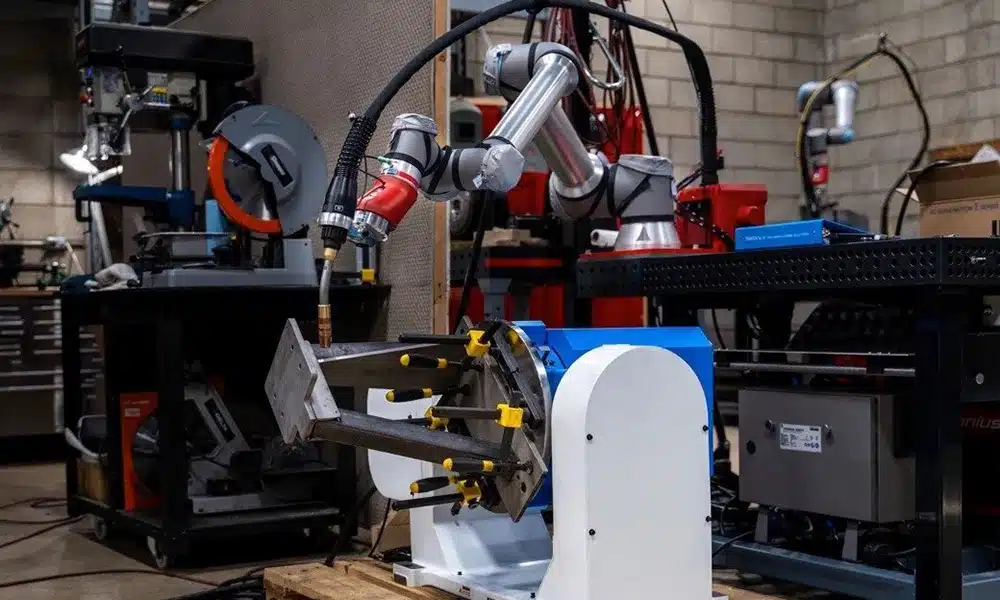
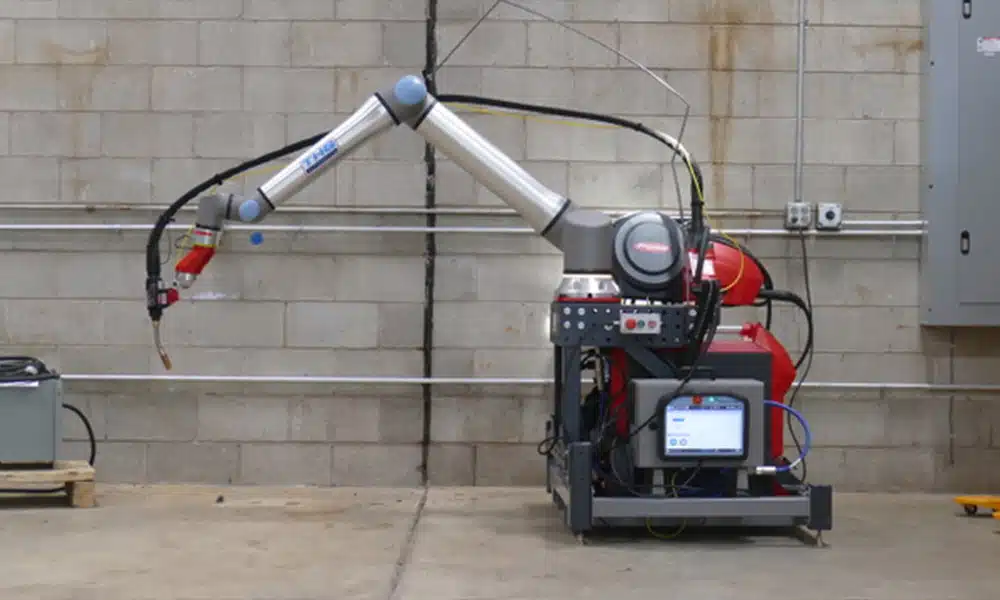
You acquire a system that’s a part of a modular architecture that grows with you. THG Automation becomes your partner, not just another vendor. We are there to help you choose the system capabilities you need today and provide additional functionalities as your business evolves.
Talk to our fabrication experts to get started today.