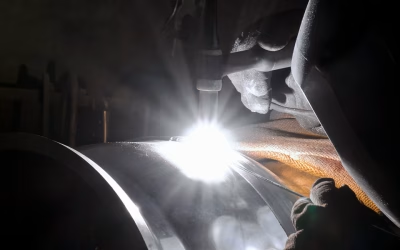



Fronius robotic welding systems deliver proprietary welding technologies that solve the practical problems of both welding and automation.
Everything from issues of part variation to excessive spatter, heat input, and limited process flexibility. Their power sources integrate seam tracking, adaptive fill, and process monitoring capabilities that go above and beyond what the industry typically offers today.
THG Automation builds complete robotic welding cells around Fronius technology, with deep integration that unlocks advanced features most integrators never enable. You get systems that handle real-world production challenges, not just demo parts in controlled environments.
Let’s first introduce Fronius and what makes their welding equipment positioned to handle most robotic welding jobs, regardless of the typical obstacles of automated welding.
Fronius Technologies Offer Next-Gen Welding Processes
Fronius built its reputation by questioning the limitations everyone else accepted. While most power source manufacturers optimize existing processes, Fronius engineers fundamentally reimagine how metal transfer occurs, how arcs behave, and how welding systems respond to real-world variables.
This approach produces power sources with digital arc control, adaptive process monitoring, and proprietary weld modes that competitors can’t replicate. To fully understand just how much Fronius technologies can improve your production, see the Funkhouser Race Cars story below. They improved their welding time by 700% while ensuring consistent quality and repeatability.
Other industry giants offer reliable, proven technology based on decades-old arc physics. But Fronius develops new arc characteristics and metal transfer modes that expand what’s possible with welding as a whole, and develop new ways to improve robotic welding in particular.

Fronius Power Sources Offer Proprietary Welding Features
Fronius power sources include integrated technologies that address the specific challenges to dramatically boost welding results and ease of welding.
Before we dive into robotic welding, let’s discuss how Fronius power sources improve weld quality, application range, and productivity.

Manage Travel Speed for Thermal Control
Pulse Multi Control (PMC) Improves Pulsed Arc Stability
You’ve heard of pulsed MIG welding, but PMC from Fronius adds a layer of penetration stabilizer and an arc length stabilizer. These two provide improved arc control and stability. But more importantly, PMC provides:
- 15% higher welding speed.*
- 15% reduced energy input.*
- Spatter-free ignition (SFI).
- Precise regulation of the droplet detachment at the end of the wire.
- Much better at avoiding undercuts thanks to better arc stability.
- Easier to reproduce previously achieved welding results.
- Better control of vertical upseams thanks to PMC Mix.
- TIG-like seam ripple effect with PMC Ripple Drive from Fronius.
- Higher arc stability against the external magnetic field (no more arc blow).
- Perfect for narrow welds. PMC provides a narrow arc focus with high pressure.
* Compared to a conventional pulsed arc.
Spatter-free ignition (SFI)
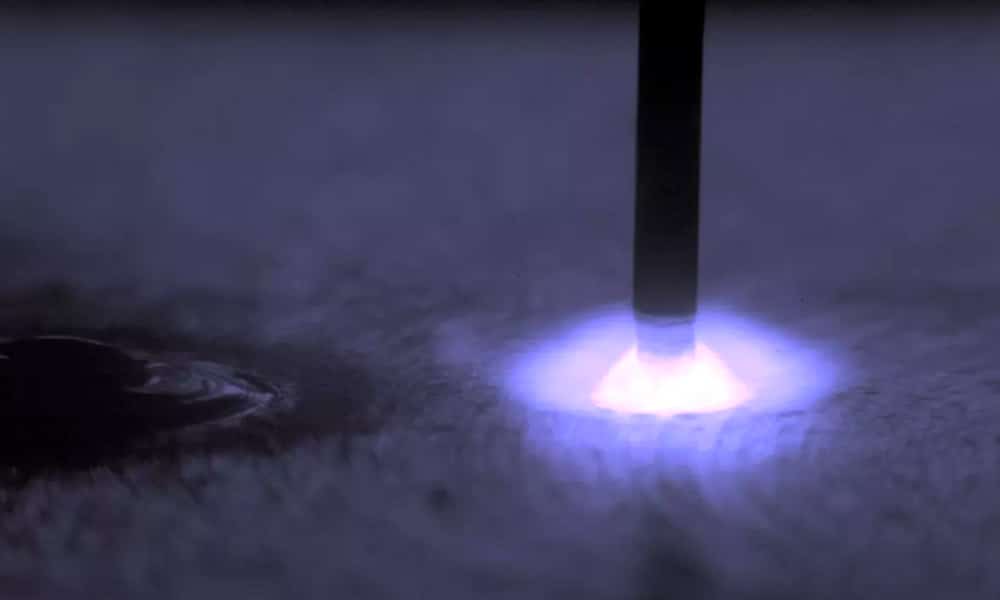
Spatter-free ignition as a part of PMC works by retracting the wire at a low current level. As a result, the arc is stable and you can reproduce the arc start action with the next part. Arc starts can be difficult to time right every time. You want the initial weld point to be as uniform as possible across the part batch, and SFI helps achieve that with timed wire action.
This is particularly problematic with aluminum due to its ability to rapidly absorb heat. SFI HotStart addresses this issue by uniformly increasing the arc energy at the arc start, greatly reducing the chance of a lack of fusion.
PCS (Pulse Controlled Spray Arc)
You know about the spray transfer MIG and about pulsed MIG. But Fronius combines the benefits of both by dropping the intermediate arc. So you get the low spatter of pulsed arc and an aggressive deposition rate of the spray arc. This means deep penetration, rapidly filling grooves, while simultaneously reducing heat input and spatter. That’s a holy-grail-type-of-combo you don’t usually find in a power source.
Low Spatter Control (LSC)
Fronius’ LSC detects short-circuit incidents early, enabling the soft reignition of the arc at a low current. As a result, the arc is more stable and produces far less spatter. LSC will help you achieve:
- Up to 75% less spatter*
- 4.5X faster travel speed compared to TIG root you’d usually do to avoid spatter.
- Great out-of-position action.
- Ability to genuinely root weld in downward position. Most welders know, this isn’t something you do with MIG. With Fronius, you actually can.
- Less rework, less scrap.
* Compared to standard arc at 6 m/min wire speed, 5 mm unalloyed steel.
Penetration Stabilizer
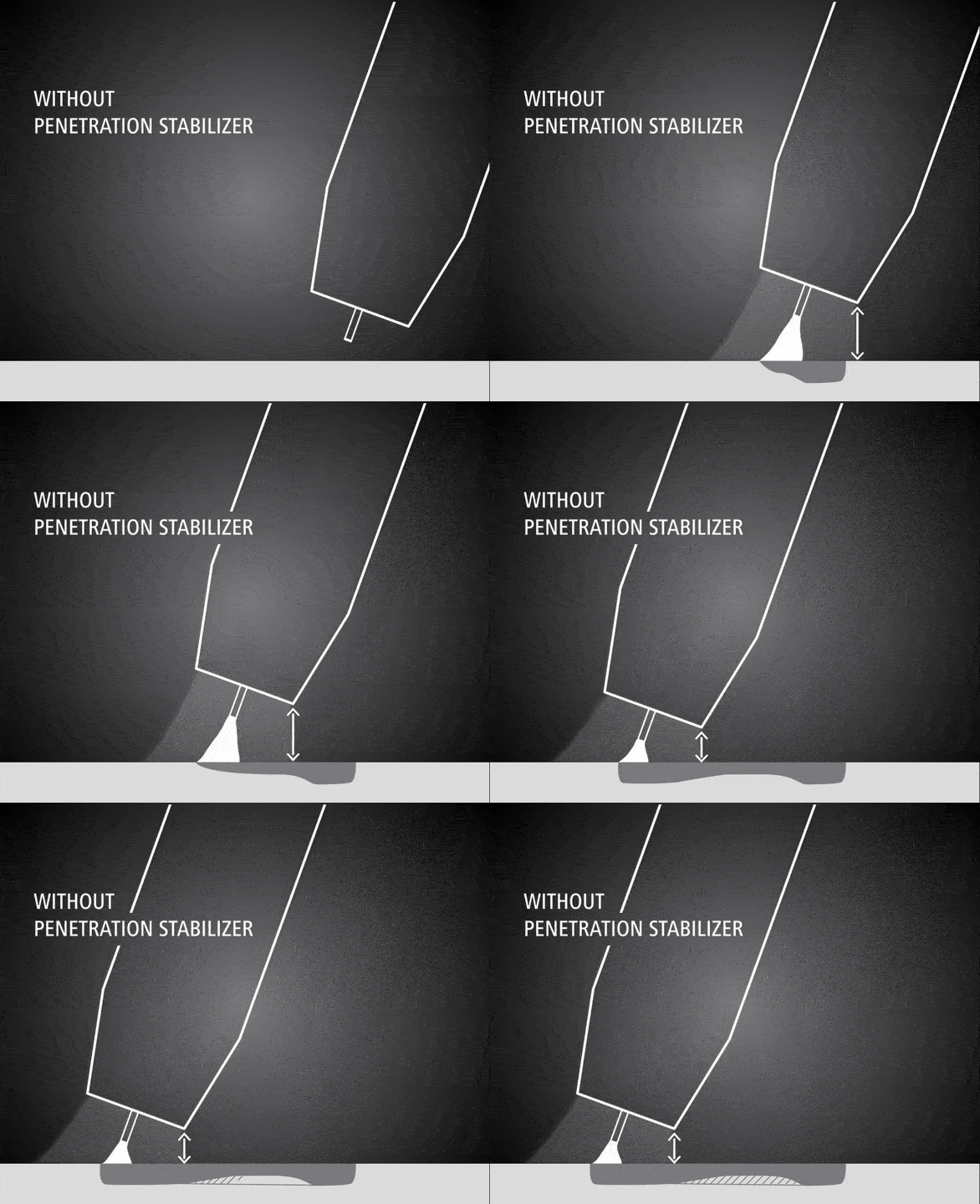
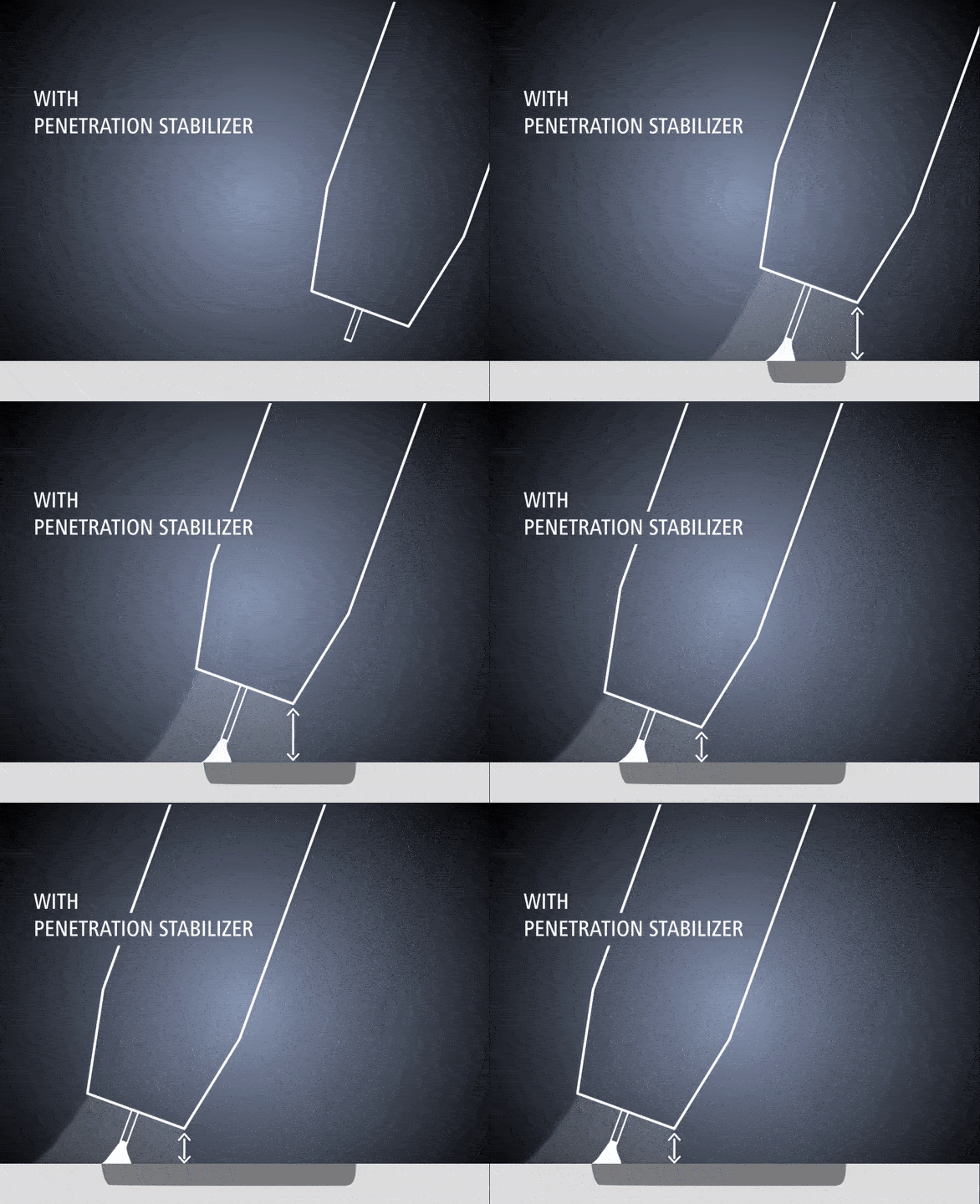
Fronius has a notable feature that’s valuable for manual or robotic welding. When active, this function adjusts the wire speed instead of the welding current to compensate for the distance between the torch and the joint. While the robot will hold the torch uniformly, the question is, will the joint surface be perfectly uniform? If not, the distance will vary anyway. And the Fronius Penetration Stabilizer can help.
Traditional MIG Welding vs. Fronius CMT
Traditional short circuit GMAW is messy, runs hot (compared to CMT), and it’s just way too dated for the quality market requires for some parts. Cold Metal Transfer (CMT) is a sophisticated, proprietary, GMAW welding process from Fronius that offers drastic improvements in every aspect of MIG. Plenty of high-end manufacturers (including vehicle manufacturers) use Fronius’ CMT, and now you can too.
Look at the numbers below. CMT on its own can significantly improve your shop, and we haven’t even touched on the Fronius robotic features yet.
| Standard MIG | Cold Metal Transfer | |
| Travel Speed | Lower | 2X Higher |
| Spatter | High | 99% Less spatter |
| Arc Stability | Low | Excellent (even with 100% CO2 shielding gas) |
| Heat Input | Moderate | 33% Less heat |
| Application Range | Moderate | Very high |
| Robotic Welding Suitability | Moderate | High |
The video below shows a THG Automation robotic welding system joining two .030” stainless with .045” wire using CMT welding. The result speaks for itself.
Fronius Robot Welding Features Solve Major Automation Issues
Fronius robotic welding solutions are integration packages, not complete cells. They manufacture power sources, wire feeders, and torch systems with robot-specific software/functions that solve the problems preventing successful automation:
- Part variation
- Inconsistent fit-up
- Variations in clamping tolerances
- Seam location uncertainty
- Spatter
- Weld defects
Their equipment communicates with any robot controller through standardized protocols. But more importantly, it actively participates in the robotic process.
While other manufacturers offer “robot-ready” equipment that simply receives start/stop commands, Fronius systems provide real-time adaptive welding functions to improve the very applicability of the robotic welding.
Many welding jobs simply can’t be automated without such features. Fronius solutions significantly broaden the application range of robotic welding.
WireSense Enables the Wire To Act As a Sensor
Optical measuring systems (cameras or other sensors) require costly hardware and integration. Likewise, they are bulky and prevent torch access. Fronius response? Turn the wire electrode into the sensor itself.

In the animation above, you can see how our GMAW robotic welding system uses WireSense to check the part prior to welding to ensure uniform welding despite minor variations in the joint gap.
Clamping, fixtures, and parts themselves can vary slightly. WireSense solves this issue and allows robotic welding even to manufacturers that can’t provide perfect part presentation.
TeachMode Handles Stickout Integrity
If you haven’t programmed a robotic welder before, you wouldn’t consider unwanted wire contact with the part/fixtures/table as a big deal. But it is. When the operator accidentally makes contact, the wire gets bent. Then, they have to fix the altered stickout, wasting their time and energy.
TeachMode from Fronius retracts the wire upon unwanted impact, ensuring the set stickout remains consistent. A simple feature that makes programming easier.
TouchSense Determines The Start and End Weld Points Automatically
The Fronius TouchSense feature lets the robot use the welding wire to touch the part weld points and calculate the exact seam path. See this feature in action from one of our customers:
TouchSense can significantly cut down programming time, even for small batch sizes where you have to switch out multiple parts.
SeamTracking Prevents Defects Due To Minor Inconsistencies
SeamTracking is an invaluable function Fronius provides for robotic welding. It helps prevent weld defects from part and clamping variations. It auto-corrects the seam path by detecting variations. You get precise seam tracking and path regardless of clamping or part inconsistencies.
Manufacturers often doubt they’ll be able to provide a sufficient level of upstream practices and fixturing tolerances needed for robotic welding. They are correct to question consistency, as dimension deviations can easily eliminate all robotic welding advantages. However, SeamTracking from Fronius can reduce fit-up requirements and welding errors caused by breached tolerances.
See below how a robotic welding system from THG Automation uses SeamTracking to produce a completely uniform weld bead along a curvy seam path, all automatically.
THG Automation and Fronius Robotic Welding
THG Automation is the largest provider of Fronius-powered robotic welding systems in North America. That scale matters because deep integration requires sustained engineering investment, understanding of Fronius protocols, and building software interfaces that make advanced features accessible to operators without robotics expertise.
Most integrators connect Fronius power sources to robots at a basic level: start weld, stop weld, adjust power.
THG systems provide the full functionality: TouchSense, SeamTracking, WireSense, and other features. And, we provide robotic solutions with intuitive interfaces that production staff can actually use.
You’re not buying a robot with a Fronius welder attached; you’re buying a system engineered to engage Fronius technology.
THG Fronius Robot Welder Systems: MIG, TIG, or Both
THG Automation offers GMAW and GTAW robotic systems. Likewise, we can accommodate multi-process Fronius robot welding if you need both welding processes within one robot cell. All are modular, allowing us to best match the system features with your needs.
Robotic MIG welding systems use Fronius TransSteel and TPS/i with CMT, PMC, and LSC capabilities for thick and thin material applications. These systems handle steel, stainless, and aluminum with process flexibility that adapts to your production mix.Robotic TIG welding systems pair Fronius Magic Wave power sources with robotic systems for precision welding of aerospace components, automotive, and general manufacturing applications requiring exceptional weld quality with controlled heat input.

All configurations support external axes (positioners, tracks), coordinated motion, and offline programming.
How THG Systems Work: Programming Built for Welders
THG Automation developed its URCaps for Universal Robots to program welds in all THG robotic welding systems. No need to code. The operator can quickly program the robotic welder and include any Fronius feature using a graphical interface and simple manual manipulation of the robot arm.
See the brief demonstration below. You can quite literally program simple welds in a few minutes and complex ones in less than an hour.
THG robotic systems require you to know fabrication, material behavior, joint design, and other trade-related work.
As for programming, you’ll quickly grasp it. The robot becomes just another tool in the stack. Only this tool makes a dramatic impact on your business and profitability.
Your Provider’s Experience Matters More Than Robotic Features
Fronius technology solves welding and adaptive control challenges. It doesn’t address structural rigidity, feature integration, cable management, or mechanical details that determine whether a robotic system survives production environments.
This is why your robotic system provider’s manufacturing expertise is critical. Poor system integration or fundamental misunderstandings of real-world manufacturing conditions will negate any positives from the robot arm or system features.

THG Automation robotic systems use durable, heavy-duty welding tables, torches, and cables. But most importantly, we integrate Fronius features to their maximum capabilities and make them easily accessible for most manufacturing requirements. You can apply Fronius features with our robotic welders for nearly any welding joint or part configuration.
Pre-integrating Fronius Systems With Robotics And Other Hardware
Most manufacturers start with a basic robot welding system with one specific application in mind. But once they learn the ropes and see just what they can do with robotic welding, they start exploring how to weld and handle more complex parts with the robot.
This is where they learn just how limiting most systems are.
Manufacturers reach out to us all the time asking if we can help expand their robotic capabilities where their present providers can’t.
This is why THG Automation pre-integrates all system capabilities, allowing you to expand your system whenever you are ready.
Manufacturers who future-proof their welding needs save tens of thousands of dollars. Retrofitting and integrating hardware into software not built to support it is very expensive and time-consuming.
Likewise, getting another system’s brand just to get TIG welding, for example, forces you into repeat downtime, training, and ramp-up.
THG solves all of the above by just letting you introduce a positioner, coordinated motion, tracks, or other hardware at any point. All integrated with Fronius features and robot software.
Ready to Explore Fronius-Powered Robotic Welding?
Fronius welding and robotic features bring immense value to all manufacturers, regardless of the industry. However, your robot system provider must specialize in Fronius technologies to fully benefit from them.
And this is where THG comes in.

We’ll evaluate your production and parts, and help you choose the robotic welding package that fits your needs while leaving the door open for any future expansion.
Talk to our fabrication experts to discuss your application, production requirements, and how Fronius technology can address your specific welding challenges.