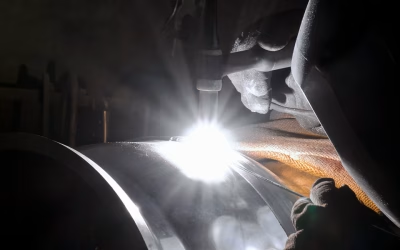


Your manual welding operation hit a wall.
- You’re missing delivery deadlines because throughput can’t keep up.
- Quality inconsistencies are creating costly rework.
- Or, your best welder just gave notice, taking years of expertise with them.
If any of this sounds familiar, robotic welding is likely your next step.
With consistent part presentation, robotic welding can transform your business. Predictable cycle times, repeatable quality, and production that runs while your team tackles complex, high-value work.
Today, it’s all about how to use robotics effectively. Don’t go through the costly learning experience yourself. Instead, let’s dive into how, why, and under what conditions robots are beneficial over manual welding.
Robotic Welding Vs. Manual Welding Table Comparison
You’ve seen the generic comparisons before: robots are faster, manual is cheaper upfront. But those surface-level charts ignore the factors that actually determine whether automation makes sense for your specific production requirements.
Here’s everything that may matter for your decision:
Manual Vs. Robotic Welding Head On Comparison
| Factor | Manual Welding | Robotic Welding |
| Salary/Investment Costs | $65,000-100,000/welder annually | $95,000-300,000 depending on system’s complexity |
| Overtime Costs | Minimum 50% higher hourly wage* | (no additional cost) |
| Reliability Issues | Turnover, injuries, burnout, sick leave | Planned maintenance, infrequent unexpected faults |
| Repeatability | Relatively good, drops with volume | Excellent, consistently |
| Rework/Defect Rate | 5-10% depending on welder skill/fatigue | 0.5-3% with proper setup |
| Weld Quality | Lower | Higher |
| Arc-On Time | 15-25% (breaks, setup, positioning) | 60-80% |
| Travel Speed | 10-20 IPM | 10-100+ IPM, depending on the robotics type and model |
| Metal Deposition Rate | Lower and variable | Higher and consistent |
| Overwelding Wire Waste | Up to 60% | No waste |
| Shielding Gas Waste | Significant | Negligent (Up to 5X less) |
| Safety Incidents | Arc flash, fume exposure, repetitive stress | Minimal human exposure to hazards |
| Insurance/Workers Comp | Higher premiums | Lower risk ratings |
| Production Scaling Ability | Limited by labor availability | Unlimited |
| Skill Dependency | High, performance varies by individual | Low, consistent programmed results |
| Batch Size Efficiency | Better for <10 parts | Better for 10+ parts |
| Training Time | 6 months-2 years for proficiency | 1-4 weeks, depending on robotic system complexity |
| Overall Welding Efficiency | Lower | Significantly higher |
* Per Overtime Pay Requirements of the Fair Labor Standards Act, at DOL.gov.
What Is Robotic Welding And Its Purpose
Robotic welding uses programmable machines to perform welding operations with consistent parameters. Unlike manual welding, robotic systems execute identical welding sequences every time. Robots don’t depend on individual skill or vary weld quality with fatigue.
The real value isn’t just automation. It’s the consistency that comes from optimized part presentation and tested welding parameters.
There are different types of robotic applications. Some robots work in collaborative applications, others are isolated from the workforce. Robotic systems can be specialized for certain welding jobs or be more flexible.

Industrial Robots vs. Collaborative Robots (Cobots)
Your production volume determines which robot type makes sense for your operation. Traditional industrial robots excel at high-volume production (10,000+ parts per month). These systems can be highly specialized. They will require safety cages, complex programming, and dedicated operators.
Collaborative robots (cobots) work alongside your existing team without safety barriers. They have power and force limitations to safely work alongside humans. However, the safety aspects depend on the collaborative application. It’s still necessary to conduct a risk assessment to meet the safety requirements. Refer to ISO 10218:2025 for more information.
Cobots perform well in high-mix, low-volume production (10-500 parts per day or week). They are best for applications that require more flexibility than pure speed. They also have easy-to-learn interfaces for programming/teaching. A skilled welder can program a cobot in hours, not days.
In the end, the decision isn’t about which technology is “better.” It’s about matching robot type to your batch sizes and production variety.
Robotic Cell Components And Why Their Flexibility Matters
Most vendors sell you on the robot arm and software, promoting reach, payload, and programming features. While these are important, everything else also affects your system’s success. Your power source determines the welding features, reliability, and capabilities. The fixture precision and quality can make or break your robotic welding success. Even the welding torch must be appropriate for the welding current and joint accessibility.
All parts of the robotic cell matter. Your vendor must have deep welding expertise, not just be fluent in robotics.
Properly designed robotic cells include:
- Robot arm
- Teach pendant with the necessary software
- Welding power source
- Wire feeding unit (for wire processes)
- Welding torch (GMAW, GTAW, Laser, Plasma, etc.)
- Welding table
- Fixtures and clamping systems
- Safety fence for robot systems as required.

However, this isn’t where the story ends. Some systems may require additional sensors, cameras for quality control, welding fume extraction systems, and more.
Generally, you want a lean system with the most versatile capabilities that can grow and adapt later on. For example, a THG Automation robotic GMAW welding system that optionally lets you use WireSense from Fronius.
WireSense allows your robot to use the welding wire as a sensor to detect joint variations. No need for expensive sensors/cameras or obstructing access to the joint. See how WireSense works on the animation below. Lean, effective, and adaptable.

The Plug-And-Play Fallacy And The Real World
While basic “plug-and-play” cobot welding systems are attractive, they struggle with more complex parts. Not all simple parts can be fixtured to a flat table.
Many businesses get sold on the ease of use of cobots. However, it doesn’t take long before these simple welding systems fail flat with parts requiring more complex fixtures, positioning, tracks, or advanced systems.
Here’s what frequently happens with fresh businesses entering robotic welding:
- They see robot presentations online or in trade shows and envision how it’ll work with the current jobs they do manually.
- They present their welded parts to the vendor. Once the vendor shows the system can handle them, everyone is happy.
- They buy the system. It works great for THOSE parts.
- Then, as they learn more about the system, they want to do more than simple welds, or the initial part specs have changed.
- The robotic system they bought can’t handle the advanced capabilities or the new specs as effectively or at all.
- They start struggling and… some of them reach out to us. They usually ask for help with advanced fixturing and part positioning. Or, they require the advanced capabilities to reduce spatter, minimize distortion, and work with exotic alloys.
And yes, we do help them, often very successfully. It was never about what comes included in the package (although that’s important too). But whether your system can adapt and grow with your needs.
That’s why THG Automation systems are designed, ground up to handle:
- Part positioning – positioners and coordinated motion.
- Multi-process – either through multi-process welding with the same robot or with the ability to add another robot using the same operating system.
- Cutting – oxy and plasma cutting.
- Tracks – to expand the reach for large parts.
- Through-the-wire seam tracking – to handle joint deviations.
- Advanced welding processes – CMT from Fronius and other modified welding processes for improved weld quality.
- And more.
For example, adding THG’s coordinated motion with a positioner exponentially improves welding capabilities. Robotic systems will limit what you offer to customers if they aren’t pre-built to add critical hardware and features.
All without complex hardware or software integrations, working with multiple vendors, or additional staff training.
One vendor, all needs are met. You don’t even need to acquire all the additional equipment upfront. That’s the benefit of working with a vendor that has future capabilities pre-integrated and ready to be added. You can get started with a GMAW robot and introduce a THG positioner later on. But if the system doesn’t natively support it, you’ll have to work with another vendor. Or, struggle to integrate a positioner to a non-supported system.
Robotic Welding Costs Can Be FAR Higher Than Quoted
Initial robotic welding costs range from $95,000 for basic cobot setups to $300,000+ for specialized robotic systems. But those upfront numbers miss critical details. Installation downtime, training time, maintenance, and system obsolescence cost far more.
Hidden costs that can double your investment:
- Integration may even match equipment costs.
- Training takes 2-4 weeks with reduced productivity.
- Maintenance contracts run 5-10% annually.
- Implementation downtime costs weeks of lost production.
But there’s a whole other layer of hidden costs manufacturers discover too late. Your needs will evolve after implementation. New customer requirements, different welding processes, and increased volumes can make your “simple” system limiting within 2-3 years.
You try to reduce the manual welders’ cost per weld, only to get stuck with a system that can’t produce revenue with new customers.
Unless your vendor supports system expansion, you are looking at more training, downtime, and an additional system purchase. And that’s a real investment killer.
Smart manufacturers invest in modular platforms that grow with their business. Systems that grow into new capabilities save you $100-200,000+ in replacement costs. Likewise, they generate additional revenue from capabilities you couldn’t handle before.
Robotic Welding Advantages
You’re already paying hidden costs with manual welding. You just don’t see them itemized on a bill. The biggest advantage of robotic welding is eliminating expenses buried in your current operation that you’ve accepted as “normal.”
- Productivity boost: Robots achieve 60-80% arc-on time vs manual 15-25%.
- Safety hazards reduction: Eliminates unpredictable workers’ compensation costs from arc flash, repetitive stress, and fume exposure.
- Labor shortage solution: Get more done while reducing turnover and handling rising labor costs.
- Scrap reduction: Manual 5-10% rework rates vs robots 0.5-3%.
- Consumable savings: Manual wastes 60% more wire + 5X more shielding gas (can pay off entire system cost).
- Business advantages: Guaranteed delivery dates, better pricing, and new contract opportunities.
Robotic welding reveals how much your current approach has been costing you. You are presently paying the cost of the robotic system every year, and you get nothing in return.
You are already “investing” into overtime, overwelding, overwasting consumables, rework, scrap, and constant turnover. Invest in a proper system instead, and watch as your limits become sky high.
Where Manual Welding Still Wins
Manual welding excels at projects requiring real-time adaptability. But the knowledge of your welders is best applied through automated tools whenever possible. Humans are better at figuring out what needs to get done. Robots are generally better at doing it.
Manual Welding Advantages And Disadvantages
Advantages
- Excellent for complex one-off projects
- Allows real-time decisions
- Field-repairs
- Prototype development
- High adaptability
- Making judgment calls robots cannot
Disadvantages
- Business built around welder availability and human capabilities
- Personal emergencies are a production risk
- Performance varies with fatigue
- Labor failures during rush deliveries damage customer confidence
- Career changes disrupt production, high turnover
- Can’t be repetitive as robotics
The winning strategy combines both approaches. When you automate manual welding, you’re not just replacing human hands with robot arms. You’re standardizing processes that were previously dependent on individual welder skill and availability.
See how Pik Rite Inc., a structural steel manufacturer, uses both manual and robotic welding systems from THG. They win at both ends. Applying human skills manually where needed, and scaling the human experience using robotics on all other jobs.
“We want to give employees a third arm – more power, more ownership, more time to be yourself, and less time where you have to follow a repetitive operation,” says Zach Van Meter, Owner/Operator at TMF Center.
Strategic Planning Makes Robotic Welding Successful
The manufacturers who succeed with robotic welding choose the best system architecture before they need it. The best time to plan for the system’s future capability expansion is before you know what you’ll need to expand into. Don’t rush into automated welding. Be strategic, and you’ll achieve consistent production boost over the years with little to no jobs you can’t hand off to the robot.
You know you can’t sustain your growth or even the current trajectory with human welders alone. The workforce data is bleak, while the demand for excellence rises. Still, investing in a robotic system that can’t adapt to new jobs 6-months later will have you looking for a retrofit or a new system sooner than you think. That’s precisely what happens with many businesses reaching out to us.
THG Automation designs modular welding systems that grow with your business. From MIG to laser welding to multi-process capabilities with positioners, tracks, and coordinated motion. All integrated seamlessly without vendor switching or operator retraining.Don’t wait until you outgrow a rigid system to discover the value of true expandability. Contact THG Automation to discuss how modular robotic welding systems can future-proof your production capabilities.