

If you minimize welding heat input and apply the correct technique, you can MIG weld stainless steel with the kind of quality you only see with TIG welding.
With the correct equipment setup, selection, and application, you can apply a perfect arc that precisely matches your stainless job.
And that’s the whole “secret” to welding stainless. But the fine details matter, a lot.
A quick note on scope: This guide covers austenitic stainless steel (200 and 300 series) — the most common type in fabrication. Ferritic, martensitic, duplex, and other grades behave differently and are outside the scope of this article.
Stainless Steel Welding Challenges
Stainless steel is harder to weld than mild steel primarily because of two compounding problems: it holds heat aggressively and punishes you for it.
Unlike mild steel, stainless has low thermal conductivity. Heat stays concentrated in the weld zone rather than spreading through the base material. That creates a narrow margin between “enough heat to fuse properly” and “too much heat to cause damage.” Exceed it, and you’re dealing with some combination of the following:
- Distortion — Heat buildup warps and distorts parts faster than mild steel, especially on thinner sections
- Sensitization — Prolonged heat in the 800-1650°F (425°C–900°C) range pulls chromium toward grain boundaries, stripping corrosion resistance from the HAZ through carbide precipitation.
- Discoloration — Excessive oxidation from poor heat control or inadequate shielding gas coverage signals surface and subsurface damage

The animation shows how the chromium content near the grain boundary in the metal (the gray line), migrates quickly towards the carbon content near the grain boundary at high temperatures. Once met, they form chromium carbides, depleting the HAZ of chromium. And since it’s chromium that prevents corrosion, the stainless steel loses corrosion resistance.
That’s why low-heat-input control is critical for stainless. It prevents carbide precipitation.
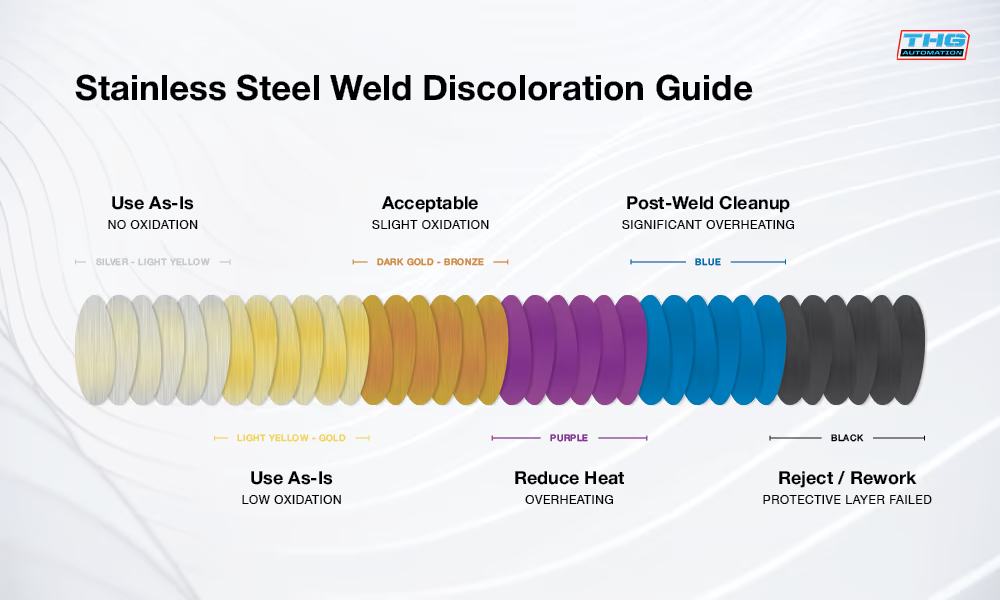
Reading Weld Colors: What Overheating Looks Like
Overheating stainless steel provides visual feedback. While more than visual testing is needed to determine weld quality, stainless weld color provides critical feedback.
Weld discoloration occurs when the chromium oxide layer thickens under heat. But it’s not directly indicative of heat damage. It just helps the welder understand if stainless steel was under excessive heat input.
If all else is done correctly, you can read the weld discoloration gradient:
- Silvery to light yellow: perfect.
- Light yellow/gold to dark gold: low amount of oxidation.
- Dark gold to bronze: Acceptable, be cautious of heat.
- Purple: Overheating is apparent. Mostly acceptable, depending on the use case.
- Blue: Significant overheating.
- Black: Reject the weld.
Hot Cracking: Why MIG Wire Selection Matters
Hot cracking occurs because stainless steel with elevated sulfur or phosphorus content is susceptible to solidification cracking as the weld cools. ER308L, ER316L, and similar low-carbon filler wires contain controlled ferrite content that interrupts crack propagation during solidification. Matching your MIG wire to the base material grade is your primary defense against hot cracking.
How To Pre-Clean And Prepare Stainless Steel For Welding
Stainless is sensitive to pollutants, especially hydrocarbons. It’s critical to clean the welding joint from oils, grease, paints, pen marks, and other impurities. Contaminants can reduce corrosion resistance and weaken the joint by introducing carbon in the weld.
- Acetone or dedicated stainless cleaner removes oils and cutting fluids before welding.
- Acid pickling paste dissolves surface oxides and heat tint that mechanical cleaning can’t reach.
- Laser cleaning is a precise, chemical-free option for shops that need it.
- Dedicated tools only — wire brushes, wheels, and grinders that have touched carbon steel introduce free iron particles. Cross-contamination is irreversible once it’s embedded in the surface and will ruin the weld.
Welding Technique And Torch Manipulation
To avoid stainless steel oxidation, distortion, and excessive heat input, focus on the fundamentals:
- Don’t preheat. It’s mostly detrimental for austenitic stainless.
- Minimize part restraint. Excessive restraint may cause solidification cracking.
- Use appropriate travel speed. Slow travel means more heat into the part. Keep your travel speed deliberate and consistent.
- Push, don’t drag. A push angle improves puddle wetting and shielding gas coverage, reduces oxidation, and produces a flatter, cleaner bead profile.
- Run stringer beads. Weaving deposits more heat into a wider area. Stringers keep the HAZ narrow. But waving can still be used for esthetics and gap filling when needed with heat input in mind.
- Use copper chill bars. Clamping copper backing bars or chill blocks behind the weld joint conducts heat away from the base metal rapidly, especially effective on thin sheet metal.
- Purge pipe interiors. When welding stainless pipe, back-purge with argon to shield the inside of the weld from atmospheric oxidation.

MIG Welding Stainless Steel Equipment Setup
Choosing the right shielding gas, consumables, and welding wire can make or break your success with stainless. While details can vary, this is a general equipment starting point for stainless steel MIG welding:
Transfer Mode And Gas Selection | ||
Short-circuit MIG | Spray Transfer MIG | Pulsed MIG |
Suitable for thin to medium thicknesses, but more likely to overheat compared to pulsed MIG. | Runs very hot but suitable for high-speed welding where appropriate (eg., thick sections using high deposition rate). | The best choice for all thicknesses. Power source alternates between the high/low currents to prevent overheating. |
90% Helium / 8% Argon / 2% CO2 | 98% Argon 2% O2 | |
The “Tri-Mix” gas relies on helium for penetration, argon for ionization, and carbon dioxide for stability. CO2 can harm corrosion resistance. | Argon allows spray or pulsed arc, while oxygen improves arc stability and penetration. The mix can also work great with 99% argon and 1% O2 for reduced weld oxidation. | |
To understand the effect of short-circuit vs. pulsed MIG, see the animation below. While pulsed MIG intermittently introduces high heat, short circuit (and spray transfer) continuously introduce heat as the arc deposits the wire. With reduced heat input of pulsed welding, HAZ remains cooler, there’s less distortion, and chromium doesn’t migrate to carbon at grain boundaries as quickly.
Filler Wire Selection | |
301, 302, 304, 304L, 305, 308, 308L | ER308L, ER308Si |
309 | ER309, ER309L, ER309Si, ER310 |
316, 316L | ER316L, ER316LSi |
As a general rule, austenitic stainless requires a wire with matching or exceeding alloy content. While these are commonly welded alloys, others may require more specialized wires. L = low carbon content, Si = added silicon content to improve GMAW usability but may slightly increase crack sensitivity in some cases. | |
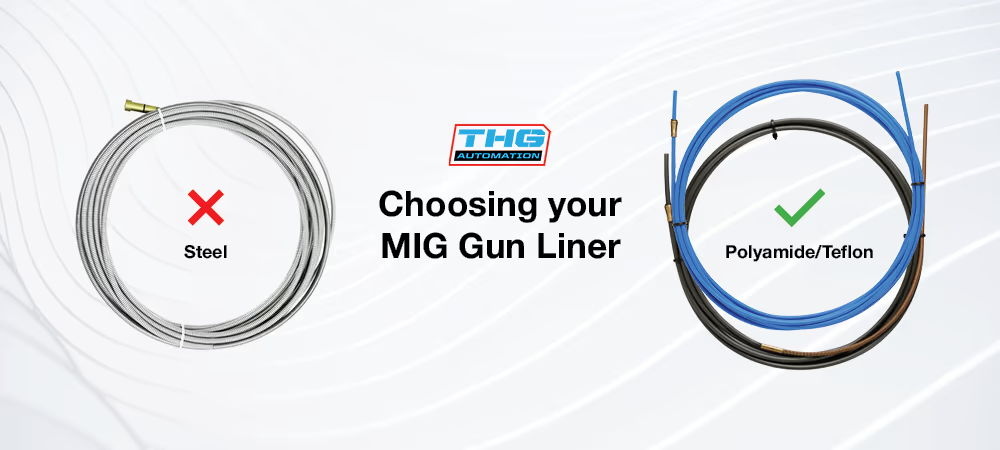
It’s also critical to choose the right MIG gun liner for stainless steel. Use polyamide (PA) or Teflon (PTFE) liners instead of the steel wound coil liner you’d use for carbon MIG wires. Otherwise, stainless wire will drag, wear the steel liner, and pick up carbon.
Modern Welding Equipment Improves Weld Quality And Productivity
Everything covered so far gets dramatically easier to put into practice with the right power source. For stainless steel specifically, not all MIG welders are created equal.
Fronius Is the Choice for Low-Heat Stainless Steel Welding
Fronius power sources are built around one core advantage for stainless: precise, programmable heat input control.
Their Pulse Multi Control (PMC) is a significant advancement over conventional pulsed MIG. Like standard pulsed MIG, PMC alternates between a high-peak current for wire transfer and a low background current. This results in lower average heat input than short-circuit or spray transfer, a narrower HAZ, and better preservation of corrosion resistance.
But PMC goes further: 15% higher welding speed and 15% less heat input than conventional pulsed MIG. Paired with their full process suite:
- Spatter-Free Ignition (SFI) — clean and reproducible arc starts
- PMC Ripple Drive — produces a TIG-like rippled seam
- Vertical-up at full speed — no oscillation required
- Arc blow resistance and high arc pressure — stability in difficult positions
- Pulse Controlled Spray (PCS) — bridges the gap between pulsed and spray transfer for high precision, maximum penetration work
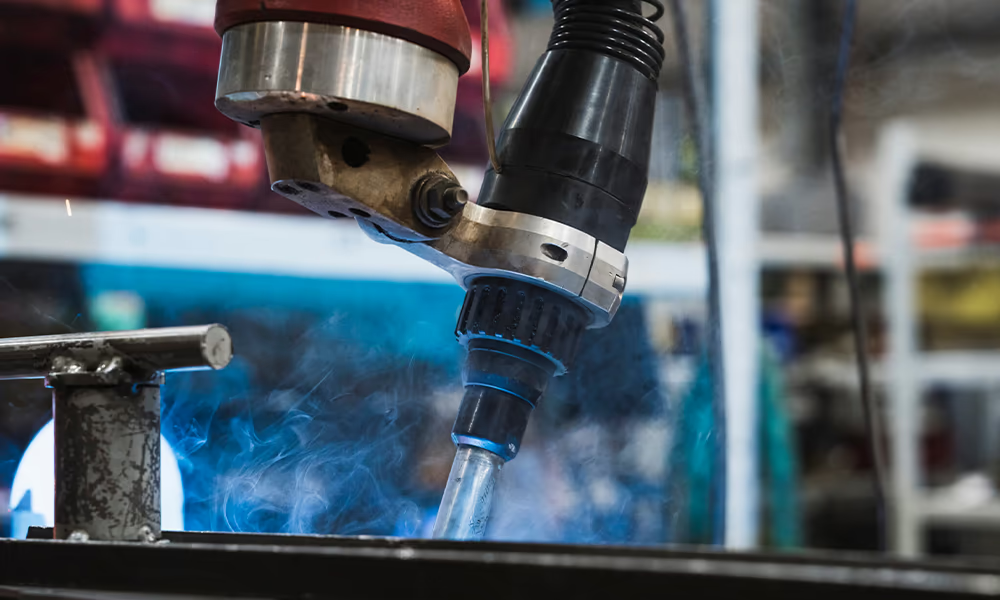
See below THG Automation’s stainless steel welding job using Fronius PMC Mix:
CMT (Cold Metal Transfer) takes this further. The wire physically retracts during each droplet transfer, mechanically assisting detachment rather than relying on electrical force alone. Heat input drops dramatically, making CMT the go-to process for thin stainless where burn-through and sensitization are the primary risks.
The videos below show THG Automation’s CMT Fronius robotic welding on thin stainless with high speed and zero distortion. Notice how narrow the HAZ is despite the material being ultra-thin. That’s CMT’s reduced heat cycle doing exactly what it’s designed to do.
Cobot Welding: More Accessible Than You Think
For shop owners running stainless production, cobot welding addresses the hardest part of the whole process: human consistency. Heat input, travel speed, torch angle, and contact-tip-to-work distance are held constant by the robot on every single pass.
Modern cobot systems are designed for high-mix, low-volume shops, not just high-volume production lines. Programming is increasingly simplified to the point where a welder can set up a new part using manual robot-arm manipulation and some fine-tuning on a teach pendant.
Choose Robotic Welding To Skyrocket Your Stainless Steel Weld Quality
Stainless doesn’t forgive inconsistency and excessive heat input. But a robot doesn’t make mistakes. Once dialed in, every pass is identical. And most importantly, it’s very easy to set it to weld.
THG’s modular cobot welding systems are built specifically for shops that need flexibility without complexity. You can get started with a table-based system and easily expand with positioners, tracks, or add more welding processes and robots to the mix. All accessible and simplified for shops, no need to code or do advanced robotic setups.
Whether you are struggling with stainless steel or other exotic materials, talk to our fabrication experts to take your shop to the next level.