


You are buried in backlog, manual welders can’t consistently provide the quality you need, or there simply aren’t enough welders to hire in your area.
Whatever the case may be, robotic welding can be a solution.
However, robots aren’t magical tools. You must have solid upstream and fixturing practices. Once parts can be presented consistently, you are ready to automate.
If your parts have inconsistent fit-up or your fixturing varies considerably, automation will just produce bad welds faster. But when your process is dialed in and parts are presented consistently, robotic welding delivers repeatable quality, expanded capacity, and production that runs while you sleep.
Understanding welding process selection, robotic system types, and system capabilities determines whether your automation investment delivers results or collects dust.
What Is Robotic Welding?
Robotic welding uses a programmable robot to move a welding torch along pre-defined paths while controlling welding parameters with precision a human can’t maintain consistently.
Humans excel at solving problems and deciding what needs to be done. Robots are best at actually executing those decisions with perfect repetition.
The robot doesn’t make better welds than a skilled welder. It makes the same weld over and over, exactly as programmed.
Understanding the types of robotic systems, what makes up a welding cell, and the prerequisites for success will determine whether your investment delivers results or collects dust.
Types of Robotic Welding Applications
The biggest mistake manufacturers can make is choosing the wrong robotic welding system. High-volume producers need speed and throughput. Job shops need flexibility and quick changeovers. Pick the wrong application type, and the robot will be far less effective.
| Application Type | Best for | Speed | Flexibility | Safety Requirements |
| Traditional Robotic Applications | High-volume production | Fast | Low: dedicated to specific tasks | Requires safety caging and guarding |
| Collaborative Robot Applications | High-mix, low-volume job shops (5-500 parts per run) | Moderate | High: quick programming and changeover | Can work alongside humans with safety features |
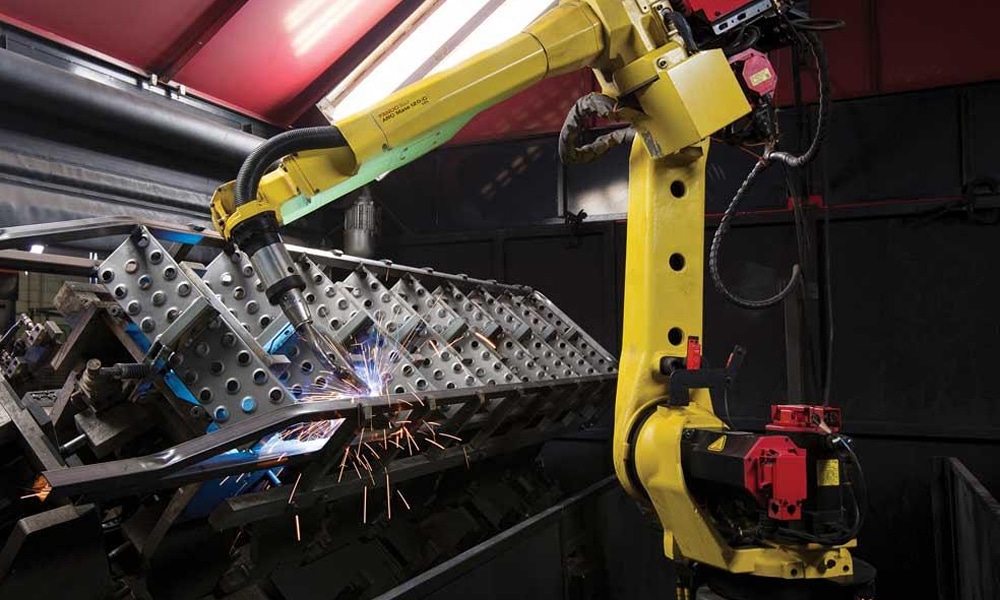
Traditional robotics dominates high-volume production environments where speed matters more than flexibility. They require safety caging, dedicated floor space, and experienced programmers. But, they deliver the fastest cycle times for repetitive work.
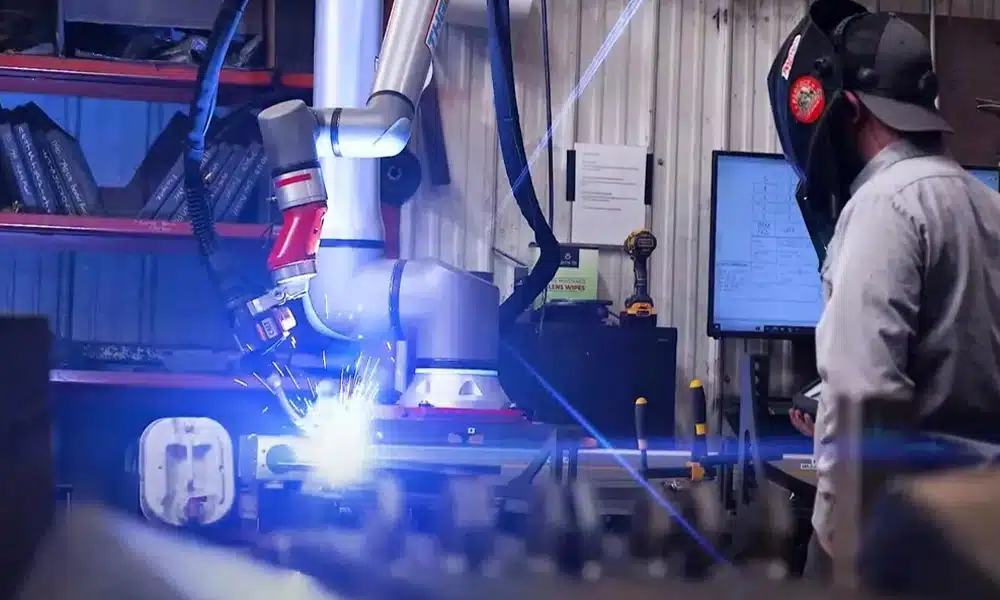
Collaborative robot applications like THG Automation’s systems are designed for manufacturers running multiple parts with varying batch sizes. These systems use an intuitive and graphical programming interface. Operators can create and switch between weld programs without needing to understand the programming code.
Their built-in safety features eliminate the need for extensive safety caging. However, it’s still necessary to conduct a safety assessment to ensure your collaborative application meets safety standards (ISO 10218-2:2025).

For most small to mid-sized manufacturers, collaborative robot applications offer the best balance of capability, flexibility, and manageable upfront cost.
The Components Of A Robotic Welding Cell
A robotic welding cell isn’t just a robot; it’s five core components working together. Plus, optional additions that can significantly increase the value of robotic welding. The scope of hardware and software working WITH the robot defines just how broad its welding application range can be.
Robotic cell core components:
- Robot arm – Positions the welding torch along the defined path.
- Welding power source – Defines the welding process.
- Wire feeder – Feeds filler metal wire.
- Welding torch – MIG/TIG/Laser welding torch fixed by end-of-arm tooling.
- Fixturing – Holds the part in place.
- Controller and programming interface – Stores weld programs and allows the operator to program the weld.
- Safety equipment – Light curtains, emergency stops, and either safety caging or built-in safety features.

Optional additions (increasingly needed):
- External axes – Tracks for the robot arm to extend reach.
- Positioners with coordinated motion – Rotating the part + coordinating the torch movement with rotation of the positioner.
- Seam sensing – Using technologies like the WireSense from Fronius to analyze the joint variability and adapt on the fly (optional with THG Automation robotic welding).
- Multi-process capability – Ability to switch the tooling and use a robot for welding with multiple processes.
- Advanced welding processes – CMT, pulsed welding, laser welding and others for exotic metals, reduced spatter, or less distortion.
- And more. There are plenty of technologies that manufacturers may need in their robotic system.
See the video below for an example of a THG Automation MIG welding robotic system mounted on tracks for added reach.

Selecting The Right Robotic Welding Process To Automate
Choosing the right welding process for your automated welding can improve your results significantly. For example, choosing a MIG welding process to automate what you previously did manually with TIG can yield tremendous productivity boost.
Advanced MIG modifications like CMT and pulsed MIG can achieve similar results to TIG. You might also actually need TIG or even laser welding. Ultimately, the choice is about the applications you’ll do. The more optimal the process you choose, the higher the productivity and ROI.
MIG Welding (GMAW): Speed and Versatility
Best for: Carbon and stainless steel, thin to thick materials, high-deposition welds, and general fabrication.
Advantages:
- Fast travel speeds and high deposition rates.
- Forgiving of minor joint gaps and fit-up variations.
- Works well with a wide range of materials (carbon steel, stainless, aluminum).
- Less sensitive to part positioning than TIG or laser.
- Tolerates minor joint contamination.
- Advanced MIG processes like CMT, PMC mix, LCS root (up to 75% less spatter), and others.
Constraints:
- Requires consistent wire feed and gas coverage.
- Standard short-circuit MIG produces more spatter compared to TIG or laser.
- More heat input can cause distortion on thin materials.
THG systems can integrate premium Fronius MIG power sources with adaptive features like WireSense for seam tracking and CMT (Cold Metal Transfer) for reduced spatter and heat input. This combination handles both heavy structural welds and thinner materials where traditional MIG struggles. You can achieve exceptional MIG welds with the right setup.
Generally, MIG is the most cost-effective, easiest to deploy, and most productive welding process for robotic automation.
TIG Welding (GTAW): Precision and Clean Welds
Best for: Sheet metal welding, stainless steel, aluminum, and exotic metals (titanium, Inconel), cosmetic welds, and applications requiring zero spatter.
Advantages:
- Exceptional weld quality with minimal spatter or cleanup.
- Precise heat control reduces distortion (with advanced power sources).
- Ideal for visible applications.
- Excellent for aluminum and exotic metals.
Constraints:
- More challenging process, requires higher expertise.
- Slower travel speeds than MIG.
- Must solve the issue of arc length management for robot welding.
- Requires tighter joint fit-up.
- Weld preparation must be exceptional, especially cleanliness.
- More sensitive to gas shielding and contamination.
- Typically requires filler wire feeding, adding complexity.
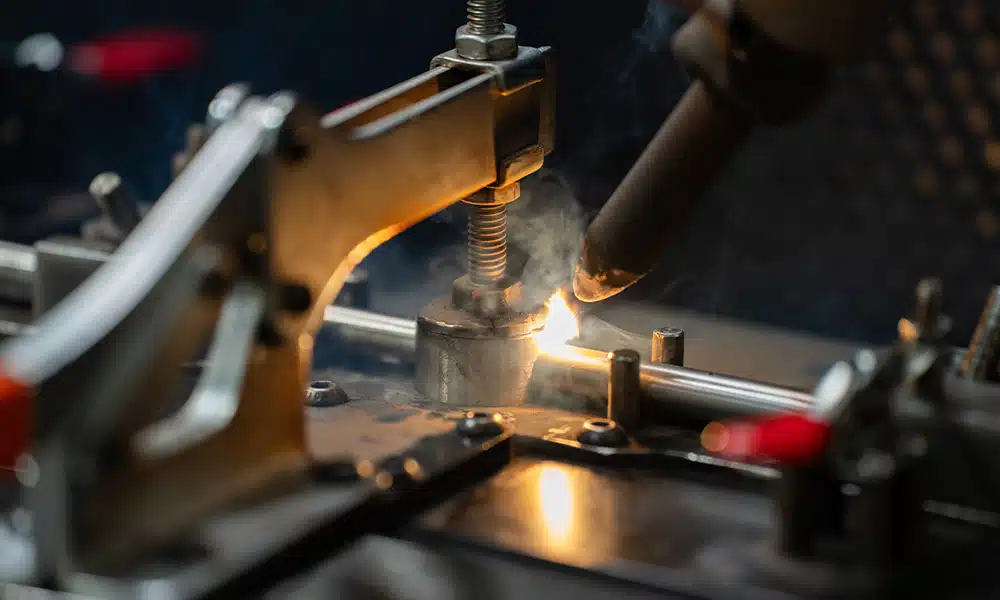
THG’s TIG-capable systems support automatic arc length control based on the set voltage, making robotic TIG welding easier to use. Likewise, the range of highly advanced AC/DC TIG welding functions from Fronius power sources provide you with robust, industrial-grade TIG capabilities. THG TIG welding robots can also use the touch sensing feature to adapt to part variations on the fly. And we support autogenous or wire TIG.
Fiber Laser Welding: Minimal Distortion and High Precision
Best for: Thin materials, dissimilar metals, high-speed production, and applications where heat distortion must be minimized.
Advantages:
- Extremely fast travel speeds.
- Tight nozzle makes joints easy to access.
- Minimal heat-affected zone reduces warping.
- Deep, narrow welds with high strength-to-width ratios.
- Can weld dissimilar materials.
- Exceptionally easy to use with the right system.
- No filler wire required for many applications.
- Ability to conduct pre- and post-weld cleaning with laser.
Constraints:
- Must meet laser welding safety standards, including safety enclosure.
- Requires tight fit-up tolerances.
- Higher upfront equipment cost.
- Reflective materials (aluminum, copper) require specialized settings.
- Joint accessibility and alignment are critical.
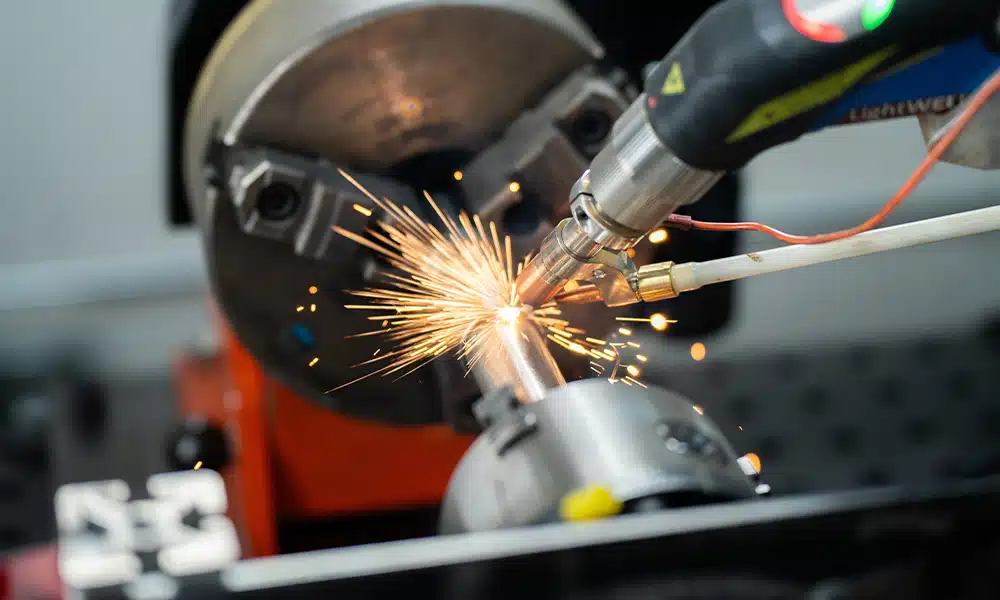
THG integrates IPG laser systems with wobble functionality, which can oscillate the laser beam to bridge gaps up to 5mm (5/32”). This solves the tight fit-up constraint that limits most laser welding automation.
THG robotic welding laser systems are practical for job shops and manufacturers without aerospace-level part preparation.
Choosing Your Robotic Welding Process (or Processes)
Most manufacturers start with MIG for its versatility and forgiving nature, then add TIG or laser capability as production demands evolve. The key is ensuring your robotic system vendor supports multi-process capabilities. You don’t want to go through another integration, system training, and ramp up by buying another welding process robot from a different vendor.
THG Automation’s modular architecture is designed to handle MIG, TIG, laser welding, and even plasma cutting on the same platform. This leaves the door open for you to introduce more processes as your team learns more about the system. Regardless of your starting point, it’s much more cost-effective if your vendor lets you add a robot with another welding process with the same software and interface. No additional training or excessive downtime.
Robotic Welding Advantages: From Productivity To Consistency
Advantages of robotic welding can turn your shop into a powerhouse. Robots can deliver dramatic improvements across productivity, quality, and cost. This is especially true when the robotic system is pre-engineered to introduce additional capabilities you might need later.
Key advantages of robotic welding:
- Consistency and repeatability – The robot executes the same weld parameters on part 1 and part 500, eliminating human variability across shifts and operators.
- Increased throughput – Robots weld faster and run longer, expanding capacity without adding headcount.
- Improved weld quality – Precise control of travel speed, wire feed, and torch angle reduces defects, spatter, and rework.
- Labor cost optimization – One operator can supervise multiple robots or focus on high-value tasks while the robot handles production welds.
- Reduced scrap and rework – Consistent parameters mean fewer bad parts and less material waste.
- Lights-out production capability – Systems can run second and third shifts unattended with proper fixturing and part loading.
- Scalability through external axes – Adding positioners, tracks, or coordinated motion significantly extends the capability of the system.
Pairing the right cobot system and the welding process for your manufacturing can yield exceptional results. For example, our customer, West Coast Manufacturing, boosted their productivity by 400%. They switched from manual TIG to robotic laser welding, which allowed them such an exceptional throughput increase. See their story below:
The primary advantage of robotic welding is consistency in applying the knowledge and experience of your best welders. As another of THG customers puts it:
“We want to give employees a third arm – more power, more ownership, more time to be yourself, and less time where you have to follow a repetitive operation,” —Zach Van Meter, Owner/Operator at TMF Center.
That “third arm” Zach is talking about will always do precisely as instructed by their team. TMF Center had great people. They just needed them to do more. THG welding cobots helped them do just that.
Limitations: Why Robotic Welding Can Fail
Most robotic welding failures aren’t caused by the robot. They’re caused by inconsistent part presentation, poor upstream processes, or inadequate fixturing.
- Part presentation consistency: Robots follow programmed coordinates. If your part shifts by 5mm (5/32”) between welds, the robot will weld that much off the joint. Successful robotic welding requires consistent part-to-fixture positioning.
- Fixturing repeatability: Clamps that require operator judgment, fixtures worn beyond tolerance, or manual positioning instead of mechanical locators will cause inconsistent welds. If a human has to “eyeball it,” automation won’t work.
- Upstream process control: Material cleanliness, consistent joint gaps, and proper fit-up matter even more for robots than manual welding. A skilled welder quickly adjusts for mill scale, gaps, or slightly less/more ground joint shape. A robot cannot. Address these issues before automation, not after.
If you can’t achieve consistent manual welds with documented parameters, adding a robot won’t fix the problem. It will just automate inconsistency.
However, advanced welding technologies can help with inconsistent parts. For example, the laser wobble function can bridge the gaps and fuse slightly off parts.
Or, Technologies like Fronius WireSense allow the robot to detect joint and clamping variations and adjust in real-time. It helps maintain precision even when parts have fit-up inconsistencies. This type of adaptive capability separates basic robotic welding from systems designed for real-world manufacturing.

Manual vs Robotic Welding: When Each Makes Sense
Manual welders aren’t obsolete. Your professionals are just better at different types of jobs. You want your team to make decisions, check quality, and scale their expertise. Their skills are wasted if they are welding repetitively.
Manual Welding Excels At:
- Complex, one-off projects
- Out-of-position work
- Constant mid-weld adaptation
- Tight spaces and awkward access
- Problem-solving fixturing challenges
Robotic Welding Excels At:
- Repetitive production runs
- In-position, consistent joint access
- Repeating the same parameters exactly
- Open, programmable work envelopes
- Consistent fixturing with mechanical locators
The best approach for most shops? Use robots for high-volume production welds while your skilled welders focus on custom work, complex assemblies, and troubleshooting. Read our full comparison of manual vs robotic welding comparison guide.
Robotic Welding Costs Breakdown
The sticker price on a robotic welding system is only the beginning. Most manufacturers focus on the $150K-$200K upfront cost and miss the hidden expenses that have a notable impact on the payback period.
Hidden robotic welding costs most manufacturers underestimate:
Installation and integration downtime: Ask your vendor how long it will take for the system to be up and running once it’s delivered. Robotic welding systems can start welding in as little as one day or several weeks.
Training and ramp-up: Expect 2-4 weeks at 50-70% utilization while your team learns the system. You’ll likely earn less during this period.
Programming time for new parts: Depending on the robotic system and part complexity, programming can take 30 minutes or multiple days. Collaborative robots are far easier to program. Most parts can be programmed in under one hour with a cobot.
Maintenance: Budget for 3-5% of the system price for maintenance annually. Also account for lost production capacity during maintenance or repairs.
Future-Proof Your Robotic Welding With Pre-Integrated Capabilities
Manufacturers usually discover new automation opportunities within 6-12 months of their first robotic welder. The team masters the system, new opportunities arise, and they want to start welding complex parts. But this is where many discover too late that not all systems are designed for growth.
You don’t know what you don’t know, and no one can predict every future need. You might need a positioner with a coordinated motion to handle welding exhaust systems, piping, or other curved parts. Likewise, you might start with standard MIG only to realize that you need CMT too. Or you might discover that adding a linear track would let you take on larger assemblies you’re currently turning down.
Your system should have pre-integrated capabilities to future-proof your needs. While most systems offer only the limited capabilities you need today, THG Automation leaves the door open for tomorrow’s opportunities too.
You shouldn’t need custom integrations, work with multiple vendors, and go through extensive training and downtime just to introduce a new feature or an additional axis.
Our systems pre-integrate our entire modular platform, allowing quick deployment of additional capabilities you will need later on. Don’t rush into robotic welding. Be strategic. We frequently receive requests from manufacturers to retrofit their systems after discovering limitations they didn’t anticipate. It’s much more cost-effective if you get a modular, designed-for-growth system from the start.
Ready to build automation that evolves with your production? Contact our fabrication experts to see how our robotic welding systems can support you at all the way.