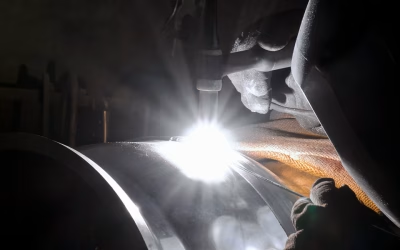



Many companies have adopted robotic automation to improve or speed up their welding operations. With aluminum, this has been a more difficult endeavor due to a couple of reasons. The first is aluminum is more challenging to weld than other more common materials like carbon steel and stainless steel. Another challenge is making the robotic weld look as good as the previous hand welded parts in most cases TIG welded (GTAW). Read on to see how to improve your robotically welded aluminum application.
How to calculate a weld weave versus weld pulse for a stack of dimes effect.
If you ask a welder to describe a good-looking weld, more often than not, you will hear the phrase “stack of dimes.” In welding, the stack of dimes look is when the weld freezes (cools) at a different rate in one part of the weld than another.
In some cases, the stack of dimes looks like a side effect of a physical weave made by a human welder or a robotic welder, which could be used for filling larger gaps in the metal. As a secondary benefit, this consistent movement side-to-side or back-and-forth will create a pattern in the weld bead, or a stack of dimes look.
Sometimes in robotic welding, there is the opportunity or requirement to focus not only on weld strength but also on weld appearance. In this case, there are typically two methods of achieving a stack of dimes look in the weld:
- The weave pattern or weave motion
The weave method moves the weld wire in a pattern as it travels along the weld path. This could be a side-to-side motion (zig-zag), front-to-back motion, figure 8, etc., depending on the robot controller options. For a stack of dimes effect, the back-and-forth option is best—or at least the simplest. - The pulse method
A process option on some modern welding power sources such as Miller Electric’s Profile Pulse, Fronius’s Synchro Pulse, Lincoln Electric’s Pulse-On-Pulse, and versions from other manufacturers. This process changes the weld energy multiple times a second, switching between a hotter process and a colder process. It creates a similar effect as the weave method, causing the weld puddle to freeze at two different rates and leaving the stack of dimes appearance.
Since in most cases the welding process will be pulsed MIG (GMAW-P), we’ll refer to this second technique simply as the pulse method.
Which tool should you use?
In an automated setting, when choosing either the weave or pulse method, you need to first determine whether you need the weave for reasons beyond appearance. If so, you’re already committed to that method.
However, if you can use either method, it’s a good idea to calculate the initial parameters so that both welds look similar. With a weave, the settings are dimensional, meaning there’s a weave length (pitch), weave width, weave shape, and other variables to fine-tune. For this article, we’ll focus on length and pitch to predict the look of the dimes, whether using the weave or pulse method.
All we have is weave.
The weave method causes the weld to freeze in a pattern based on the back-and-forth movement of the weld wire. Each time the weave changes direction, it leaves a mark in the weld puddle. The longer the wire stays in one spot, the larger the dime in the weld bead.
Typically, the robot’s controller will create the weave every given distance (in inches or mm). If you know how far apart you want the dimes, simply input that value into the controller.
Keep in mind: the robot is still traveling along a path while moving the wire torch based on your dimensions. If distances are too large or the weave isn’t feasible for the travel speed, you’ll run into issues.
Just pulse it!
The pulse method does not use motion to create the dime effect. Instead, it changes weld energy at a fixed frequency and wire feed rate.
For example, with Fronius Synchro Pulse, the energy change is driven by varying wire feed speed. If the base speed is 150 and we set a deviation of 60 at 2 Hz (cycles per second), the wire speed changes between 90 and 210 twice a second.
Now for the conversion.
Here’s where it gets tricky:
- Weave method uses pitch (distance between dimes).
- Pulse method uses frequency (cycles per second).
In the weave method, changing the travel speed does not change the pitch.
In the pulse method, increasing travel speed increases the distance between dimes.
That’s because the pulse frequency is fixed by the welding power source and doesn’t adjust for travel speed. But don’t worry—use the tables provided to make the proper adjustments.
To calculate your weave:
Fig 1 shows the relationship between weave length and frequency at a given travel speed.
For example:
- Distance between cycles = 0.125″
- Travel speed = 30 IPM
- Result: 4 weave cycles per second (one every 0.25 seconds)
If the weave length is increased to 0.25″, the frequency drops to 2 Hz (one every 0.5 seconds).
Use this to choose a matching pulse frequency.

To calculate your pulse:
Fig 2 shows the relationship between pulse cycles and weld dime pitch at a given travel speed.
Example:
- Pulse frequency = 4 Hz
- Travel speed = 30 IPM
- Result: dimes are 0.125″ apart
- Reduce pulse to 2 Hz → 0.25″ apart
As speed increases, pulse pitch increases. That might not be desired.
In contrast, weave pitch remains fixed regardless of speed. Keep controller limitations in mind when increasing travel speeds with weave settings.

When reviewing the weave length table, pay attention to how the frequency changes as travel speed increases. Keep in mind that your robot controller may have a limit on how quickly it can execute the weave motion.
In contrast, with the pulse method, the distance between weld dimes (pitch) increases as travel speed increases—this may not be desirable for some applications.
To assist with setup, you can [download the full Weave_Pulse Chart here], which includes formulas and reference values. The calculations can also be adjusted for different units if needed.
When it comes to advanced robotic welding, THG Automation has decades of experience across aluminum, carbon steel, and stainless steel. Reach out to speak with our team about how we can bring your welding presses to their full potential.