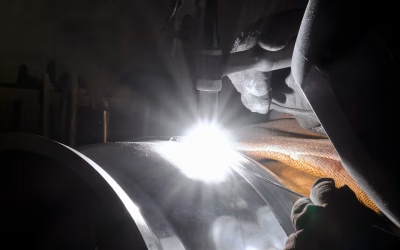

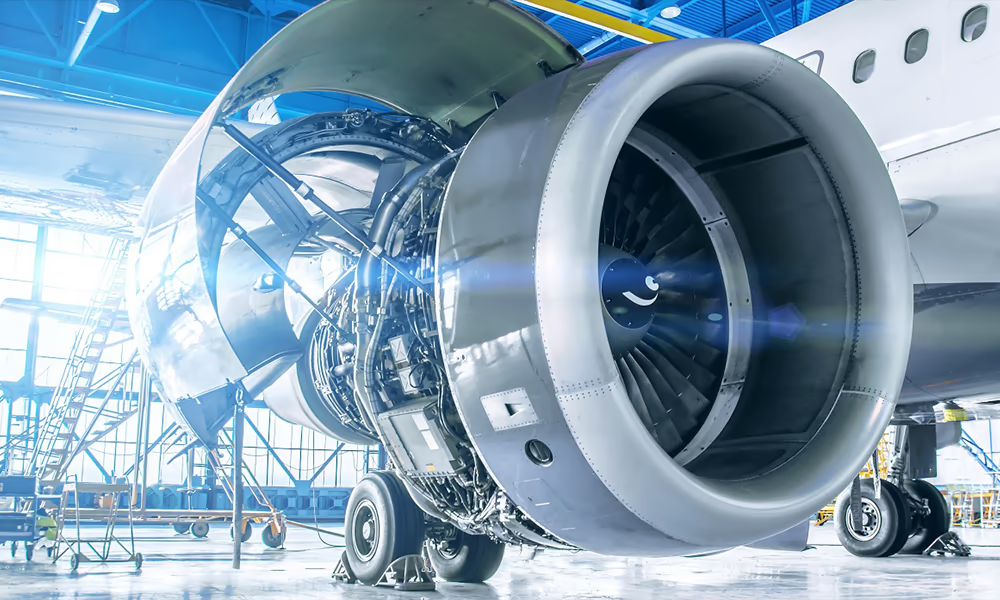

Aerospace welding is difficult because manufacturers must control qualified procedures on exotic materials. Even small inconsistencies can cause costly quality issues, rework, and production problems.
That combination of strict process control, challenging materials, customer-specific requirements, and regulations creates a highly constrained welding environment.
Aerospace manufacturers must maintain weld quality while dealing with skilled labor shortages, difficult-to-scale manual processes, and the practical limits of welding automation.
Let’s dive into the issues and how modern welding technologies can help manufacturers.
Aerospace Welding Means Joining Critical Parts Under Strict Process Control
Aerospace welding is the process of joining metal parts used in aircraft, spacecraft, defense systems, propulsion equipment, and related aerospace hardware.
These parts may include:
- Structural components
- Hydraulics
- Brackets
- Ducting
- Fuel system parts
- Exhaust assemblies
- Landing gear
- Tooling
- Support equipment
- And other welded components.
What makes aerospace welding different from general fabrication is the level of process control.
In aerospace, the weld is usually part of a larger quality system. The manufacturer may need to:
- Follow a qualified welding procedure
- Use approved filler metals and shielding gases
- Document weld parameters and material traceability
- Conduct quality control for acceptance criteria.
Small variations acceptable in a general fabrication environment can affect whether the weld remains acceptable in aerospace applications. These vary from heat input to fit-up and shielding gas coverage.
Ultimately, aerospace weld acceptance is governed by part-specific acceptance criteria.
Aerospace Welding Standards, Specifications, And Qualification Requirements
Aerospace welding requirements are often shaped by a combination of industry standards, customer specifications, and regulatory expectations. Depending on the application, the following standards and specifications may need adherence:
- AWS D17.1/D17.1M:2024 – Specification for Fusion Welding for Aerospace Applications
- AWS D17.2/D17.2M:2019 – Specification for Resistance Welding for Aerospace Applications
- AWS D17.3/D17.3M:2021-AMD1 – Specification for Friction Stir Welding of Aluminum Alloys for Aerospace Applications
- And others.
In addition to American Welding Society standards, manufacturers may need to meet requirements for Nadcap audit, Federal Aviation Administration (FAA), European Union Aviation Safety Agency (EASA), The International Aerospace Quality Group (IAQG), and other relevant organizations. Since the aerospace industry encompasses everything from passenger planes to rockets, satellites, and other space vehicles, the required welding techniques and relevant standards can vary.
Manufacturers also need qualified welding procedures, including WPS and PQR documentation, operator or welder qualification records, inspection records, and traceability for materials and consumables.
Challenges of Welding Aerospace Materials
Aerospace materials are selected because they solve difficult engineering problems:
- Aluminum helps reduce weight.
- Titanium provides high strength with excellent corrosion resistance.
- Nickel alloys can withstand heat in demanding propulsion and exhaust applications.
- Stainless steels offer strength, corrosion resistance, and fabrication flexibility.
- Other specialty alloys may be used when a part needs a specific combination of strength, temperature resistance, fatigue performance, or environmental resistance.
The tradeoff is that these materials are often more challenging to weld consistently than common carbon steels. Usually, they don’t respond well to heat input, require more cleanliness, and have other challenges specific to each metal and its alloy.
For example, aluminum conducts heat quickly, distorts easily, and forms an oxide layer that must be managed before welding. On the other hand, stainless retains heat and can suffer corrosion resistance loss and distortion because of it. In another example, titanium is highly reactive at elevated temperatures, which means shielding gas quality and backside protection are critical.
Exotic materials require “exotic” welding skills. High precision, heat control, and the right equipment are critical to meet the aerospace welding quality standards.

These material behaviors directly affect aerospace welding procedures. They influence which welding process, equipment, filler metal, shielding setup, heat input range, inspection method, and post-weld steps are needed to meet the applicable customer or code specification.
Aerospace Welding Process Selection
Aerospace manufacturers may use several welding processes depending on the material, part design, production volume, inspection requirements, and customer specifications.
Common aerospace welding processes are:
- Gas tungsten arc welding (GTAW/TIG)
- Gas metal arc welding (GMAW/MIG)
- Plasma arc welding (PAW)
- Laser welding
- Resistance welding
- Friction stir welding
- Electron beam welding
- and other specialized joining methods.
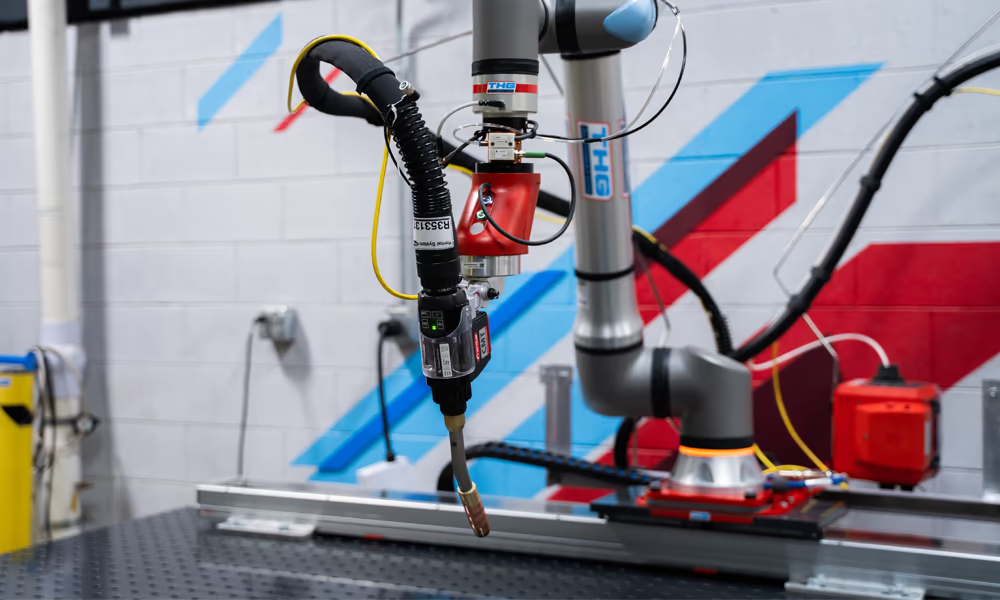
MIG Welding System
UR cobots with Fronius iWave or TPS/i and native CMT integration. For high-duty-cycle production across steel, stainless, and aluminum.
Explore
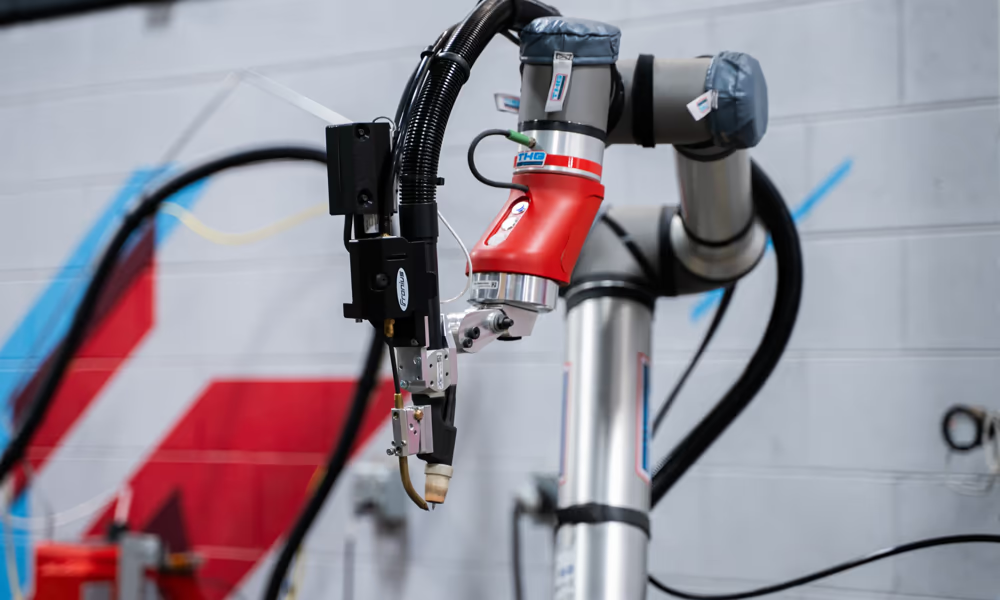
TIG Welding System
Precision GTAW for thin-gauge, high-quality requirements. Full digital process control through the Fronius iWave and THG’s interface.
Explore
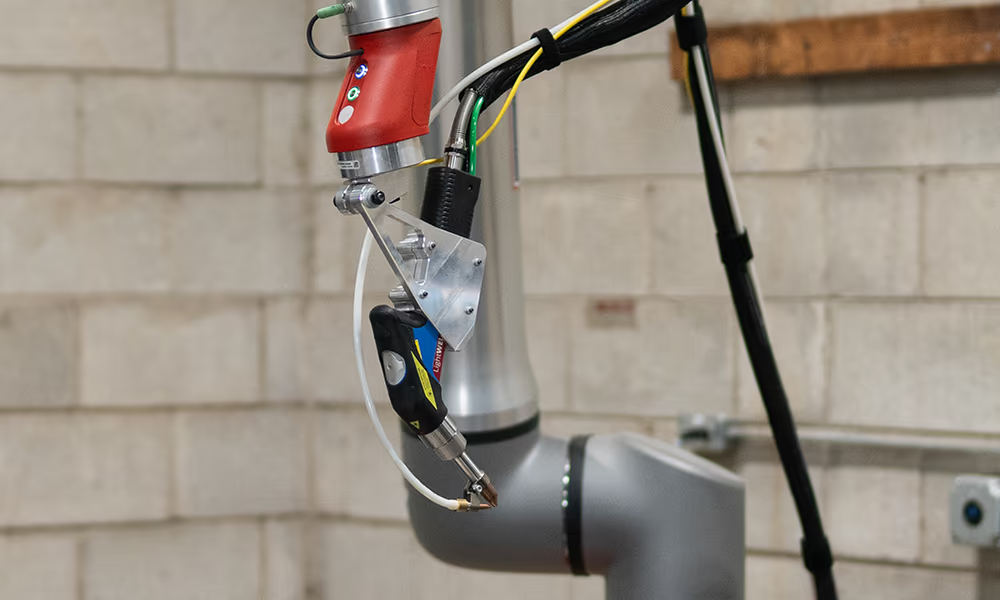
Laser Welding System
IPG fiber laser sources for cosmetic, thin-gauge, or high-volume runs where weld quality and repeatability can’t be compromised.
Explore
TIG welding remains one of the most commonly used arc processes in aerospace due to legacy procedure requirements, especially for aluminum. Many arc-welded parts are already qualified for TIG welding. Manufacturers won’t always seek to requalify the process with MIG, laser, or other more productive processes because this can require significant time and resources.
While TIG is slower than MIG and other more contemporary processes, it offers better precision and process control. Likewise, TIG decouples the filler metal from the fusion process, which can be a major advantage for weld quality. TIG is well suited for precision welds, thin materials, critical weld joints, and applications where visibility and manual control are important.
MIG, pulsed MIG, laser welding, friction stir welding, and electron beam welding can all be strong options when the application supports them. For example, friction stir welding can be valuable for joining aluminum alloys that are extremely difficult to fusion-weld (e.g., 2000 and 7000 series).
Process Limitations And Maximizing Productivity Through Automation
The limitation of process selection is not always technical capability. Sometimes the process can make the weld, but qualifying that process for the part, material, inspection requirement, and customer specification costs more than the productivity gain is worth.
However, that doesn’t mean manufacturers shouldn’t maximize what the qualified process offers. There’s more than one way to apply the qualified process.
Manual welding can sometimes be more productive, but very difficult to scale. Automated welding isn’t always unattainable. And manufacturers still have plenty of low-hanging fruit to “pluck” with the right automation for the right problems.
For example, a shop that must use TIG for aerospace welding procedures can use THG Automation’s collaborative robotic TIG welding systems. We developed this system specifically for situations where you can’t replace TIG while needing to maximize productivity.
Aerospace Weld Quality Depends On Inspection, Testing, And Documentation
In aerospace welding, inspection, testing, and documentation are part of the production process. Weld quality also depends on process verification, recordkeeping, and traceability back to the procedure, operator, material, and production conditions.
Inspection requirements vary by part, material, customer specification, and governing code. Depending on the application, aerospace welds may require:
- Visual inspection
- Dimensional checks
- Nondestructive testing (penetrant inspection, radiographic testing, ultrasonic testing, or other specified methods)
- Qualification testing
- And production documentation.
Aerospace welding is about process discipline. Manufacturers need clean materials, stable weld parameters, qualified operators, repeatable fit-up, proper shielding, and documented weld data. You must control the process sufficiently to repeatedly produce acceptable welds. And it’s critical to maintain records documenting how each weld was made.
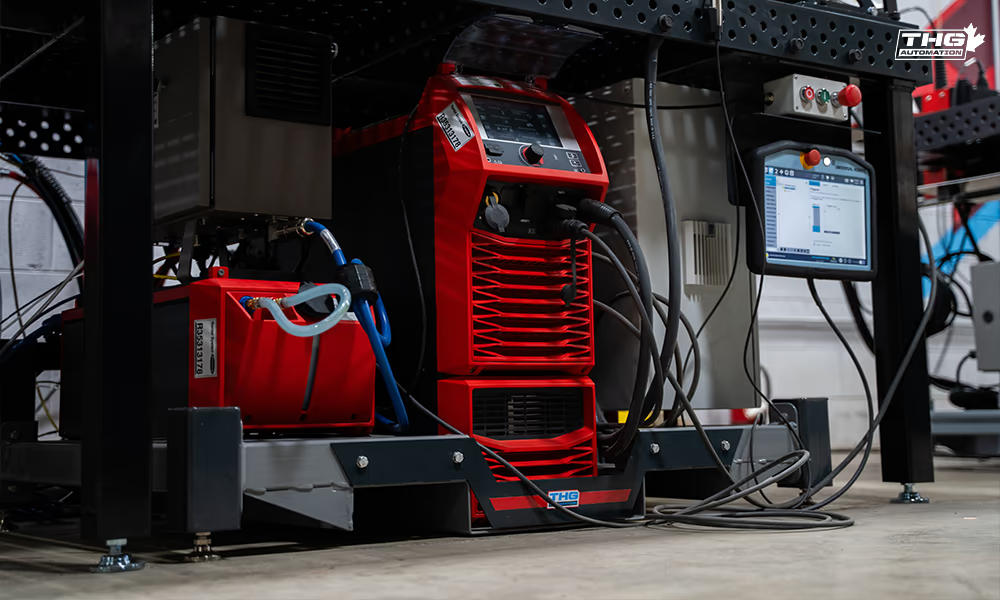
Some welding systems used in aerospace have built-in software for traceability. For example, Fronius’ Weld Cube provides full documentation of welding data and traceability at the component and seam level. This is just one of the reasons why, here at THG Automation, we use Fronius equipment for arc welding systems.
Aerospace Manufacturers Need More Output Without Losing Process Stability
Aerospace manufacturers need more welding output, but they cannot pursue productivity at the expense of process stability.
Skilled aerospace welders are difficult to find, train, qualify, and replace. As experienced welders retire, manual welding capacity becomes harder to scale. This creates a difficult production problem: manufacturers need more throughput, but the work still has to meet qualified procedures and customer specifications.
Basic high-volume robotic welding does not always solve this problem. Most serially produced parts that are easy to automate are already handled with traditional robotic welding systems. Aerospace parts causing the most bottlenecks today are often lower-volume, higher-mix, and more sensitive to material welding behavior.
The real opportunity is to automate difficult, repetitive manual work without destabilizing the qualified process. That requires collaborative robotic welding systems that serve as an extension of your welders. Robots that become their tools. However, such systems must support the actual aerospace welding procedures, not just move a torch.
Welding Automation in Aerospace Is Evolving To Meet Real-World Needs
Small and medium aerospace manufacturers can benefit from automated welding, but only when the system supports the capabilities their parts actually require:
- Robotic AC/DC TIG welding with a high-quality aerospace-capable power source.
- Laser, plasma, and advanced robotic MIG welding where appropriate.
- Floor- or table-mounted positioners for part rotation.
- Coordinated motion between the robot and the positioner.
- Larger welding tables for bigger parts and assemblies.
- Linear tracks to extend robot reach (also the ability to pair tracks with a positioner).
- Manual-to-robotic welding flexibility, such as THG’s SideCar.
- Adaptive arc features for real-time response to part variation, such as Fronius and their WireSense, TouchSense, and other functions. Read more about Fronius robot welding.
- Intuitive no-code, hand-guided, and teach pendant programming for welders.
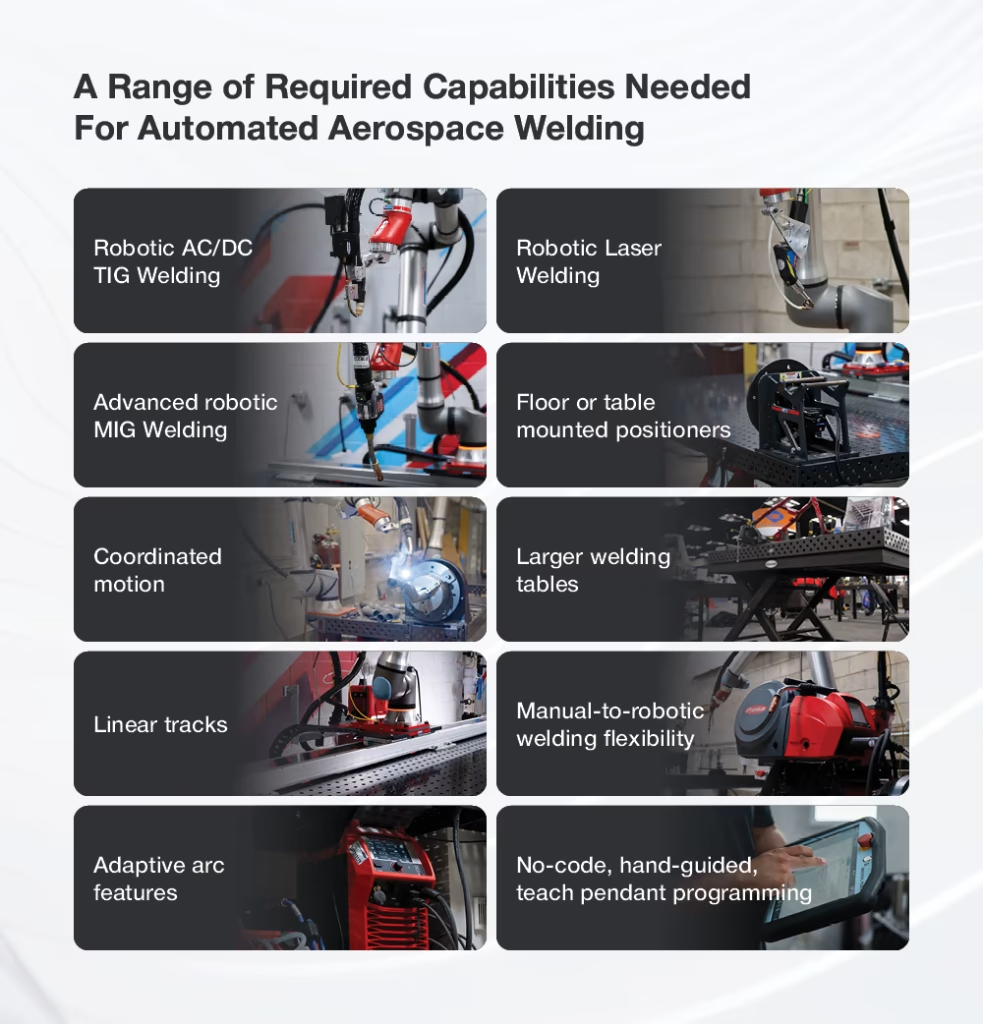
You don’t need all of these features. But you might need one or more of them at first, with more added later.
This is where basic “simple” automation can become limiting. Simple programming and easy operation are important, but simplicity should not come at the cost of capability. If a system cannot grow into additional axes, advanced welding processes, or stronger documentation requirements, it can become a dead-end investment.
That’s why THG Automation builds standardized but modular, flexible, and easy-to-scale systems for advanced robotic welding. And it’s all based on collaborative robotics and URCap software your welders can learn to use quickly. No robotic expertise is needed.
The real automation question is whether the automation system can protect the welding procedure, support the required process, adapt to changing parts, and give skilled welders a practical way to produce more without losing control.
Talk to our fabrication experts for advanced, but simple-to-use, collaborative robotic welding for aerospace applications. Our engineers can review your parts and production requirements and help you find the right solution.